Japan stirs controversy with huge COVID aid contract for ad giant Dentsu
TOKYO (Reuters) - Off a narrow corridor above a store selling Persian rugs in central Tokyo, a small office houses a private operation which won a tender in April to distribute more than $20 billion in government aid to businesses hit by the new coronavirus.
The agency, the Service Design Engineering Council, actually carried out only a fraction of that work, local media reported last month. Service Design was co-founded by Dentsu Group Inc., one of Japan's most influential companies. It passed hundreds of millions of dollars to administer the project back to Dentsu, an advertising and PR company with close ties to Prime Minister Shinzo Abe's ruling Liberal Democratic Party (LDP), government documents show.
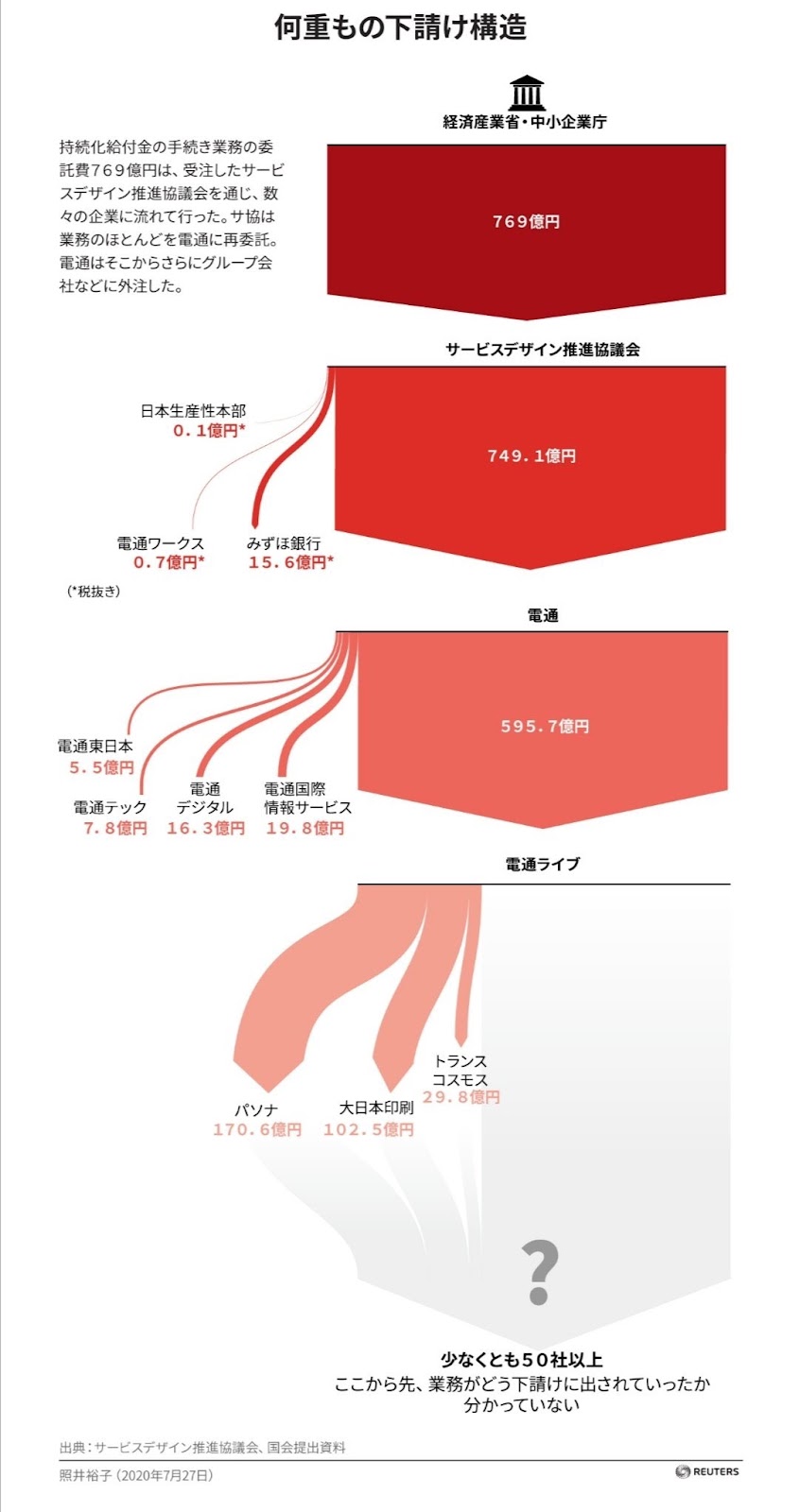
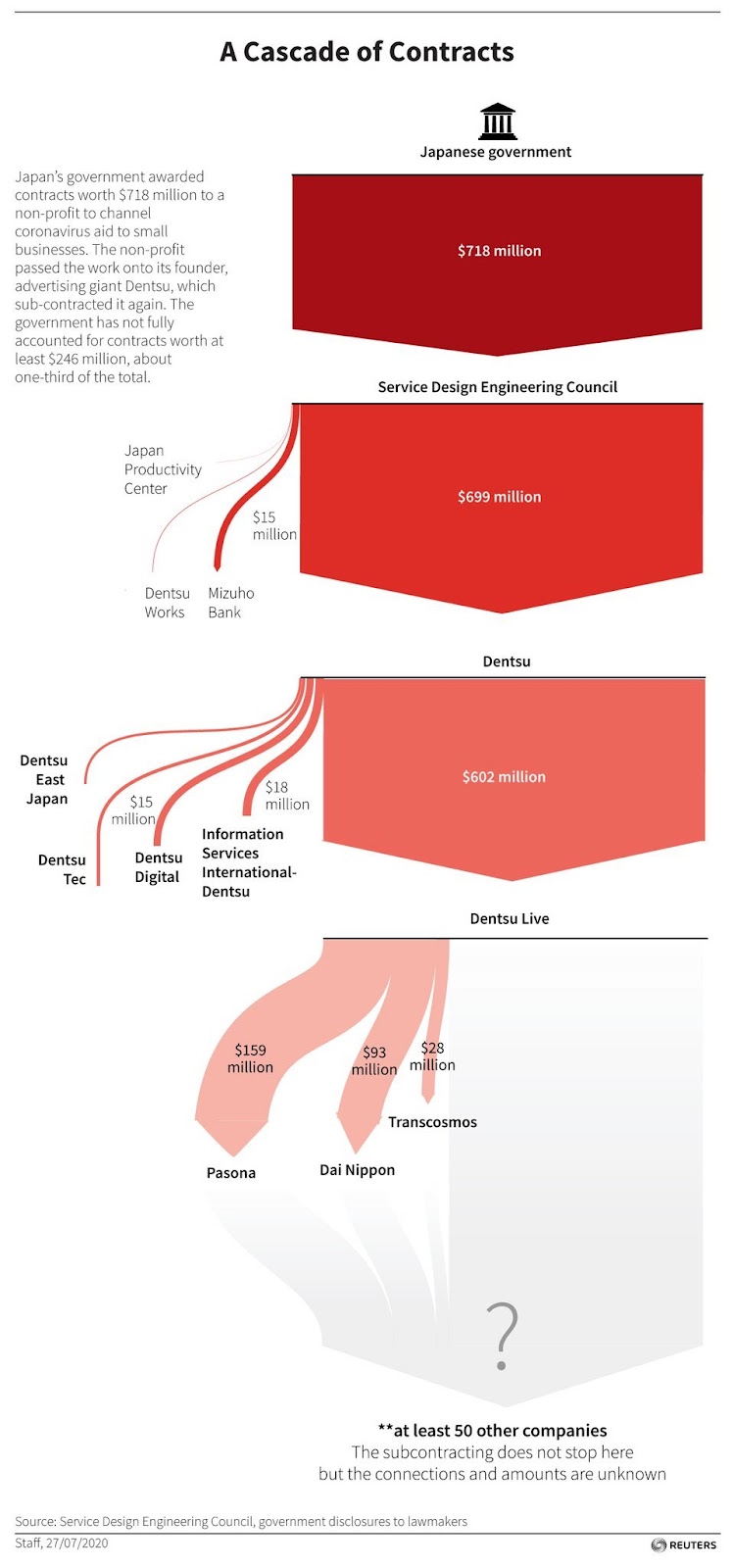
Under the arrangement, Service Design won the contract to distribute the $20 billion, but actually took less than 1% of the total $718 million for managing the project and passed on most of the rest to Dentsu, which set up vetting procedures, websites and call centres, the companies and the Ministry of Economy, Trade and Industry (METI) said.
Dentsu, in turn, subcontracted the work again through its subsidiaries. The ministry has said that there were five tiers of subcontractors and at least 63 companies involved. Officials have disclosed the names of only 14 of those; the government has not fully accounted for contracts worth at least $247 million, about one-third of the total.
The arrangement led to confusion and delays for small business owners. Members of parliament have questioned how taxpayers' money was spent during a national emergency.
Controversy over the contract - one of the largest that Japan has outsourced from its pandemic budget - is widening for Abe's government, already facing a fall in public support over its handling of the pandemic. Questions are mounting from opposition politicians about the government's links to Dentsu, a publicly listed company. At issue is whether Service Design helped shield Dentsu's leading role from scrutiny. The government and Dentsu have come under fire in the past for their close ties.
Nearly three million firms have applied for payouts of up to $18,600 each, according to METI, which awarded the contract. Thousands are still waiting to be approved or paid. Some small business owners told Reuters the wait was so long and the payout so small, they had no choice but to fold.
Service Design is a private, not-for-profit group which does not disclose ownership details and has a staff of 22. Dentsu founded it with Pasona Group Inc, a temporary staffing agency, and Transcosmos Inc, an IT services firm; three of its nine directors and several of its employees are from Dentsu group companies.
The ministry declined to disclose the full list of companies involved because of a clause in Japan's disclosure law. If revealing information about a company could harm the firm's competitive position, it said, it is not obliged to disclose it.
There are no allegations of illegality in the process.
Opposition politicians blame the subcontracting for administrative costs rising to what one of them, Masayuki Aoyama, said was roughly 30 times more than a similar programme for private individuals that was handled by local governments. They and some frustrated small business owners want to know why the government picked Service Design, and why and to whom the work to distribute the money was then farmed out.
"The whole thing is extremely grey," said Kaname Tajima, one of dozens of opposition members of parliament who are campaigning for the ministry to release full details of how the contracts have been handed out.
"What is strange is the government is protecting Dentsu from scrutiny about lack of information and accountability," Tajima said.
A poll in June by TV Asahi, a broadcaster, found 73% of respondents thought the government had handled the programme inappropriately.
The economy ministry said that as of July 20, it had received 2.9 million applications from small businesses and distributed funds to 2.67 million; Service Design said that for the most part, funds are being paid out roughly two weeks after an application is received.
Yusuke Tanaka, the official at the ministry in charge of the payouts programme, said METI conducted a competitive tender and awarded the contract based on a comprehensive rating system. He said the ministry had not given preferential treatment to Service Design and Dentsu. Asked if involving private companies added costs to the project, Tanaka said that applicant vetting, and the cost of providing face-to-face support for the applicants, had lifted administrative costs compared with the scheme for private individuals.
Service Design, which told Reuters by email it tendered for the project because it had experience with an IT subsidy programme, hired extra staff and found venues to help businesses with their applications, and retained a bank to help process the payments. It said Dentsu was best placed to carry out the ambitious and wide-ranging project.
Dentsu said the contracting structure was not opaque and that payouts were timely. Administering the project requires various companies and more than 10,000 workers, it said.
"To begin with, we did not think that it was possible for one company to handle a public project of this level," the company said in a statement to Reuters on July 21.
The next day, Dentsu announced on its website that in response to public reaction over its dealings with the government in the small business programme, it was conducting a review of its involvement in such projects. The company said it would not bid on any new contracts from METI until the review was complete.
Transcosmos and Pasona declined to comment.
TRACK RECORD
Abe told parliament in June the outsourcing had been carried out appropriately. But support for his administration's response to the pandemic fell to 36% on July 20, a Kyodo News poll showed, down from 49% a month ago.
"There's no question the unclear scheme around the small business relief programme has ... damaged public support over (the government's) handling of the pandemic," said Atsuo Ito, an independent political analyst.
Abe's party, in power in Japan almost continuously since the 1950s, is an important client for Dentsu. Dentsu has done work for the party since the 1950s and 60s, when it was hired to help it campaign in elections, and smooth the passage of an unpopular security treaty with the United States. It was also involved in the 1964 Olympics.
More recently Dentsu, which started as a news agency, has made sports marketing a centrepiece of its business. It served as a marketing agent for Tokyo's bid to host the 2020 Olympics, for which it helped Japan raise a record $3.1 billion in domestic sponsorship. The tournament has been postponed for a year due to the pandemic.
The world's sixth-largest advertising agency, Dentsu also works in public relations, market research and polling.
The coronavirus aid was meant to help businesses like Takenobu Tonegawa's video production firm, which specialised in corporate events. When cases of COVID-19 surged in spring, most of his clients canceled. The Tokyo-based entrepreneur waited four weeks for his $10,000 cheque from the government, he said.
While he waited, the 41-year old found work delivering food on his bicycle for Uber Eats. Tonegawa said he had rung a call centre operated by one of the companies under Service Design more than 100 times over three days to chase his application. Each time he was referred to a different part-time employee who was not aware of it. It was one of the most stressful periods of his life, Tonegawa said.
"I don't blame the outsourcing itself, but if they run this system with taxpayers' money, they should've operated it better," he said.
PASS THE BUCK
Pictured on national TV as a sparsely furnished office where a handful of employees type at laptops under fluorescent lights, Service Design oversees the entirety of the small business aid project. It coordinates with companies and liaises with the ministry, METI's Tanaka said.
Service Design competed for the relief contract with Deloitte Tohmatsu Financial Advisory, the ministry said. Deloitte had two meetings with government officials, one of them over the phone.
Service Design met with ministry officials in person three times and was joined at the meetings by Dentsu officials, the ministry has said, adding that it followed proper procedures. A spokeswoman at Deloitte declined to comment on the process.
As a non-profit, Service Design is not required to release detailed earnings information. When it tendered for the contract it had not filed the required public records of its assets and liabilities for three years, Japanese media reported. It posted them on its website after the reports, and told Reuters it had not done so before because of an internal communication error.
The non-profit passed most of the contract to Dentsu, which in turn handed down the work. The largest portion of the subsequent contract went to Dentsu Live, an event production company that is wholly owned by Dentsu, according to the ministry. Dentsu Live further outsourced the work, Service Design said.
Japanese ministries are free to award contracts to bidders who intend to subcontract some of the work, but subcontracting more than 50% of a taxpayer-funded project is not normally advisable, governance experts say, citing standards issued by the finance ministry in 2006 to ensure transparency in public projects.
METI officials have told Reuters that even though Service Design subcontracted a large portion of the awarded funds, it still managed the "core" of the project.
Last month, after politicians asked the ministry to explain why Service Design was allowed to outsource so much of its work, it provided heavily redacted bidding documents, which some lawmakers said obfuscated crucial information. The ministry said it could not disclose further details due to competitive concerns.
Dentsu told journalists in June it didn't become the primary contractor for the aid project because it believed Service Design had the necessary track record, and felt recipients of the payouts may be confused if they saw Dentsu was involved in the payments.
Added to this, Dentsu told Reuters in July it had decided not to lead the work itself after its accounting department advised that doing so would "impact the balance sheet and possibly hinder normal operations." It did not elaborate.
The ministry has set up a third-party panel to review how it awards public contracts and make recommendations on increasing transparency, it said.
RUBBLE
By the time hotel owner Yoshiteru Yonezawa's $18,600 stimulus arrived, he had decided to sell out. Going bust would make it hard for him to run another hotel, he said.
He used the cash to pay severance to around 90 employees of the hotel that his family has run for nearly seven decades in Hokkaido, a region popular for winter sports.
"What small business owners really want is for any kind of support programme to start as soon as possible," said Yonezawa in a tired voice.
The government has said it expects hundreds of thousands more firms to apply for its next round of relief funds.
It would be too late for Fumiaki Ichiyama. He ran Yonosuke, an old-school bar in Tokyo, for more than 40 years. Decorated with red lanterns and the day's specials written by hand on paper on the walls, the bar was popular with media types.
Before the pandemic, it brought in $4,000 a day in sales, he said. In early April that slumped to $400. He could not afford the rent; the bar manager had had enough.
A few weeks after the bar closed, workers demolished the building. All that remains is a mound of rubble.
(Graphic: a Cascade of Contracts -
here)
(Reporting by Mari Saito and Ju-Min Park; additional reporting by Ritsuko Shimizu, Maki Shiraki and Antoni Slodkowski; Edited by David Dolan and Sara Ledwith)







1607年に兪如為が記した中国の救荒書『荒政要覧』
(第4巻の一項目が『朱子社倉法』として単独で紹介されている。八巻一雄『民間備荒録と荒政要覧』岩手史学研究1963★参照)
https://www.wul.waseda.ac.jp/kotenseki/html/yo07/yo07_00961/index.html
https://archive.wul.waseda.ac.jp/kosho/yo07/yo07_00961/yo07_00961.pdf
216:
228-229
いうまでもなく朱子の社倉法は、長孫平の森倉法と、王安石の青苗法から発展したもので、社倉そのものは『隋書食貨志』以来見えるものである。これが江戸初期に研究されたことは、備荒思想が朱子を通じて再認識されたことを示すものであろう。つぎの佐藤友信の『社倉由来』も、この流れを汲むものである。社倉関係の文献を挙げれば、それだけで長大なリストとなろう。しかし、明治初期の織円の認識には、それらは入っていなかったのである。
それは、朱子の社倉法が、為政者のとるべき備荒策であって、民衆自身のなすべき努力と異なった次元で考えられていたことと無縁ではないだろう。朱子社倉法と、清庵の村共同性に根ざした備荒思想との差は大きい。さらに、為政者―‐lii荒思想が主流であるなかで、板行本としては『民間備荒録』が最初ということは、備荒思想の受容基盤との関係を考えさせられるのである。清庵の備荒、救荒は制度ではない。農民自身の経営理念であり、行動指針であり、生活技術である。それだけ民衆的な受容基盤があったといえよう。
以上のことを踏まえて、ここでは、『荒政要覧』を中心として、本書にみられる中国農書の
影響についてみておきたい。この点については、すでに早く八巻一雄氏の詳細な研究「
民間備荒録と荒政要覧 II 漢籍受容態度の考証 I 」(『岩手史学)第四二号、一九六三年)
...
荒政要覧』十巻の目次はつぎのようである。
巻一詔論、
巻二奏議、
巻三救荒総論、
巻四平日修備之要、
巻五水旱捍禦之要、
卷六餓饉極致之要、
巻七荒後寛恤之要、
巻八遇荒得失之鏊、
巻九備荒樹芸、
巻十救荒本草
『荒政要覧』十巻の目次はつぎのようである。巻一 詔諭、巻二 奏議、巻三 救荒総論、巻四 平日修備之要、巻五 水早拝禦之要、巻六 餞饉極致之要、巻七 荒後寛仙之要、巻八 遇荒得失之5、巻九 備荒樹芸、巻十 救荒本草
このうち、清庵が最も多く依拠しているのは巻九と巻十であり、他にも巻一などがみられる。
『荒政要覧』巻九の構成は、 まず『斉民要術』にいう「木奴千あれば凶年なし」(清庵も、この文を栗の項で引用している)の立場から、 棗、栗、銀杏、柿、手、 外す、支ヽ菌章、蕨、 山業の一〇種の栽培法を述べ、つぎに凶年の非常代用食の製法として、勢粥法、淡黄韮煮レ粥法、辟穀法、千金方、服二生松柏葉・法、食二車木葉一法、食二生黄一妥法について述べ、最後に治療法として、服二百漆水一法、療二垂レ死畿人一法、救・水中凍死人一法について述べている。このうち、『民間備荒録』に取上げられているのは、 備荒作物のうち棗、栗、柿の三種、非常代用食のうち彿粥法、淡黄茎煮レ粥法を除く五種、 そして治療法のうち服二百浚水一法を除く二種である。 これは本書の目次と対比すればわかるように、項目としては本書の大半を占めるものである。つぎに巻十は、 飢饉を救うための植物の説明であるが、『民間備荒録』巻之下の「食草木葉法」にはこれによったものが多い。 なお、 巻之下には朱備の『救荒本草』からの引用も多く、 その引用数は『荒政要覧』から一一、『救荒本草』から九と数えられる。ただ、後述(本章の3)するように、『救荒本草』は、『荒政要覧』あるいは『農政全書』からの孫引きかもしれない。以上、八巻氏の研究を踏まえて概略をみたが、 こうした状況を考えれば、一‐昼夜あんじ煩らひしかとも……術なかりし」と嘆いていた清庵が、『荒政要覧』を手にすることによって、一‐慨然として」執筆に踏みきった心情もわかるのである。
清庵が中国の救荒書を利用するときの基本的立場は、食物の備蓄であった。冒頭で『礼記』王制編を引用して、国にとって備蓄の肝要なることを述べ、日本の一‐救急料」の理念を併せて援用しながら、金銀を貯えることを好む者は飢えても食えず、寒くとも着られず、食を貯えることこそ重要と説くのである。理念的にはこうした立場に立って、この具体化を、中国書にある知識を上台として、わが国ないし東北地方の実情に合わせて述べていくのである。このような単なる中国書の紹介にとどまらない態度は、清庵が手元において参照した『農業全書』の著者宮崎安貞の著述態度金則述)に学んだものであろう。とくに、東北地方の実情に合うように具体化したことは、清庵の日ごろの知見によるところが大きいと思われる
兪汝為なる人物および『荒政要覽』が著わされた年代が不明なため、『荒政要覧』と『
救荒本いま『荒政要覧』巻之九のなかの「瓜楼根」についてみると、その全文が朱槭の『
救荒本草』と全く同一であるす「食草木葉法」は、『荒政要覧』巻之十に採録された「救荒
...
http://www.tosyokan.pref.shizuoka.jp/data/open/cnt/3/354/1/SZK0002693_20040929055329451.pdf#search='荒政要覧とは'
きゅうこうしょ みんかんびこうろく 日本最初の本格的救 荒 書『民間備荒録』(Q611-2)
救荒書とは一般には飢饉を生き延びる術を記した書物を指します。飢饉への備えを説き、飢饉 の際にどのようにして食糧を食いつなげ、またどのような食物が食べられるかを伝えることを 目的としています。救荒書の登場は、中国では15世紀初頭の『救荒本草』が最初です。日本で
たてべせいあん はさらに遅れ18世紀後半に現れます。奥州一関藩藩医建部清庵(正徳2(1712)年~天明3
(1783)年)が記した『民間備荒録』が、本格的な日本最初の救荒書で、それ以降の救荒書の一つ の手本となりました。当館の久能文庫には、版本2巻が所蔵されています。(Q611-2)
建部清庵は漢方外科を修得しながら、 オランダ医学にも深い知識を持っていました。また『解 らんがくかいてい おおつきげんたく
体新書』で有名な杉田玄白と親交を結び、さらに『蘭学階梯』の著者大槻玄沢の師でもありま した。
ほうれき めい わ 『民間備荒録』の最初の刊行は宝暦5(1755)年、10(1760)年、明和8(1771)年と諸説がある
ものの、当館が所蔵するものは文政7(1824)年版です。 『民間備荒録』の記述からみると、宝暦5年に東北地方は 5 月から異常な低温となり、8 月
まで雨が降り続く冷害に遭い、16世紀末以来という惨状となったとあります。清庵はその惨状 ゆじょい こうせいようらん
を目の当たりにし、さらに1607年に兪如為が記した中国の救荒書『荒政要覧』を見たこと じょこうけい のうせいぜんしょ みやざきやすさだ
で同書の編纂を思い立ちました。本書は『荒政要覧』や徐光啓の『農政全書』をもとに、宮崎安貞 のうぎょうぜんしょ かいばらえきけん や ま と ほんそう てらじまりょうあん わ か ん さんさい ず え
の『農業全書』や貝原益軒の『大和本草』や寺島良安の『和漢三才図会』などの成果を参考 にしながら成立しました。建部はこの書を見てもわかるように中国の成果を受け継ぎ、農書・ 本草学分野の成果を活用し、地域性を考慮した植物の栽培にまで神経を払っていました。序の
きもいり くみがしら 部分で、「この書は、もっぱら肝煎・組頭という村役人に、飢饉に苦しむ貧しい農民を救わせ
る方法を教えることを目的としており、実のなる木々を植えて、今後の飢饉に備えさせようと するものである。」といい、村役人に飢え苦しむ民を救う方法を伝えるという現実的な飢饉対策 を唱え、同時に飢饉対策の責任が村役人にあることを断言しています。
本編は上下巻によって大きく内容を変えており、上巻では飢饉の際に食糧とする植物(なつ め・栗・柿・桑・菜種)の栽培法や飢饉に備えて食料を蓄える方法が記され、下巻では人々を 飢えから救うために草根木葉の正しい食べ方とその解毒法を述べています。
びこう
『民間備荒録』に記載した救荒のための植物を中心に、104種の植物を採録した図集が『備荒 そうもくず す ぎ たげんぱく す ぎ たはくげん
草木図』です。『備荒草木図』は、清庵死後、杉田玄白の娘婿になった息子杉田伯玄が、父の遺 稿を校訂し世に出しました。文字の読めない当時の庶民にも一見してわかるようにとの配慮の もとに編纂されたものです。
【参考資料】
『日本農書全集』第18巻・第68巻(610.8/11) 「日本における救荒書の成立とその淵源」白杉悦雄
(『東アジアの本草と博物学の世界 上』所収 499.9/16) 『近世農書に学ぶ』飯沼二郎(610.3/127)
『近世科学思想 上』古島敏雄
(『日本思想体系62』 121.08/100)
中国荒政史
https://ja.m.wikipedia.org/wiki/%E4%B8%AD%E5%9B%BD%E8%8D%92%E6%94%BF%E5%8F%B2Silver Lining 飢饉でも生き抜く方法を伝えた人
https://karatachi3go.blog.fc2.com/?m
飢饉でも生き抜く方法を伝えた人
市役所の敷地内に綺麗に紅葉している木があった。
20161116.jpg近づいてみると誰かの銅像があった。
建部清庵(たけべ・せいあん)という江戸時代中期の医者。
ここ一関の地から杉田玄白と書簡を交わし、蘭学の発展に協力した人。
江戸時代の東北地方にはしばしば、冷害によって飢饉が起こり、多数の餓死者が出た。
清庵はその惨状を眼にする。
ある日、友人の郷内勝清の家で、明の兪汝為の『荒政要覧』を見て、これをヒントに救荒書の編纂を思い立つ。
宝暦5年(1755年)、『民間備荒録』上下2冊を発行した。
上巻では、飢饉に備えて食用となる樹木を植え、食料を備蓄する方法を述べている。
下巻では、具体的に草や木の葉を食べる方法、解毒法、応急手当法などを述べている。
一関藩の奉行・代官を通じて、藩内の村々に配られたという。
印刷された救荒書としては早くに出たもので、何度か版を重ね、16年後の明和8年(1771年)には江戸で出版された。
(ウィキより引用)
名前や編纂書物は知っていたけど(友人の卒論テーマだったので)、ここに銅像があったのは知らなかった。
私が今生きているという時点で、私の先祖は江戸中期にいたはずで、
この人のおかげで先祖が飢饉から生き延びていた可能性は無きにしも非ず。
もしかしたら先祖が知り合いだったかも(という言い伝えは全く無いですが)、
今生きている誰かの先祖は知り合いだったわけで、
歴史上の人物を身近に感じるときって、
こういう想像をしている時なんだよなぁと一人コンデジを向けていたのでありました。
201611162.jpg日本最初の救荒書『民間備考録』を編纂した人、一関藩医、建部清庵。
それにしても美しい紅葉でした。
とある。勤建社会は保守的である。中国の舞建社会は、常に周代の遺制をその理想として、この実現を侯。大夫:士に求めたのである。
儒教の役割は、これら政治機簿の担当者を養成するにあった。右の引用文中。古に準じて警く之を用ひ、民をして変遷を免れしむるは則
ち其の人に存す日と説く。法の活殺一に人ありとは、古今東西ともにを同じくする
しかし、清庵は、医察の狭い範照が活動分野で行政にタッチし得ない立場にあった。従って、その明智も理解ある上司を快って始めて
実践出来る窮屈さにあった。礼記に章る荒年の施政をかげると次の通り。
周礼大可能以三荒政十有二:張』万民」1日散』財 (散三共所→積)、二日海征(軽三租税こ、三目級,刑 (凶年犯と法者多綴"之恐』致»
変也。)四日弛と役(息三議役)、五(金三山林川沢之禁」)六日去»幾(関市不三幾察 ) 七日 青礼(凡有三礼節! 皆後三滅省) 八日
殺』哀 (凡行(喪礼1皆後三降殺こ 九日蕃」楽 (閉、感楽器:) 十日多』行(不»儲»礼前婚要) 十一日素:鬼神:(求三 廃弛」而儀"之)千
国除三盗賊」 (磯麓盗賊多波備継捕以除»之)。幾=|
巻之四は、平日修備之要として、修川挙水利 : 六款 (禁»巻:湖蕩 疏!経河」·築:岸山郷水利藤修に築海 こと論三積艦法」をあ
げている。そして、後者には、王制豊年積儲法・平糴(てき)法・義倉法・常平倉法・朱子社倉法・修三預備倉法・備荒蔵穀法等と項を分ち詳
述している。この項目中の朱子社倉法については、別に一書として刊行されている。即ち、題名は "朱子社倉法=
明。巻尾に寿文と刊とあり。山崎嘉 (闇素) の序文がある。内容は朱子が地方官在戦中に施行した社倉の記である。これでみると、識
者の間に、社倉法が注目された時期はあったが、充分に活しうる人は乏しかったのである。
巻之五(水早坪禦之要)の細目は、修』徳穣> 災·誠」藤」:求三直言」早報,災,速検»荒。督»卒修::補囲田」。区田救》早法。悩田
銀い 水法。頒=早稲槍」,治"嘘·貸»種。勧"種三二。破»民節三稲飲食」である。わが風でも
種の栽培が奨励されている
巻之六 (像催極救之要)の細目をあげると、鰯三糧税。賑済。賑耀,借貸内庫-」。融有無」。立三賞格。加三健寒士·存他流民」
施三粥魔」。=巻養独。治>盗·掩緒埋此間
巻之七 (荒後寛地之要)の細目は、間三民疾苦」、超撮循良」。縄三逮負,賑と農。戒:修廃」·酒禁。懲:遊幣」。施三楽餌-,招流亡」
贈』養男女」。識三禦薦像油1
巻之八 (遇い荒得失之慶)には、上天以億兆之命寄寄ニ之天子」、救荒善政四十九条,失»救狭』民二十三条。この二十三条の中に次の
文がある
乗未使景作乱。江南連年早韓江揚尤甚。百姓流亡相与入』山谷江」こ草根木業変灰」而食之。所布皆尽死者敵,野。富室無」食皆鳥
てき
(細~)
で刊行年月不
(超の)
天明の飢髄に当っては、早稲
んv
適負年賞の未納
33
面機形。衣江羅、」懐コ金玉1糖1状艦
備荒録凡例に… 他郷より案る流民鶴形島面の老弱男女蟻のごとく群来るは目もあてられねことどもなり。と流民を同一の形容で表現し
ている点、清庵の"荒政要院= 熱院の深さが知られる。
巻之九 (備草樹芸)、R·栗,銀杏。柿·芋。炎。。薗。蕨。山薬,粥法·淡黄蓋煮»法。降穀方·千金方。服=生松柏葉:法
面規形。安』羅、」懐n金玉朝狭状艦「養。、聴 。千里絶姻人遂翠是三白骨豪如三丘階。
.食草木葉」法·食生黄豆 1法·療三垂死磯人法とある。
巻之十 (敦荒本草)
最後の二巻が、民間備荒録と密接な関係がある。巻之九の傍点の四項目は、原名のまま採用され、圏点の二法には医官としての独自の見
解を附記している。
2、民開備荒録成立当時の状況
(温)
宝暦五年の状況を知る費料として、"備荒原木図= (天保四年刊)
元禄八年乙亥初夏より仲秋のまで度々淋雨し寒令行れ五穀登らす奥州おほいに創箇し諸村の百姓妻子相離れ、老弱は溝堅に転び、壮者
は四方に離散る事あるに至る山谷などの僻村は人跡絶て民畳はありながら空く狐狼の柄となり、田園は拡野と変じたる処もありしと古
老の物語に伝聞たれども死を免れたる飢民何物を食ひ、いかなる術ありて、創をしのぎたりけん記し置たる人もなければ、今に及て当
時の事情を知れる者なし。然るに宝歴五年乙亥にも叉元禄の時ごとく寒令行れ淋雨稼を傷り五毅登らず飢離におよぶ。此時他郷より流
離し群来れる民ども得形鳥面の老弱男女道路に枕繕(ふしたふれ)たる形勢地獄餓鬼道の苦と云ふらんも是には過ぐべからずことに我
一関はは郡邑の傭著倉を開せ諸吏に命ありて戸々を巡見せしめ、普く封内に在るところの創人を訪て白粥を食はせ久1しく飢疲たる者に
はまづ精湯を歓しむ。気力を調へて後に毎日間断なく米を与へ給ひしかば飢民恩沢を歓喜力を得て勝躍進んで山に登り沢に下り、木葉
草根を択び採て親製し米を離へて賦食の助とせしゆゑ餓死流亡の患なく百姓安堵せり。翌る六年の春より時侯も順度にして、耕作鋳芸
を励み勅けるに、秋の登り例の年より勝りてめでたき世になんたちかへりける。抑々思民の常情、飽ば飢を忘ると習にて、過にし年の
困者はいつか忘れて、語り出せる人もなく況して記置て後来に告んとする者のきこえざるこそ悲しけれ。此後もし又領鰹の事あらば
元禄宝歴の時のごとくならん事を恐るトが故に、宝燃の時、飢民の食して命を保ち、身に書無かりつる草木を問質し、記て世に示し
万人に一人も錬死の患なからしめんと志し、山老に計り、野曳に問ひて、近き野山なるをば、子弟に命して堀て前裁に移し植させ遠き
界よりは、その根薬を求集て、生写しける間に、同国江刺郡岩谷堂なる遠藤志峯
の題言を次に掲げる。
もみく
じよう
とひただし
(提の)
此拳を伝開て、自編る荒蔵録と云へる書を贈