芸術のための芸術(げいじゅつのためのげいじゅつ、仏: L'Art pour l'art、羅: Ars Gratia Artis、英: Art for Art's Sake)は、19世紀初頭のフランスで用いられ始めた標語。芸術それ自身の価値は、「真の」芸術である限りにおいて、いかなる教訓的・道徳的・実用的な機能とも切り離されたものであることを表明している。そのような作品は時として「自己目的的」(autotélique <ギリシア語 'autoteles')、すなわち人間存在の「内向性」や「自発性」を取り入れるために拡張された概念であると評される。日本ではこれを主義として捉え芸術至上主義と呼ぶこともある。
In the introduction to the Japanese translation of Why Does Language Matter to Philosophy? Ian Hacking argues that it was Hegel who considered language to be public property-as opposed to the Kant who, in Hacking's view, was trapped in the philosophy of subjectivity. This Hegel is said to have initiated an important shift of emphasis when he stated that language is a self-consciousness as being-for-the-other, and that language is an externalized substance. When one recognizes that language is external, public, and social, one at the same time experiences a radical shift also concerning ego and iden- tity.41 Hacking also points out that it was J. G. Hamann, the friend and critic of Kant (who also influenced Herder), who first conceived this idea. There is, however, a distinct vagueness both in Hacking's use of the term "public" and in his distinction between community and society. For this reason, Hacking cannot distinguish between Herder's and Hegel's accounts of language as being public and Wittgenstein's critique of "private language."42 The Kantian transcendental critique, as I have already said, was in actuality dealing with the matter of language. So it is wrong to assume that a `new' linguistic turn would clear away the problematic of ego, especially when the ego equals the doubting existence. In the problematic of language, there is a knotty obstacle that cannot be subsumed into the circuit of individuality-generality: proper names. Since ancient times, philosophers have been struggling over individuality and generality. Realists maintain that substance exists as a general concept, whereas individuality is only its contingent appearance. For instance, a dog is a contingent appearance of the concept cans. Taking the opposite tack, nominalists hold that only the individual exists as substance, whereas generality is merely a concept attained from the former. On this view, the concept canis is an empirical abstraction from a multitude of dogs.
イヌ属(イヌぞく、Canis)
イアン・ハッキングは、『なぜ言語が哲学に関係するのか』の日本語訳の序文で、言語を公共財とみなしたのはヘーゲルであると論じている。イアン・ハッキングは、言語を公共財とみなしたのはヘーゲルであり、カントが主観性の哲学にとらわれていたのとは対照的である、と論じている。このヘーゲルは、言語とは他者のための存在としての自己意識であり、言語は外在化した物質であると述べて、重要な強調の転換を開始したと言われている。またハッキングは、この考えを最初に思いついたのは、カントの友人であり批判者であった J. G. ハーマン(ヘルダーにも影響を与えた)であると指摘している。しかし、ハッキングの「公共」という言葉の使い方にも、共同体と社会との区別にも、明確な曖昧さがある。このため、ハーダーやヘーゲルによる言語の公共性についての説明と、ウィトゲンシュタインによる「私的言語」批判とを区別することができない42。 カントによる超越論的批判は、すでに述べたように、実際には言語の問題を扱っていたのである。ですから、「新しい」言語的転回が自我の問題を一掃すると考えるのは間違いです。特に、自我が存在を疑うことに等しい場合には。言語の問題には、固有名詞という、個と属の回路に納まりきらない厄介な障害がある。古来、哲学者たちは個性と一般性をめぐって争ってきた。実在論者は、実体は一般概念として存在し、個性はその偶発的な外観に過ぎないと主張する。例えば、犬は缶という概念の偶発的な姿である。これに対して、名目主義者は、実体として存在するのは個体のみであり、一般性は前者から得られる概念に過ぎないとする。この考え方では、カニスという概念は、多数の犬から経験的に抽象化されたものである。
deepl
24. According to Ian Hacking, while Kant remained in the philosophy of subjectivity, it was Johann Georg Hamann, a critic of Kant, and Herder under Hamann’s influence who first conceived of language as public. Hegel made it clearer; Hacking suggests, “[Hegel] argued that ‘language is self-consciousness existing for others,’ and that it is ‘an outer reality.’ Thus, when language was recognized as external, public, and social, we experienced simultaneously a radical conversion regarding the ego or identity” (Preface to the Japanese edition of Why Does Language Matter to Philosophy? [Gengo wa naze tetsugaku no mondai ni narunoka], trans. Kunitake Itō [Tokyo: Keisō Shobō, 1989]). Yet these philosophers’ attention to language does not necessarily signify philosophy’s “linguistic turn.” The Romantic philosophers deemed language merely as externalization of the spirit, which lacks such impenetrable materiality or otherness that revolts against the conscious subject. On the other hand, Kant points out the antinomy of the art work: it is a concept and at the same time not a concept. In terms of linguistic art, this antinomy means that the text might have meanings independent of the author’s intention: language has impenetrable materiality that cannot be reduced to consciousness. In Hegel’s Aesthetics, artwork is merely a realization of the spirit, or concept (See Hegel’s Aesthetics, vol. I, trans. T. M. Knox [Oxford: Clarendon Press, 1975]). That is to say, Hegel sees language only as sensibilization or aestheticization of the spirit.
NATION AND AESTHETICS On Kant and Freud KOJIN KARATANI TRANSLATED BY JONATHAN E. ABEL, DARWIN H. TSEN, AND HIROKI YOSHIKUNI
24. イアン・ハッキングによれば、カントは主観性の哲学にとどまったが、言語を公共的なものとして最初に構想したのは、カントの批判者であるヨハン・ゲオルク・ハーマンと、ハーマンの影響を受けたヘルダーであった。ヘーゲルはそれをより明確にした。ハッキングは、「(ヘーゲルは)『言語は他者のために存在する自己意識』であり、『外的現実』であると主張した」と指摘する。このように、言語が外的、公的、社会的なものとして認識されたとき、我々は同時に自我やアイデンティティに関する根本的な転換を経験した」(『なぜ言語は哲学に関係するのか』日本語版への序文)。[伊藤邦武訳『言語はなぜ哲学の問題になるか』日本語版序文。伊藤邦武訳『哲学はなぜ言語を問題にするのか』(勁草書房、1989年))。しかし、こうした哲学者の言語への注目は、必ずしも哲学の「言語的転回」を意味するものではな い。ロマン派の哲学者たちは、言語を単に精神の外在化として捉え、意識的主体に反抗するような不可解な物質性、他者性を欠いたものと考えた。一方、カントは、芸術作品は概念であると同時に概念ではないという二律背反を指摘する。言語芸術の場合、この二律背反は、テキストが作者の意図とは無関係に意味を持つ可能性があることを意味し、言語は意識に還元できない不可解な物質性を持っている。ヘーゲルの美学では、芸術作品は精神、あるいは概念の実現に過ぎない(参照:Hegel's Aesthetics, vol. I, trans. T. M. Knox [Oxford: Clarendon Press, 1975] を参照)。つまり、ヘーゲルは言語を精神の感性化あるいは美学化としてのみとらえているのである。
The Emergence of Probability: A Philosophical Study of Early Ideas about Probability, Induction and Statistical Inference, (Cambridge University Press, 1975, 2nd ed., 2006).
President Kennedy faced a foe more relentless than Khrushchev, just across the Potomac: the bellicose Joint Chiefs of Staff argued for the deployment of nuclear weapons and kept pressing to invade Cuba. A presidential historian reveals that Kennedy's success in fending them off may have been his most consequential victory.
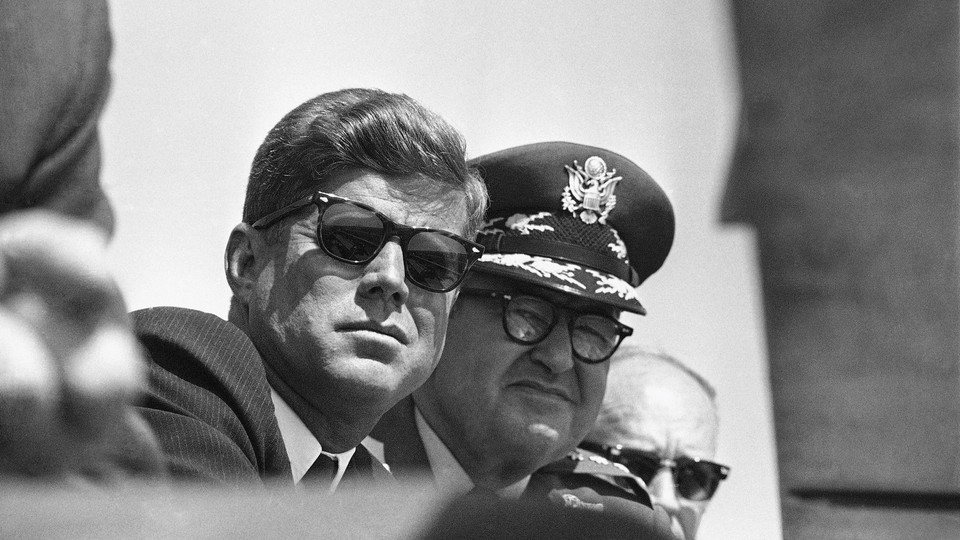
In 1962, President Kennedy watches B-52 bombers in FLorida as their pilots show their readiness for war. General Curtis LeMay, the Air Force chief of staff and JFK's frequent antagonist, looks over his shoulder. (Associated Press)
Every enlisted man dreams of it: pulling rank on the military's highest brass. The heroics of John F. Kennedy, lieutenant, junior grade, in the South Pacific after his PT‑109 was sunk in 1943 eased his way, 17 years later, to being elected the nation's commander in chief. In the White House, he fought—and defeated—his most determined military foes, just across the Potomac: the members of the Pentagon's Joint Chiefs of Staff. "Here was a president who had no military experience at all, sort of a patrol-boat skipper in World War II," Joint Chiefs Chairman Lyman Lemnitzer later said of Kennedy. Mutual respect, from the first, was in short supply.
In comparison, Nikita Khrushchev was a pushover, at least during the events that brought President Kennedy's most-notable achievements. By persuading the Soviet leader to remove missiles from Fidel Castro's Cuba and agree to a ban on nuclear tests in the atmosphere, underwater, and in outer space, Kennedy avoided a nuclear war and kept radioactive fallout from the air and the oceans, thereby earning the country's enduring regard for his effectiveness as a crisis manager and negotiator. But less recognized is how much both of these agreements rested on Kennedy's ability to rein in and sidestep his own military chiefs.
From the start of his presidency, Kennedy feared that the Pentagon brass would overreact to Soviet provocations and drive the country into a disastrous nuclear conflict. The Soviets might have been pleased—or understandably frightened—to know that Kennedy distrusted America's military establishment almost as much as they did.
The Joint Chiefs of Staff reciprocated the new president's doubts. Lemnitzer made no secret of his discomfort with a 43-year-old president who he felt could not measure up to Dwight D. Eisenhower, the former five-star general Kennedy had succeeded. Lemnitzer was a West Point graduate who had risen in the ranks of Eisenhower's World War II staff and helped plan the successful invasions of North Africa and Sicily. The 61-year-old general, little known outside military circles, stood 6 feet tall and weighed 200 pounds, with a bearlike frame, booming voice, and deep, infectious laugh. Lemnitzer's passion for golf and his ability to drive a ball 250 yards down a fairway endeared him to Eisenhower. More important, he shared his mentor's talent for maneuvering through Army and Washington politics. Also like Ike, he wasn't bookish or particularly drawn to grand strategy or big-picture thinking—he was a nuts-and-bolts sort of general who made his mark managing day-to-day problems.
To Kennedy, Lemnitzer embodied the military's old thinking about nuclear weapons. The president thought a nuclear war would bring mutually assured destruction—MAD, in the shorthand of the day—while the Joint Chiefs believed the United States could fight such a conflict and win. Sensing Kennedy's skepticism about nukes, Lemnitzer questioned the new president's qualifications to manage the country's defense. Since Eisenhower's departure, he lamented in shorthand, no longer was "a Pres with mil exp available to guide JCS." When the four-star general presented the ex-skipper with a detailed briefing on emergency procedures for responding to a foreign military threat, Kennedy seemed preoccupied with possibly having to make "a snap decision" about whether to launch a nuclear response to a Soviet first strike, by Lemnitzer's account. This reinforced the general's belief that Kennedy didn't sufficiently understand the challenges before him.
Admiral Arleigh Burke, the 59-year-old chief of naval operations, shared Lemnitzer's doubts. An Annapolis graduate with 37 years of service, Burke was an anti-Soviet hawk who believed that U.S. military officials needed to intimidate Moscow with threatening rhetoric. This presented an early problem for Kennedy, in that Burke "pushed his black-and-white views of international affairs with bluff naval persistence," the Kennedy aide and historian Arthur M. Schlesinger Jr. later wrote. Kennedy had barely settled into the Oval Office when Burke planned to publicly assail "the Soviet Union from hell to breakfast," according to Arthur Sylvester, a Kennedy-appointed Pentagon press officer who brought the proposed speech text to the president's attention. Kennedy ordered the admiral to back off and required all military officers on active duty to clear any public speeches with the White House. Kennedy did not want officers thinking they could speak or act however they wished.
Kennedy's biggest worry about the military was not the personalities involved but rather the freedom of field commanders to launch nuclear weapons without explicit permission from the commander in chief. Ten days after becoming president, Kennedy learned from his national-security adviser, McGeorge Bundy, that "a subordinate commander faced with a substantial Russian military action could start the thermonuclear holocaust on his own initiative." As Roswell L. Gilpatric, Kennedy's deputy defense secretary, recalled, "We became increasingly horrified over how little positive control the president really had over the use of this great arsenal of nuclear weapons." To counter the military's willingness to use nuclear weapons against the Communists, Kennedy pushed the Pentagon to replace Eisenhower's strategy of "massive retaliation" with what he called "flexible response"—a strategy of calibrated force that his White House military adviser, General Maxwell Taylor, had described in a 1959 book, The Uncertain Trumpet. But the brass resisted. The stalemate in the Korean War had frustrated military chiefs and left them inclined to use atomic bombs to ensure victory, as General Douglas MacArthur had proposed. They regarded Kennedy as reluctant to put the nation's nuclear advantage to use and thus resisted ceding him exclusive control over decisions about a first strike.
The NATO commander, General Lauris Norstad, and two Air Force generals, Curtis LeMay and Thomas Power, stubbornly opposed White House directives that reduced their authority to decide when to go nuclear. The 54-year-old Norstad confirmed his reputation as fiercely independent when two high-profile Kennedy emissaries, thought to be Secretary of State Dean Rusk and Secretary of Defense Robert S. McNamara, visited NATO's strategic military command in Belgium. They asked whether Norstad's primary obligation was to the United States or to its European allies. "My first instinct was to hit" one of the Cabinet members for "challenging my loyalty," he recalled later. Instead, he tried to smile and said, " 'Gentlemen, I think that ends this meeting.' Whereupon I walked out and slammed the door." Norstad was so clearly reluctant to concede his commander in chief's ultimate authority that Bundy urged Kennedy to remind the general that the president "is boss."
Explore the JFK Issue
Check out more from this issue and find your next story to read.
General Power, too, was openly opposed to limiting the use of America's ultimate weapons. "Why are you so concerned with saving their lives?" he asked the lead author of a Rand study that counseled against attacking Soviet cities at the outset of a war. "The whole idea is to kill the bastards … At the end of the war, if there are two Americans and one Russian, we win." Even Curtis LeMay, Power's superior, described him as "not stable" and a "sadist."
The 54-year-old LeMay, known as "Old Iron Pants," wasn't much different. He shared his subordinate's faith in the untrammeled use of air power to defend the nation's security. The burly, cigar-chomping caricature of a general believed the United States had no choice but to bomb its foes into submission. In World War II, LeMay had been the principal architect of the incendiary attacks by B‑29 heavy bombers that destroyed a large swath of Tokyo and killed about 100,000 Japanese—and, he was convinced, shortened the war. LeMay had no qualms about striking at enemy cities, where civilians would pay for their governments' misjudgment in picking a fight with the United States.
During the Cold War, LeMay was prepared to launch a preemptive nuclear first strike against the Soviet Union. He dismissed civilian control of his decision making, complained of an American phobia about nuclear weapons, and wondered privately, "Would things be much worse if Khrushchev were secretary of defense?" Theodore Sorensen, Kennedy's speechwriter and alter ego, called LeMay "my least favorite human being."
The strains between the generals and their commander in chief showed up in exasperating ways. When Bundy asked the Joint Chiefs' staff director for a copy of the blueprint for nuclear war, the general at the other end of the line said, "We never release that." Bundy explained, "I don't think you understand. I'm calling for the president and he wants to see [it]." The chiefs' reluctance was understandable: their Joint Strategic Capabilities Plan foresaw the use of 170 atomic and hydrogen bombs in Moscow alone; the destruction of every major Soviet, Chinese, and Eastern European city; and hundreds of millions of deaths. Sickened by a formal briefing on the plan, Kennedy turned to a senior administration official and said, "And we call ourselves the human race."
FIASCO IN CUBA
The tensions between Kennedy and the military chiefs were equally evident in his difficulties with Cuba. In 1961, having been warned by the CIA and the Pentagon about the Cuban dictator Fidel Castro's determination to export communism to other Latin American countries, Kennedy accepted the need to act against Castro's regime. But he doubted the wisdom of an overt U.S.-sponsored invasion by Cuban exiles, fearing it would undermine the Alliance for Progress, his administration's effort to curry favor with Latin American republics by offering financial aid and economic cooperation.
Nuclear tensions, and the bumbling at the Bay of Pigs, convinced Kennedy that a primary task of his presidency was to bring the military under strict control.
The overriding question for Kennedy at the start of his term wasn't whether to strike against Castro but how. The trick was to topple his regime without provoking accusations that the new administration in Washington was defending U.S. interests at the expense of Latin autonomy. Kennedy insisted on an attack by Cuban exiles that wouldn't be seen as aided by the United States, a restriction to which the military chiefs ostensibly agreed. They were convinced, however, that if an invasion faltered and the new administration faced an embarrassing defeat, Kennedy would have no choice but to take direct military action. The military and the CIA "couldn't believe that a new president like me wouldn't panic and try to save his own face," Kennedy later told his aide Dave Powers. "Well, they had me figured all wrong." Meeting with his national-security advisers three weeks before the assault on Cuba's Bay of Pigs, according to State Department records, Kennedy insisted that leaders of the Cuban exiles be told that "U.S. strike forces would not be allowed to participate in or support the invasion in any way" and that they be asked "whether they wished on that basis to proceed."When the Cubans said they did, Kennedy gave the final order for the attack.
The operation was a miserable failure—more than 100 invaders killed and some 1,200 captured out of a force of about 1,400. Despite his determination to bar the military from taking a direct role in the invasion, Kennedy was unable to resist a last-minute appeal to use air power to support the exiles. Details about the deaths of four Alabama Air National Guard pilots, who engaged in combat with Kennedy's permission as the invasion was collapsing, were long buried in a CIA history of the Bay of Pigs fiasco (unearthed after Peter Kornbluh of George Washington University's National Security Archive filed a Freedom of Information Act lawsuit in 2011). The document reveals that the White House and the CIA told the pilots to call themselves mercenaries if they were captured; the Pentagon took more than 15 years to recognize the airmen's valor, in a medal ceremony their families were required to keep secret. Even more disturbing, this Bay of Pigs history includes CIA meeting notes—which Kennedy never saw—predicting failure unless the U.S. intervened directly.
Afterward, Kennedy accused himself of naïveté for trusting the military's judgment that the Cuban operation was well thought-out and capable of success. "Those sons of bitches with all the fruit salad just sat there nodding, saying it would work," Kennedy said of the chiefs. He repeatedly told his wife, "Oh my God, the bunch of advisers that we inherited!" Kennedy concluded that he was too little schooled in the Pentagon's covert ways and that he had been overly deferential to the CIA and the military chiefs. He later told Schlesinger he had made the mistake of thinking that "the military and intelligence people have some secret skill not available to ordinary mortals." His lesson: never rely on the experts. Or at least: be skeptical of the inside experts' advice, and consult with outsiders who may hold a more detached view of the policy in question.
The consequence of the Bay of Pigs failure wasn't an acceptance of Castro and his control of Cuba but, rather, a renewed determination to bring him down by stealth. Attorney General Robert F. Kennedy, the president's younger brother and closest confidant, echoed the thinking of the military chiefs when he warned about the danger of ignoring Cuba or refusing to consider armed U.S. action. McNamara directed the military to "develop a plan for the overthrow of the Castro government by the application of U.S. military force."
The president, however, had no intention of rushing into anything. He was as keen as everyone else in the administration to be rid of Castro, but he kept hoping the American military needn't be directly involved. The planning for an invasion was meant more as an exercise for quieting the hawks within the administration, the weight of evidence suggests, than as a commitment to adopt the Pentagon's bellicosity. The disaster at the Bay of Pigs intensified Kennedy's doubts about listening to advisers from the CIA, the Pentagon, or the State Department who had misled him or allowed him to accept lousy advice.
TAKING CONTROL
During the early weeks of his presidency, another source of tension between Kennedy and the military chiefs was a small landlocked country in Southeast Asia. Laos looked like a proving ground for Kennedy's willingness to stand up to the Communists, but he worried that getting drawn into a war in remote jungles was a losing proposition. At the end of April 1961, while he was still reeling from the Bay of Pigs, the Joint Chiefs recommended that he blunt a North Vietnamese–sponsored Communist offensive in Laos by launching air strikes and moving U.S. troops into the country via its two small airports. Kennedy asked the military chiefs what they would propose if the Communists bombed the airports after the U.S. had flown in a few thousand men. "You [drop] a bomb on Hanoi," Robert Kennedy remembered them replying, "and you start using atomic weapons!" In these and other discussions, about fighting in North Vietnam and China or intervening elsewhere in Southeast Asia, Lemnitzer promised, "If we are given the right to use nuclear weapons, we can guarantee victory." By Schlesinger's account, President Kennedy dismissed this sort of thinking as absurd: "Since [Lemnitzer] couldn't think of any further escalation, he would have to promise us victory."
The clash with Admiral Burke, tensions over nuclear-war planning, and the bumbling at the Bay of Pigs convinced Kennedy that a primary task of his presidency was to bring the military under strict control. Articles in Time and Newsweek that portrayed Kennedy as less aggressive than the Pentagon angered him. He told his press secretary, Pierre Salinger, "This shit has got to stop."
Still, Kennedy couldn't ignore the pressure to end Communist control of Cuba. He wasn't ready to tolerate Castro's government and its avowed objective of exporting socialism to other Western Hemisphere countries. He was willing to entertain suggestions for ending Castro's rule as long as the Cuban regime demonstrably provoked a U.S. military response or as long as Washington's role could remain concealed. To meet Kennedy's criteria, the Joint Chiefs endorsed a madcap plan called Operation Northwoods. It proposed carrying out terrorist acts against Cuban exiles in Miami and blaming them on Castro, including physically attacking the exiles and possibly destroying a boat loaded with Cubans escaping their homeland. The plan also contemplated terrorist strikes elsewhere in Florida, in hopes of boosting support domestically and around the world for a U.S. invasion. Kennedy said no.
Policy toward Cuba remained a minefield of bad advice. By late August 1962, information was flooding in about a Soviet military buildup on the island. Robert Kennedy urged Rusk, McNamara, Bundy, and the Joint Chiefs to consider new "aggressive steps" that Washington could take, including, according to notes from one discussion, "provoking an attack against Guantanamo which would permit us to retaliate." The military chiefs insisted that Castro could be toppled "without precipitating general war"; McNamara favored sabotage and guerrilla warfare. They suggested that manufactured acts of sabotage at Guantánamo as well as other provocations could justify U.S. intervention. But Bundy, speaking for the president, cautioned against action that could instigate a blockade of West Berlin or a Soviet strike against U.S. missile sites in Turkey and Italy.
The events that became the Cuban missile crisis triggered Americans' fears of a nuclear war, and McNamara shared Kennedy's concerns about the military's casual willingness to rely on nuclear weapons. "The Pentagon is full of papers talking about the preservation of a 'viable society' after nuclear conflict," McNamara told Schlesinger. "That 'viable society' phrase drives me mad … A credible deterrent cannot be based on an incredible act."
The October 1962 missile crisis widened the divide between Kennedy and the military brass. The chiefs favored a full-scale, five-day air campaign against the Soviet missile sites and Castro's air force, with an option to invade the island afterward if they thought necessary. The chiefs, responding to McNamara's question about whether that might lead to nuclear war, doubted the likelihood of a Soviet nuclear response to any U.S. action. And conducting a surgical strike against the missile sites and nothing more, they advised, would leave Castro free to send his air force to Florida's coastal cities—an unacceptable risk.
Kennedy rejected the chiefs' call for a large-scale air attack, for fear it would create a "much more hazardous" crisis (as he was taped telling a group in his office) and increase the likelihood of "a much broader struggle," with worldwide repercussions. Most U.S. allies thought the administration was "slightly demented" in seeing Cuba as a serious military threat, he reported, and would regard an air attack as "a mad act." Kennedy was also skeptical about the wisdom of landing U.S. troops in Cuba: "Invasions are tough, hazardous," a lesson he had learned at the Bay of Pigs. The biggest decision, he thought, was determining which action "lessens the chances of a nuclear exchange, which obviously is the final failure."
Kennedy told his paramour something he could never have admitted in public: "I'd rather my children be red than dead."
Kennedy decided to impose a blockade—what he described more diplomatically as a quarantine—of Cuba without consulting the military chiefs with any seriousness. He needed their tacit support in case the blockade failed and military steps were required. But he was careful to hold them at arm's length. He simply did not trust their judgment; weeks earlier, the Army had been slow to respond when James Meredith's attempt to integrate the University of Mississippi touched off riots. "They always give you their bullshit about their instant reaction and their split-second timing, but it never works out," Kennedy had said. "No wonder it's so hard to win a war." Kennedy waited for three days after learning that a U-2 spy plane had confirmed the Cuban missiles' presence before sitting down with the military chiefs to discuss how to respond—and then for only 45 minutes.
That meeting convinced Kennedy that he had been well advised to shun the chiefs' counsel. As the session started, Maxwell Taylor—by then the chairman of the Joint Chiefs of Staff—said the chiefs had agreed on a course of action: a surprise air strike followed by surveillance to detect further threats and a blockade to stop shipments of additional weapons. Kennedy replied that he saw no "satisfactory alternatives" but considered a blockade the least likely to bring a nuclear war. Curtis LeMay was forceful in opposing anything short of direct military action. The Air Force chief dismissed the president's apprehension that the Soviets would respond to an attack on their Cuban missiles by seizing West Berlin. To the contrary, LeMay argued: bombing the missiles would deter Moscow, while leaving them intact would only encourage the Soviets to move against Berlin. "This blockade and political action … will lead right into war," LeMay warned, and the Army, Navy, and Marine Corps chiefs agreed.
"This is almost as bad as the appeasement at Munich," LeMay declared. "In other words, you're in a pretty bad fix at the present time."
Kennedy took offense. "What did you say?"
"You're in a pretty bad fix," LeMay replied, refusing to back down.
The president masked his anger with a laugh. "You're in there with me," he said.
After Kennedy and his advisers left the room, a tape recorder caught the military brass blasting the commander in chief. "You pulled the rug right out from under him," Marine Commandant David Shoup crowed to LeMay. "If somebody could keep them from doing the goddamn thing piecemeal—that's our problem. You go in there and friggin' around with the missiles, you're screwed … Do it right and quit friggin' around."
Kennedy, too, was angry—"just choleric," said Deputy Secretary of Defense Gilpatric, who saw the president shortly afterward. "He was just beside himself, as close as he ever got."
"These brass hats have one great advantage," Kennedy told his longtime aide Kenny O'Donnell. "If we … do what they want us to do, none of us will be alive later to tell them that they were wrong."
BETTER "RED THAN DEAD"
Jackie Kennedy told her husband that if the Cuban crisis ended in a nuclear war, she and their children wanted to die with him. But it was Mimi Beardsley, his 19-year-old intern turned paramour, who spent the night of October 27 in his bed. She witnessed his "grave" expression and "funereal tone," she wrote in a 2012 memoir, and he told her something he could never have admitted in public: "I'd rather my children be red than dead." Almost anything was better, he believed, than nuclear war.
Kennedy's civilian advisers were elated when Khrushchev agreed to withdraw the missiles. But the military chiefs refused to believe that the Soviet leader would actually do what he had promised. They sent the president a memo accusing Khrushchev of delaying the missiles' departure "while preparing the ground for diplomatic blackmail." Absent "irrefutable evidence" of Khrushchev's compliance, they continued to recommend a full-scale air strike and an invasion.
Kennedy ignored their advice. Hours after the crisis ended, when he met with some of the military chiefs to thank them for their help, they made no secret of their disdain. LeMay portrayed the settlement as "the greatest defeat in our history" and said the only remedy was a prompt invasion. Admiral George Anderson, the Navy chief of staff, declared, "We have been had!" Kennedy was described as "absolutely shocked" by their remarks; he was left "stuttering in reply." Soon afterward, Benjamin Bradlee, a journalist and friend, heard him erupt in "an explosion … about his forceful, positive lack of admiration for the Joint Chiefs of Staff."
Yet Kennedy could not simply disregard their advice. "We must operate on the presumption that the Russians may try again," he told McNamara. When Castro refused to allow United Nations inspectors to look for nuclear missiles and continued to pose a subversive threat throughout Latin America, Kennedy continued planning to oust him from power. Not by an invasion, however. "We could end up bogged down," Kennedy wrote to McNamara on November 5. "We should keep constantly in mind the British in Boer War, the Russians in the last war with the Finnish and our own experience with the North Koreans." He also worried that violating the understanding he had with Khrushchev not to invade Cuba would invite condemnation from around the world.
Still, his administration's goal in Cuba had not changed. "Our ultimate objective with respect to Cuba remains the overthrow of the Castro regime and its replacement by one sharing the aims of the Free World," read a White House memo to Kennedy dated December 3, which suggested that "all feasible diplomatic economic, psychological and other pressures" be brought to bear. All, indeed. The Joint Chiefs described themselves as ready to use "nuclear weapons for limited war operations in the Cuban area," professing that "collateral damage to nonmilitary facilities and population casualties will be held to a minimum consistent with military necessity"—an assertion they surely knew was nonsense. A 1962 report by the Department of Defense on "The Effects of Nuclear Weapons" acknowledged that exposure to radiation was likely to cause hemorrhaging, producing "anemia and death … If death does not take place in the first few days after a large dose of radiation, bacterial invasion of the blood stream usually occurs and the patient dies of infection."
Kennedy did not formally veto the military chiefs' plan for a nuclear attack on Cuba, but he had no intention of acting on it. He knew that the notion of curbing collateral damage was less a realistic possibility than a way for the brass to justify their multitudes of nuclear bombs. "What good are they?," Kennedy asked McNamara and the military chiefs a few weeks after the Cuban crisis. "You can't use them as a first weapon yourself. They are only good for deterring … I don't see quite why we're building as many as we're building."
In the wake of the missile crisis, Kennedy and Khrushchev both reached the sober conclusion that they needed to rein in the nuclear arms race. Kennedy's announced quest for an arms-control agreement with Moscow rekindled tensions with his military chiefs—specifically, over a ban on testing nuclear bombs anywhere but underground. In June 1963, the chiefs advised the White House that every proposal they had reviewed for such a ban had shortcomings "of major military significance." A limited test ban, they warned, would erode U.S. strategic superiority; later, they said so publicly in congressional testimony.
The following month, as the veteran diplomat W. Averell Harriman prepared to leave for Moscow to negotiate a nuclear-test ban, the chiefs privately called such a step at odds with the national interest. Kennedy saw them as a treaty's greatest domestic impediment. "If we don't get the chiefs just right," he told Mike Mansfield, the Senate majority leader, "we can … get blown." To quiet their objections to Harriman's mission, Kennedy promised them a chance to speak their minds in Senate hearings should a treaty emerge for ratification, even as he instructed them to consider more than military factors. Meanwhile, he made sure to exclude military officers from Harriman's delegation, and decreed that the Department of Defense—except for Maxwell Taylor—receive none of the cables reporting developments in Moscow.
"The first thing I'm going to tell my successor," Kennedy told guests at the White House, "is to watch the generals, and to avoid feeling that just because they were military men, their opinions on military matters were worth a damn."
Persuading the military chiefs to refrain from attacking the test-ban treaty in public required intense pressure from the White House and the drafting of treaty language permitting the United States to resume testing if it were deemed essential to national safety. LeMay, however, testifying before the Senate Committee on Foreign Relations, could not resist planting doubts: Kennedy and McNamara had promised to keep testing nuclear weaponry underground and to continue research and development in case circumstances changed, he said, but they had not discussed "whether what [the chiefs] consider an adequate safeguard program coincides with their idea on the subject." The Senate decisively approved the treaty nonetheless.
This gave Kennedy yet another triumph over a cadre of enemies more relentless than the ones he faced in Moscow. The president and his generals suffered a clash of worldviews, of generations—of ideologies, more or less—and every time they met in battle, JFK's fresher way of fighting prevailed.
2Janis, Irving L. (1982) Victims of Groupthink: Psychological Studies of Foreign Policy Decision and Fiascoes, Boston, MA: Houghton MifflinおよびJanis (1989) Crucial Decisions: Leadership in Policymaking and Crisis Management, New York, NY: The Free Press.



 出典:pbs.twimg.com