Takahashi Korekiyo was before Keynes and saved Japan from the Great Depression
This
blog is really a two-part blog which is a follow up on previous blogs I
have written about Overt Monetary Financing (OMF). The former head of
the British Financial Services Authority, Adair Turner has just released
a new paper – The Case for Monetary Finance – An Essentially Political Issue
– which he presented at the 16th Jacques Polak Annual Research
Conference, hosted by the IMF in Washington on November 5-6, 2015. The
paper advocated OMF but in a form that I find unacceptable. I will write
about that tomorrow (which will be Part 2, although the two parts are
not necessarily linked). I note that the American journalist John
Cassidy writes about Turner in his latest New Yorker article (November
23, 2015 issue) – Printing Money.
Just the title tells you he doesn't appreciate the nuances of central
bank operations. He also invokes the Zimbabwe-Weimar Republic hoax,
which tells you that he isn't just ignorant of the details but also part
of the neo-liberal scare squad that haven't learnt that all spending
carries an inflation risk – public or private – no matter what monetary
operations migh be associated with it. I will talk about that tomorrow.
Today, though, as background, I will report some research I have been
doing on Japanese economic policy in the period before the Second World
War. It is quite instructive and bears on how we think about OMF. That
is the topic for today.
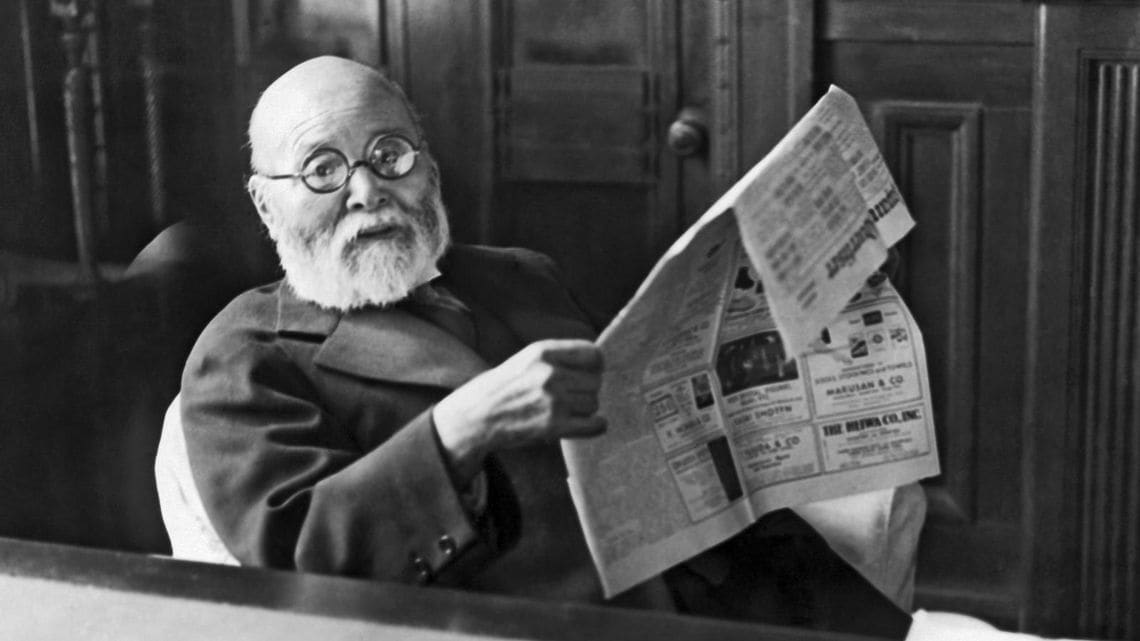
Takahashi Korekiyo
– was the 20th Prime Minister of Japan and held office twice the last
time in an acting capacity in 1932. He had previously worked in the Bank
of Japan. For the most part though, he was Finance Minister under
various administrations from the late 1920s until his death in 1936.
I
have been researching documents in the Bank of Japan archives for some
time now as part of a book project I am working on. I am up to the
period that Takahashi Korekiyo was a major player in Japanese economic
policy making and it just happens to fit in with the comments I wish to
make about Adair Turner and John Cassidy.
But I thought this background would help us for tomorrow.
Takahashi
Korekiyo is famous for abandoning the Gold Standard on December 13,
1931 and introducing a major fiscal stimulus with central bank credit
which rescued Japan from the Great Depression in the 1930s. That is
quite a reputation. His actions and the subsquent results provide a
solid evidence base for assessing whether OMF is desirable.
I
note that OMF is core Modern Monetary Theory (MMT) policy, a point that
Cassidy seems to be worried about. More about that tomorrow.
As
to Takahashi Korekiyo, I don't think his monetary acumen had anything
to do with his assassination (in his sleep by gunshot and sword) by
rebel army officers in 1936 during the so-called – February 26 Incident – which was a failed coup d'état.
He
had in fact reduced military funding because he was a moderate and
wished to reduce Japan's martial tendencies. Enemies were thus made and
they were the type of enemies that carried weapons and knew how to use
them!
As background, Japan had experienced a major private banking collapse in 1927 (the Showa Financial Crisis)
as a result of what has been referred to as "cumulative mismanagement
of cover-ups and halfway measures against earlier flaws dating back to
the post-war collapse" (quote from Takahashi, Kamekichi [1955a], Taisho
Showa Zaikai Hendou Shi (A History of Economic Fluctuations during
Taisho and Showa Eras), vol.2, Toyo Keizai Shinposha, Tokyo, p.739).
In
other words, the banksters were out in force in Japan during the 1920s.
It is argued by Takahashi Kamekichi that the stimulus measures
introduced by Takahashi Korekiyo were assisted by the reforms that were
made in the late 1920s to deal with the Showa Financial Crisis.
There were three notable sources of stimulus introduced by Takahashi Korekiyo:
1.
The exchange rate was devalued by 60 per cent against the US dollar and
44 per cent against the British pound after Japan came off the Gold
Standard in December 1931. The devaluation occurred between December
1931 and November 1932. The Bank of Japan then stabilised the parity
after April 1933.
2. He introduced an
enlarged fiscal stimulus. In March 1932, Takahashi suggested a policy
where the Bank of Japan would underwrite the government bonds (that is,
credit relevant bank accounts to facilitate government spending).
This
proposal was passed by the Diet on June 18, 1932. The Diet passed the
government's fiscal policy strategy for the next 12 months with a rising
fiscal deficit 100 per cent funded by credit from the Bank of Japan.
Bank of Japan historian Masato Shizume wrote in his Bank of Japan Review article (May 2009) – The Japanese Economy during the Interwar Period: Instability in the Financial System and the Ipact of the World Depression – that:
Japan recorded much larger fiscal deficits than the other countries
throughout Takahashi's term as Finance Minister in the 1930s.
On November 25, 1932, the Bank of Japan started 'underwriting' the government's spending.
3.
The Bank of Japan eased interest rates several times in 1932 (March,
June and August) and again in early 1933. This easing followed the cuts
by the Bank of England and the Federal Reserve Bank in the US. Monetary
policy cuts were thus common to each but the size of the fiscal policy
stimulus was unique to Japan.
Masato Shizume wrote that:
A number of observers who focus on the macroeconomic aspects of the
Takahashi economic policy praise Takahashi's achievements as a
successful pioneer of Keynesian economics. Kindleberger points out that
Takahashi conducted quintessential Keynesian policies, stating, "his
writing of the period showed that he already understood the mechanism of
the Keynesian multiplier, without any indication of contact with the R.
F. Kahn 1931 Economic Journal article."
[The full
reference is: Shizume, Masato (2009) "The Japanese Economy during the
Interwar Period: Instability in the Financial System and the Impact of
the World Depression",
Bank of Japan Review, 2009-E-2]
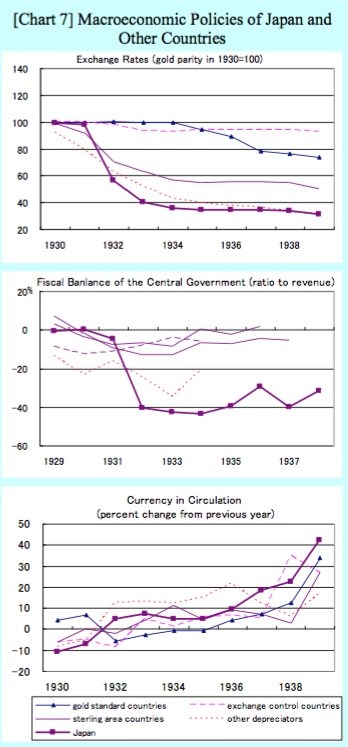
The
next graph is a reproduction of Chart 7 Macroeconomic Policies of Japan
and Other Countries from Masato Shizume's paper. It is
self-explanatory.
The big variation between the different currency blocs and Japan is in fiscal policy.

There
is substantial discussion in the literature about the relative impacts
of these three different stimulus measures. But what followed is clear:
1.
Real GDP growth returned quickly and stood out by comparison with the
rest of the world which was mired in recession. Between 1932 and 1936,
real industrial production grew by a staggering 62 per cent.
2.
Employment, which had also plummeted in the early days of the Great
Depression, grew robustly after the Takahashi intervention.
3.
Inflation spiked as a result of the exchange rate depreciation in 1933
but quickly fell to low and relatively stable levels in 1934 as the
economy's growth rate picked up under the support of the fiscal and
monetary stimulus.
It was clear that
abandoning the Gold Standard was a crucial first step because it gave
the government space to introduce major domestic stimulus policies.
These policies were not possible under the Gold Standard because they
would have pushed out the external deficit and the nation would have
lost its gold stocks.
I note a number
of the current Republican presidential potentials in the US are once
again calling for a return to the Gold Standard. They clearly haven't a
clue what they are talking about given the appalling record of nations
when they were on such exchange rate mechanisms.
It
was the Gold Standard that ensured the Great Depression ensued. As the
US started to run trade surpluses in 1929 (after the recession choked
off imports), other nations started to deplete their gold stocks which
meant they had to raise interest rates to attract capital inflow. The US
recession spread and many investors in Europe considered that the
central banks would have to devalue. Anticipating that, they withdrew
gold and the contractionary effects on the money supply worsened the
downturn. Then banks collapsed and so on.
There is an interesting article (November 12, 2015) by Greg Ip – What Republicans Get Wrong About the Gold Standard – that bears on this issue. It is targetted at those stupid Republican candidates.
Clearly,
Takahashi Korekiyo understood the constraints that the Gold Standard
and the need to maintain the money supply in proportion with the
nation's stock of gold imposed on domestic policy. Once he removed that
constraint he could then use the fiscal and monetary tools available to
him (and through the Bank of Japan) to target domestic demand.
Some
researchers have suggested that the combination of the exchange rate
depreciation and the fiscal stimulus "had significant impacts upon the
level of activity" (see Nanto, D.K. and Takagi, S. (1985) 'Korekiyo
Takahashi and Japanese Recovery from the Great Depression', American Economic Review, 75, 369-74).
Most
of the studies suggest that the monetary policy easing (cutting
interest rates) was not as significant as the other two stimulus
measures.
Another strand of argument is
that in the transition from democracy to fascism in the early 1930s,
the trade unions were suppressed and industrial disputation fell. Real
wages fell as a result, which some claim caused employment and output to
rise.
An interesting paper was published on September 30, 2000 by the Korean scholar Myung Soo Cha – Did Korekiyo Takahashi Rescue Japan from the Great Depression?.
It
sought to decompose these stimulus factors and wage reductions to see
order their impact on the exceptional recovery during the Great
Depression. He also includes world output impacts (on Japanese exports)
to see whether the recovery was driven by events outside of Japan.
He
uses statistical techniques (Vector Autoregression) and historical data
released by the Bank of Japan to show that it was the fiscal initiative
that "was critical in reversing the downswing" in Japan in the early
years of the Great Depression.
As an aside, the Bank of Japan runs an excellent Historical Statistics page. There are other sources of data that is of use in studying this period – for example the League of Nations, International Statistical Yearbook – which is available on-line through Northwestern University in the US.
The
next graph is a reproduction of Myung Soo Cha's Figure 1 and show the
evolution of Industrial Production from the mid-1920s to 1937.
It
is clear that Japan's experience was quite different to the other major
economies of the day, especially after the major stimulus package
introduced by Takahashi Korekiyo.
It is
also interesting that the turning points in the graph for the
respective countries "matches the sequence of going off gold in the wake
of the Depression: Britain, Germany and Japan in 1931, the U.S. in
1933, and finally France in 1936". That is not coincidental.

I
won't go into his methodology (it is standard) and you can read the
paper yourself if you are interested in this sort of econometric
analysis.
The results of his study are fairly clear:
1.
He writes "one cannot but be impressed by the prominent role of
Takahashi's fiscal expansion in ending the Great Depression in Japan".
2. "In particular, his deficit spending was found to have been crucial in ending the depression quickly".
3. "Devaluation did help during 1932, but its contribution to output growth was modest."
4.
"The depreciating yen provided some stimuli as well, but they were not
sufficiently strong to outweigh the contractionary influences from the
rest of the world."
Another finding
from Shizume Mazato's work is that while inflationary expectations rose
somewhat during the shift from liberal democracy to fascism, "the shift
in expectation from deflation to inflation was chiefly the result of the
currency depreciation, not the BOJ underwriting of government bonds".
Some
might argue that it was the increased military spending that provided
the fiscal stimulus, which would be undesirable in today's world.
But
research suggests that the military part of the fiscal shift to
stimulus was fairly insignificant (see for example, Metzler, M. (2006) Lever of Empire: The International Gold Standard and the Crisis of Liberalism in Prewar Japan, Berkeley, University of California Press).
Conclusion
There
is little doubt that Takahashi Korekiyo's economic policy stance –
which was very MMT in operation – saved Japan from the Great Depression.
The
large fiscal stimulus that was mostly underwritten with central bank
credit did not cause interest rates to sky-rocket nor inflation to
accelerate.
Inflation rose for a time
then fell again but this was mainly the result of the massive exchange
rate depreciation. That is a result that would always occur in a small
open-economy such as Japan (at the time – small that is).
While
there were aspects that were unnecessary – for example, the military
spending – it is clear that Takahashi Korekiyo's 'experiment' has
relevance for us today in discussions concerning Overt Monetary
Financing.
I have argued in my current book – Eurozone Dystopia: Groupthink and Denial on a Grand Scale (published May 2015) – that OMF could save the Eurozone (from itself).
But
try to get the policy makers in Brussels and Frankfurt to display as
much policy acumen and foresight as Takahashi Korekiyo did in 1931.
Politics in the Pub – Hamilton – November 17, 2015
Tonight,
I will be the speaker at the Politics in the Pub, which is held at the
Hamilton Station Hotel, Beaumont Street, Hamilton (a suburb of
Newcastle, NSW).
The title of my talk
will be 'Why budget deficits are good for Australia' and I will motivate
the talk with the quote from US philospher Daniel Dennett who told the
New York Times on April 29, 2013 that:
There's simply no polite way to tell people they've dedicated their lives to an illusion …
We will have some fun with that!
The event starts at 18:30.
I hope to see local readers there.
That is enough for today!
緊縮政策と金解禁 所謂緊縮政策について
緊縮という問題を論ずるに当っては、先ず国の経済と個人経済との区別を明かにせねばならぬ。
例えばここに一年五万円の生活をする余力のある人が、倹約して三万円を以て生活し、あと二万円はこれを貯蓄する事とすれば、その人の個人経済は、毎年それだけ蓄財が増えて行って誠に結構な事であるが、これを国の経済の上から見る時は、その倹約によって、これまでその人が消費しておった二万円だけは、どこかに物資の需要が減るわけであって、国家の生産力はそれだけ低下する事となる。ゆえに国の経済より見れば、五万円の生活をする余裕ある人には、それだけの生活をして貰った方がよいのである。
さらに一層砕けて言うならば、仮にある人が待合へ行って、芸者を招んだり、贅沢な料理を食べたりして二千円を費消したとする。これは風紀道徳の上から云えば、そうした使い方をして貰いたくは無いけれども、仮に使ったとして、この使われた金はどういう風に散ばって行くかというのに、料理代となった部分は料理人等の給料の一部分となり、また料理に使われた魚類、肉類、野菜類、調味品等の代価及びそれ等の運搬費並びに商人の稼ぎ料として支払われる。この分は、すなわちそれだけ、農業者、漁業者その他の生産業者の懐を潤すものである。しかしてこれらの代金を受取たる農業者や、漁業者、商人等は、それを以て各自の衣食住その他の費用に充てる。それから芸者代として支払われた金は、その一部は芸者の手に渡って、食料、納税、衣服、化粧品、その他の代償として支出せられる。すなわち今この人が待合へ行くことを止めて、二千円を節約したとすれば、この人個人にとりては二千円の貯蓄が出来、銀行の預金が増えるであろうが、その金の効果は二千円を出でない。
しかるに、この人が待合で使ったとすれば、その金は転々して、農、工、商、漁業者等の手に移り、それがまた諸般産業の上に、二十倍にも、三十倍にもなって働く。ゆえに、個人経済から云えば、二千円の節約をする事は、その人にとって、誠に結構であるが、国の経済から云えば、同一の金が二十倍にも三十倍にもなって働くのであるから、むしろその方が望ましいわけである。ここが個人経済と、国の経済との異っておるところである。
以上は、もとより極端な例を挙げたに過ぎない。かく言えばとて、私は待合行きを奨励する次第では決して無い。ことにそれだけの余裕なきものが、借金までして浪費する事は、無論よく無い事である。ただ私がここに待合の例証を取ったのは、世に最も浪費なりと称せられている、この待合遊びについてさえも、これを個人経済から見る時と、国の経済から見る時とは、大変な相異がある事を明かにしたまでである。
言うまでも無く、如何なる人の生活にも、無駄という事は、最も悪い事である。これは個人経済から云えば、物を粗末にする事である。倹約という事も詮じ詰れば、物を粗末にしないと云う事に過ぎない。しかしながら、如何に倹約がよいからと云って、今日産業の力を減退させるような手段を取る事は好ましからぬ事だ。もとより財政上緊縮を要するという事はあるが、その場合には、なるべく政府の新たなる支出を出来るだけ控目にする事が主眼で無くてはならぬ。すでに取かかった仕事まで中止するという事は考えものだ。
先だっても、永田町を通って見たら、帝国議事堂の鉄骨が、ガランとして秋空の上に突立っている。そうして仕事は中途半端で停止せられ、構内は寂として山寺のようである。霞ケ関でも先頃までは内務省の庁舎の基礎工事が進んでおり、桜田門では警視庁の建物がこれも鉄骨の組立てを終っていたようだ。ところが四、五日前に通って見ると、この方にも人の子一人おらず、閑古鳥も鳴かぬ有様である。
これらはすでに取掛って、現に進行中の仕事である。これを止めるとか中止するとかいうには十分に事の軽重を計り、国の経済の上から考えて決せねばならぬ。その性質をも考えず、天引同様に中止する事は、あまりに急激で、そこに必ず無理が出て来る。その無理はすなわち、不景気と失業者となって現れ出ずるのである。
現に、帝国議事堂、内務省庁舎、警視庁の例を見ても、これらの工事を止めたために、第一に請負人が職を失う。またこれに従事せる事務員、技術者、労働者及び工事の材料の生産者、その材料を取次ぐ商人等の総ては、節約または繰延べられたるだけ職を失うのである。これらの人々が職を失う事は、やがて購買力の減少となり、かような事が至る所に続出すれば、それに直接関係なき生産業者も、将来における商品の需要の減退を慮って、自分の現在雇傭せる労働者を解雇して、生産量を減少するようになる。その結果は、一般の一大不景気を招来するに至るのである。かくのごとき事は国家経済の上から、よほど考慮を要する事柄である。
金解禁の準備は自主的なるべし
近ごろ世間で唱えておるところを聞くと、所謂緊縮節約は金解禁のためである、と云っている。それは先ずよいとして、この金解禁についても、我が国民は、もっと慎重に考えるの必要がある。やれ対米為替が上ったから、やれ英米の金利が下ったから、金解禁に好都合になったと、有頂天になっている者もあるが、それは少し早計でないかと考える。もとより今日金解禁をなすについては、外国市場の金利や為替相場等の影響も考慮せねばならぬが、もっと、大事な事は、これを自主的にきめる事である。
しかして自主的の準備とは、我が国の国際貸借の関係において、支払いの立場に立たぬよう、国内の産業、海運その他の事業の基礎を確立する事である。この基礎が出来て初めて解禁という事が行われ得るので、その準備なく、徒らに為替相場や、外国市場の金利の低下を頼りとして、外国の御蔭で解禁せんとするがごときは、国家永遠の利害を考えぬ謬見と云わねばならぬ。
(昭和四年十一月)
随想録