2024年12月31日火曜日

Reckonings: a journal of justice, hope and history: Poems and Stories

https://onbeing.org/programs/rebecca-solnit-falling-together/
https://www.reckonings.net/reckonings/poems-and-stories/

Rebecca Solnit

Hope and Falling Together

May 26, 2016

"When all the ordinary divides and patterns are shattered, people step up to become their brothers' keepers. And that purposefulness and connectedness bring joy even amidst death, chaos, fear, and loss." A singular writer and thinker, Rebecca Solnit celebrates the unpredictable and incalculable events that so often redeem our lives, both solitary and public. She searches for the hidden, transformative histories inside and after events we chronicle merely as disasters, in places like post-Hurricane Katrina New Orleans.

Rebecca Solnit is a contributing editor at Harper's Magazine and a regular writer for publications including The Guardian and The London Review of Books. Her books include A Paradise Built in HellHope in the Dark, and a new collection of essays, The Mother of All Questions.

Krista Tippett, host: Rebecca Solnit describes her vision as a writer like this: "to describe nuances and shades of meaning, to celebrate public life and solitary life, to find another way of telling." She is a contributing editor to Harper's Magazine and the author of profound books that defy category. She's emerged as one of our great chroniclers of untold histories of redemptive change in places like post-Hurricane Katrina New Orleans. She writes that, so often, "When all the ordinary divides and patterns are shattered, people step up to become their brother's keepers. And that purposefulness and connectedness bring joy even amidst death, chaos, fear, and loss."

Rebecca Solnit: I want better metaphors. I want better stories. I want more openness. I want better questions. All these things feel like they give us tools that are a little more commensurate with the amazing possibilities and the terrible realities that we face.

Ms. Tippett:  Rebecca Solnit's books include A Paradise Built in HellHope in the Dark, and a new collection of essays, The Mother of All Questions. She was born in Bridgeport, Connecticut, and moved with her parents to the San Francisco Bay Area when she was young. I spoke with her in 2016.

Ms. Tippett: I usually start my conversations with an inquiry about the spiritual background of your childhood, and — however you would define that. And as I look at the sweep of your writing, I see so many elements that, to me, are profoundly spiritual — a long sense of time, a robust commitment to hope. You describe your childhood in so many ways — in one place, these are words you use: "a scrawny, battered little kid in a violent house." And I wonder how you would think about that notion of the spiritual background of your childhood. And it occurs to me that perhaps some of these things were seeded by absence, as much as by presence.

Ms. Solnit:  I think that's true. And when you ask that question, what comes to mind is a map of where most of my childhood took place. I wrote 2020-03-14_20-19-06somewhere that I had an inside-out childhood, because every place was safe but home. If you went — just on the other side of the backyard fence was a quarter horse stud farm and then dairy farms and open space. And the landscape and the animals, domestic and wild, were this huge refuge and really fed me and encouraged me, and there was a sense of community with the non-human. And so that was if you went north, even just to the other side of the fence and beyond — it was just endless open space and oak trees and grasslands and wildlife.

And then if you went south, there was a really great public library. And the minute I learned how to read, it was as though I'd been given this huge treasure. Every book was a box I suddenly knew how to open, and in it I could meet people, go to other worlds, go deep in all kinds of ways. And I spent my childhood in the hills and in the books. And those — so that was not maybe what people think of conventionally as spirituality, but that was my company, my encouragement, my teaching, my community.

Ms. Tippett: That's lovely. So the sweep of your work is wonderful, and it's daunting, as an interviewer. But I actually thought I would start with — I'd just love to have a conversation with you about this piece that was in Harper's not that long ago, about — I can't remember the title of it. But it was ostensibly about the choice not to have children.

Ms. Solnit: Oh, yeah. It's called "The Mother of All Questions."

Ms. Tippett: The Mother of All Questions." And part of what you were reflecting on, or a jumping-off point for your reflection, was the fact that people are so curious about that and, in fact, so presumptuous about it. And I think you make the case very quickly that it's a valid and life-giving choice, not to have children. But in fact, the piece, like so much of what you write, becomes a reflection on the vast expanse of what it is to be alive. And so there's this: you said, "People lock onto motherhood as a key to feminine identity in part from the belief that children are the best way to fulfill your capacity to love, even though the list of monstrous, ice-hearted mothers is extensive. But there are so many things to love besides one's own offspring, so many things that need love, so much other work love has to do in the world."

Ms. Solnit: Yeah, exactly.

Ms. Tippett: And you say — I love this phrase: "There's so much other work love has to do in the world." I just feel like that's so worth just putting out in public life and reflecting on.

Ms. Solnit: Yeah, and it's partly — we overemphasize this very specific zone of love. It's as though we've hyper-mapped it and obsessed about it and shone lights on it and things. And then there's this whole other territory of relationships, to the larger world in particular and to public life, to — I hang out with a lot of climate activists, and there's this profound love they have for the natural world, for the future, for justice. And that really shapes lives and gives them tremendous meaning. And it benefits all of us that they have this and that this motivates them, because they're acting on behalf of all of us. And we should call that love. And we should look at the way that —

Ms. Tippett: And it's a passionate love, right? It's a passionate love.

Ms. Solnit: Absolutely. It's just — it's ferocious, and it's protective the way that mother love can be. And if anything's going to save the planet, it's that love. But mostly we don't even acknowledge that it exists, and so we have these blank spots on the map of who we are. And I want to try and fill those in and encourage people to go there, to recognize that actually, their lives can take place or are already taking place there and that this will give them this bigger sense of self.

Ms. Tippett :So a lot of the themes that run through your work, the things you care about, I want to say they're outliers in terms of what we know how to talk about in public — certainly, in intellectual circles. And so maybe let's talk about hope, because I think hope is one of those.

Ms. Solnit: I can talk about hope till, I think, the cows come home.

Ms. Tippett: [laughs] Well, I just — I want to start — somewhere you write that your fascination with this — maybe you began to articulate your fascination with this when you registered your emotions and the emotions of others in response to the 1989 earthquake in San Francisco. And my sense is that what you — how you responded and how you saw others respond — it was not, perhaps, what you would have expected.

Ms. Solnit: The amazing thing about the 1989 earthquake — it was an earthquake as big as the kind that killed thousands of people in places like Turkey and Mexico City and things like that. But partly because we have good infrastructure, about 50 people died. A number of people lost their homes. Everybody was shaken up. But what was so interesting for me was that people seemed to kind of love what was going on. And when I'd ask people, or when it would come up in conversation, because for years afterwards around here, people would be like, "Oh, where were you at 5:02, or is it 5:03 P.M., on October 17, 1989?" And people would get this expression that I later ran into when I visited Halifax, Nova Scotia, after a big hurricane there, when I talked — and then eventually, I did a whole book on this mysterious emotion. People would light up. And everything we've been told about disaster by trashy Hollywood disaster movies with Charlton Heston and Tom Cruise, everything about the news — is that human beings are fragile, disasters are terrible, and we're either terrified because we're fragile, or our morality is also fragile, and we revert to our best-deal, savage, social-Darwinist, Hobbesian nature, and go out raping and looting.

Those myths became a secondary disaster, worse than the hurricane that hit New Orleans on August 29, 2005, because that's why it was — the city was shut off, turned into a prison city, why the police were shooting black people in the back, why people were not allowed to evacuate and supplies were not allowed in while people were dying of exposure and lack of medication and et cetera.

So that was part of where I got hopeful, and then also, in a larger sense, one of the things I'm really interested in is, what are the stories we tell, and what are their consequences? And are there other ways of telling, other ways — other stories that don't get told? And hopefulness is really, for me — is not optimism: that everything's going to be fine, and we can just sit back. And that's too much like pessimism, which is that everything's going to suck, and we can just sit back.

Hope, for me, just means a Buddhist sense of uncertainty, of coming to terms with the fact that we don't know what will happen and that there's maybe room for us to intervene, and that we have to let go of the certainty people seem to love more than hope and know that we don't know what's going to happen. And we live in a very surprising world, where nobody anticipated the way the Berlin Wall would fall or the Arab Spring would rise up, the impact of Occupy Wall Street. Obama was unelectable, six months before he was elected.

Ms. Tippett: But I wonder, as you just described that, just then, what you said — in those moments of disaster, of crisis, we come face to face with the reality that unexpected things will happen — as you said, that life is surprising, in good ways and bad. That's just true. But is there something life-giving, even energizing, about people actually having to face those bedrock realities in those moments?

Ms. Solnit: Yeah, and there's a way a disaster throws people into the present and gives them this supersaturated immediacy that also includes a deep sense of connection. It's as though in some violent gift, you've been given a kind of spiritual awakening where you're close to mortality in a way that makes you feel more alive. You're deeply in the present and can let go of past and future and your personal narrative, in some ways. You have shared an experience with everyone around you, and you often find very direct but also metaphysical senses of connection to the people you suddenly have something in common with.

And then oftentimes, the people who do the really important work in disasters, which doesn't get talked about much, are the neighbors. Who's going to rescue you when your building collapses, when the ice storm comes, and the power goes out? It's probably going to be the neighbors. And so the question is really two things. One is, how can we get there without going through a disaster, and …

Ms. Tippett:laughs] That's right. That's the question, isn't it?

Ms. Solnit: And I think of that as this funny way the earthquake shakes you awake. And then that's the big spiritual question: How do you stay awake? How do you stay in that deeper consciousness of that present-mindedness, that sense of non-separation and compassion and engagement — and courage, which is also a big part of it, and generosity? People are not selfish and greedy.

So and then the other question is, why has everything we've ever been told about human nature misled us about what happens in these moments? And what happens if we acknowledge, as I think people in the kind of work that neuropsychologists and the Dalai Lama's research projects and economists are beginning to say, what if human — everything we've been told about human nature is wrong, and we're actually very generous, communitarian, altruistic beings who are distorted by the system we are in but not made happy by it? What if we can actually be better people in a better world?

Ms. Tippett: A story I have always loved, that, to me — Dorothy Day, I just feel like, gets quoted all the time, more and more. Somehow, she's really come to the forefront of consciousness. And you do write about — in your book, A Paradise Built in Hell, which I love so much — you write about the San Francisco earthquake of April 18, 1906, which killed 3,000 people and annihilated the center of the city, as you say, and shattered this hundred-mile stretch.

But Dorothy Day was in Oakland. She's eight years old. She watches this thing that someplace you describe as — you say, yes, people fall apart, but in disaster, there's also this falling together that we don't chronicle. And she — the question she asked was — she saw, to me — this is me looking at this — she saw that people were capable of this; that all along, they knew how to do this, to take care of each other.

Ms. Solnit: Exactly.

Ms. Tippett: And she said, "Why can't we live this way all the time?"

Ms. Solnit: No, that is her formative experience. She said, while the disaster lasted, people loved one another. And Dorothy Day is such a key figure for that book, both because the earthquake becomes a spiritual awakening and the template for what she pursues in her life, and because she's somebody who had a partner and a child, and she kept the child, but she gave up family life for this larger sense of community she pursued as the founder of Catholic Worker. And she treated poverty as the disaster in which she would create this kind of communitas, this deeper, broader, higher, more spiritual sense of community than private life had offered her. And she's so interesting as somebody who renounces it directly and connects this other sense so directly to disaster.

Ms. Tippett: Yeah, and you talk about — in all the places you looked, and in your own circle as you were in that disaster, there's virtue that arises, and that there's a joy — there's a hope and a joy. And I was thinking about that phrase of hers, "the duty of delight." So it's not — so yes, there's — she makes sacrifices that seem — that would seem extreme in the context of most of our lives. But that joy was also something she claimed and hung onto.

Ms. Solnit: "Joy" is such an interesting term, because we hear constantly about happiness — "Are you happy?" And it's — emotions are mutable, and this notion that happiness should be a steady state seems destined to make people miserable. And joy is so much more interesting, because I think we're much more aware that it's like the light at sunrise, or the lightning, or something — that it's epiphanies and moments and raptures, and that it's not supposed to be a steady state, and that's OK. And I think it's a word that comes up a lot more in spiritual life than "happiness," that millstone, happiness.

Ms. Tippett: Absolutely, yeah. You draw a connection often between, I would say, the reasonableness of hope and the reality of darkness. Would you say something about that?

Ms. Solnit: Well, I really wanted to rescue "darkness" from the pejoratives, because it's also associated with dark-skinned people, and those pejoratives often become racial in ways that I find problematic. So I wrote a book called Hope in the Dark, about hope, where that darkness was the future — that the present and past are daylight, and the future is night. But in that darkness is a kind of mysterious, erotic, enveloping sense of possibility and communion — love is made in the dark, often as not — and then to recognize that unknowability as fertile, as rich as the womb, rather than the tomb, in some sense. And so much, for me, of hope is not, as I was saying, not optimism that everything will be fine, but that we don't know what will happen.

A guest of yours whose name I'm going to mispronounce — Walter Brueggemann…

Ms. Tippett: Yes, yes, theologian of the prophets.

Ms. Solnit: Yeah, and I listened to his interview, and he talked about how much hope is grounded in memory. And I was so excited to hear someone say that. We think of hope as looking forward, but memory lets us know, if we have a real memory, that we didn't know. We didn't know the Berlin Wall was going to fall, and the Soviet Union was going to fall apart, and the binary arrangement those of us who are older grew up in, where it seemed like capitalism and communism and the Cold War standoff was going to last for centuries.

If you study history deeply, you realize that, to quote Patti Smith, "People have the power" — that popular power, civil society, has been tremendously powerful and has changed the world again and again and again; that we're not powerless; that things are very unpredictable and that people have often taken on things that seemed hopeless — freeing the slaves, getting women the vote — and achieved those things. And I feel like so much of what we're burdened by is bad stories, both people who have amnesia, who don't remember that the present was constructed by certain forces to serve certain elements and can be deconstructed and that things could be very different, that they have been very different, that things are always changing and that we have agency in that change.

And one of the simple examples I often go back to is that when you and I were small, to be gay or lesbian or otherwise — something other than standard heterosexual — was to be considered mentally ill or criminal or both, and punished accordingly. And to go from there to national same-sex marriage rights is an unimaginable journey. It's — and that's a lot of what my hopeful stuff is about, is trying to look at the immeasurable, incalculable, indirect, roundabout way that things matter.

My friend, David Graber, has a wonderful passage about how the Russian revolution succeeded, but not really in Russia. It terrified, or at least motivated, leaders in Europe and North America and elsewhere to make enormous concessions to the rights of poor and workers and really furthered economic justice in other places. And if you can say that a revolution was successful, but not in the country it took place in, then you can start to trace these indirect impacts.

Ms. Tippett: You can listen again and share this conversation with Rebecca Solnit at civilconversationsproject.org. We are expanding On Being's Civil Conversations Project to be more of a resource for families and communities. Find audio, video, and a starter guide for beginning new conversations where you live and reinventing common life for this century, because the point of speaking together differently is to live together differently. Again, all that at civilconversationsproject.org.

Ms. Tippett: You have this wonderful sentence that "History is like the weather, not like checkers." And you talk about — here's another: "Sometimes cause and effect are centuries apart; sometimes Martin Luther King's arc of the moral universe that bends towards justice is so long few see its curve; sometimes hope lies not in looking forward but backward to study the line of that arc." It's an un-American way of thinking, but it's an essential way, I think, to inhabit this century, in particular.

Ms. Solnit: There used to be products advertised in comic books and things — "Instant results guaranteed, or your money back." If disappointment is your goal, that's a sure-fire recipe for it. For example, Occupy Wall Street was pronounced a failure before it had really gotten going, and at one point, there were Occupies in New Zealand and Japan and Europe — in California alone, there were about 400 Occupies at the peak, in late 2011. And they dispersed, as these encampments and people — in which people had these extraordinary dialogues. And the impact of those dialogues is hard to measure. But you can look at Bernie Sanders and Elizabeth Warren and Bill de Blasio of New — the mayor of New York, as people who are carrying those frameworks into the mainstream and into electoral politics. And you can also look at both national things — the movement against punitive student debt and the …

Ms. Tippett: I feel like what you're — you're kind of — you're drawing a map, and it's a different kind of map than we came out of the 20th century in our heads with, which is about how social change happens. I think maybe the image people go to, in a default way, is maybe the civil rights movement, simplified — large numbers of people on the street, a charismatic leader, and laws that get passed right in that moment.

So let me ask you this, because, one, I very much appreciated your writing about Hurricane Katrina and the world after Hurricane Katrina. And this is one of these places where we've told the story in a certain way. And we — and even from the very beginning, the story was narrated and presented in a way that was largely just incredibly demoralizing. If you met someone — say, a Martian, who — [laughs] who was not here and had never heard of this, how would you tell, start to tell, the fullness of that story of Hurricane Katrina, what happened to this city called New Orleans and how that history is still being made now?

Ms. Solnit: I should say that all my work on disaster draws from these wonderful disaster sociologists who had this — do this incredible work, documenting what happens in disasters, and have since World War II. I'm kind of their popularizer, and people like Kathleen Tierney. But — and they say there's no such thing as a "natural" disaster, meaning that in an earthquake, it's buildings that fall on you. So what are the building codes? Who lives in substandard housing? Who lives on the floodplain? Who gets evacuated? Who gets left behind? What happened to New Orleans is that the levees failed. About seven-eighths of the city flooded, meaning that a lot of it was from a few feet to 15 feet or more deep in water, and just all systems failed, and some hospitals were able to run on generators.

There was a supposedly — there was what was called a mandatory evacuation, but people who didn't have the resources to evacuate were left behind to face what happened. So that's the set-up for it that creates a disaster. In Cuba, when there's a mandatory evacuation, everybody receives the assistance they need to evacuate, so it's our kind of laissez-faire, every-man-for-himself system that left what were often portrayed as the "criminal element," was a lot of poor women, single moms with kids, a lot of elderly people. And a lot of the guys who got portrayed as gangsters and things were the wonderful rescuers and these really able-bodied young guys who did amazing things.

Then things happen, like they basically get sealed off. You can walk out of the central city to dry land, but the sheriff of a suburb called Gretna, and his thugs, get on the bridge with guns and turn people back at gunpoint. You cannot walk out of New Orleans to dry land, so you're trapped. You're a prisoner, essentially.

Ms. Tippett: And that was because of the narrative they were working off, in terms of who these people were?

Ms. Solnit: Yeah, well, the — all the clichés that surfaced in the 1906 earthquake, all the crap about human nature, about how we all revert — especially poor people, especially non-white people — how we revert to our savage, social-Darwinist nature, were aired. And the mainstream media — and this includes The New York Times and The Washington Post and CNN and The Guardian, all the major news outlets — it wasn't — were the unindicted co-conspirators, I always say. They start publishing all this garbage about how there's mass killings in the Superdome. And that was just believed so much that the Federal Emergency Management Agency sends a gigantic tractor-trailer refrigerated truck to get what turns out to be six bodies, not the 200 that are supposed to be there.

There's all these stories that people are shooting at helicopters, so you can't have helicopter rescues. And so they mount a campaign, not to treat suffering human beings and bring them resources, but to reconquer the city. Kathleen Blanco, the governor of Louisiana, said, "We have troops fresh from Iraq, and they have M16s that are locked and loaded, and they know how to use them." And it's like, that is not a humanitarian effort. M16s are not how you help that grandmother dying on the roof. And some of those grandmothers died.

And so people were not a victim of a hurricane, they were a victim of vicious stories; of the media's failures; of the failures of the government on every scale, from the city of New Orleans that left prisoners locked in flooded jails, to the federal government. And so that's political failures, but behind those politics are stories.

And what's interesting is that a lot of people believe those stories. And we often treat stories like they're very trivial, like they're story hour for kids or — but people live and die by stories. And people died of vicious stories in New Orleans. Everybody could have been evacuated in 24 hours. Everybody could have been evacuated beforehand.

Ms. Tippett: Well, and the stories you also tell that we don't hear, which were life-giving — that in the immediate aftermath, more than 200,000 people invite displaced strangers into their homes through hurricanehousing.org, which I never heard about; that the massive number of people who went to New Orleans, who went to the Gulf Coast to help rebuild — that it was like the Freedom Summer in Mississippi, magnified a thousand-fold. So there's also that taking place, and those lives, one at a time.

Ms. Solnit: And there was — from the very minute it all began, there was tremendous altruism. The first round of rescuers were people who were themselves inside the city who got boats or did other things to rescue people, who came together in buildings that weren't damaged and formed little communities and took care of the vulnerable. But there are these extraordinary stories. And people really — that impulse to help is so powerful. And they talk — they call it "disaster convergence," and it often becomes a problem, where you have — you remember after 9/11, people lined up around the block all over the country, to give blood. People really want to help. That's who we are.

And New Orleans, for years afterwards, had all these people — church groups, and I saw amazing Mennonite builders rebuilding houses, and Habitat for Humanity, and I kind of loved it. It was the whole spectrum, from Catholic Charities to the Mennonites to pretty radical anarchists. And people working with Common Ground, which was founded by the Black Panthers and young white supporters and became a project that did a lot of different things, and not all of it worked out perfectly, but some of it was amazing, and it became really a part of the conversation. But they founded the first really good clinic for people who needed emergency care, who needed their diabetes medicine or their tetanus shot or their wound disinfected. And that split off into Common GroundClinic, which is still going strong more than ten years later. And that's the kind of indirect consequences that I find so interesting to trace, is that here's something that came out of Katrina that's still helping people every day.

Ms. Tippett: Right. So we talked a little while ago about love and your idea that love has so many other things to do in the world, aside from these silos of loving our families and loving our children. So if I ask you just what story or people come to mind — if you think about the word "love" as a practical, muscular, public thing in New Orleans, ten years after Hurricane Katrina, what comes to mind for you?

Ms. Solnit: So many things; it's a really magical place. People have deep connections in New Orleans. I would try to explain that people in New Orleans and Katrina lost things that most of us hadn't had for generations. A lot of people lived in a neighborhood where they knew hundreds of people. They knew everybody who lived near them. They might have extended family. They might be like Fats Domino, who was born in a house in the Lower Ninth Ward, delivered by his grandmother. People live in their grandparents' houses. They have these deep roots and wide branches.

And they engage in public celebration. They talk to strangers. And they — it's a deeply Dionysian place, with the second line parades all — 40-something Sundays a year; not just Carnival, not just Mardi Gras. And it's a profoundly spiritual place. So all these things are part of the place, and so they're already really rich.

But a lot of people, after Katrina, felt like, OK, we really have to engage to keep this place alive. And there was a real rise in civic engagement, and a number of institutions around justice and policing were reformed. The police were actually taken over by the federal government, because it was the most corrupt and incompetent police department in the United States. They got a semi-decent mayor for a change, after a lot of corruption — particularly from Ray Nagin, who went to jail for it, the mayor during and after Katrina. And people really started to dream big, about "OK, here we are on the fastest-eroding coastline in the world, in a city that's partly below sea level, in an era of climate change, increasing storms, and rising waters. How do we adapt?" And people are having this really exciting conversation about rethinking the city and how water works in the city, building systems of survival.

And again, this is like all disasters. The storm was horrible. It killed about 1,800 people. It displaced a lot of black people who were never able to come back, and impacted the continuity and mental health of the community. But it did create this engagement and this really creative planning of the future. And New Orleans might have just continued its gentle decline, without Katrina.

Ms. Tippett: Right, and it's kind of an incubator now, isn't it? Kind of a …

Ms. Solnit: Yeah, yeah, and a lot of the young people, these young idealists who moved there, fell in love with the place and stayed. And it's complicated; some of them are the white kids who are gentrifying traditionally black neighborhoods. But they're also — some — they're not all white, and they are people who are bringing a passion for urban planning, community gardens; for thinking about these social and ecological systems. And the place is very energized right now in new ways, and it has retained quite a lot, if not all, of the energy it had before.

Ms. Tippett: I'm Krista Tippett, and this is On Being. Today, with writer, historian, and activist Rebecca Solnit. I spoke with her during the 2016 presidential election.

Ms. Tippett: It seems to me that that story of New Orleans after Hurricane Katrina becomes just an extreme example of a larger reality you see. And so here's something you wrote, where it's so beautifully stated — and in fact, each one of us individually, if we stopped to take it apart, has a story of a million events or actions or people without which we would not be. And you wrote, "Trace it far enough and this very moment in your life becomes a rare species, the result of a strange evolution, a butterfly that should already be extinct and survives by the inexplicabilities we call coincidence." [laughs]

Ms. Solnit: Yeah, and it's also about the unpredictability of our lives and that ground for hope I talk about — that we don't know what forces are at work, what — who and what is going to appear, what thing we may not have even noticed or may have discounted that will become a tremendous force in our lives.

People in this culture love certainty so much, and they seem to love certainty more than hope, which is why they often seize on these really bitter, despondent narratives that are — they know exactly what's going to happen. And that certainty just seems so tragic to me. I want people to tell more complex stories and to acknowledge that sometimes we win, and that there are these openings. But an opening is just an opening; you have to go through it and make something happen. And you don't always win, but if you try, you don't always lose.

Ms. Tippett: Yeah, you don't always win, but I think I come back to your idea that history is like — and in fact, our lives — are like the weather, not like checkers. So your point, which actually is, I would say, is the kind of complexity that I think theology at its best imposes — that you walk through the openings, and perhaps you don't win that battle, or you don't see the result you hoped for; perhaps you outright lose. But the complex way you're wanting to tell the stories of reality and of our lives is that whatever we do, there are always consequences that we don't control and can't see and can't calculate, but they matter. They count.

Ms. Solnit: The guy I'm involved with loves to say, and I'm getting — it's from Foucault, and I'm getting it wrong — that "We know what we do. We know why we do it. But we don't know what we do, does." And I love that sense that we don't know consequences. We can learn and surmise. And that a lot of what matters is indirect and nonlinear. And it's like even checkers seems too sophisticated and complex for the metaphor. I use bowling, where people are like, "Either we knocked all the pins down with this bowling ball, or we had a gutter ball, and nothing happened."

And my wonderful environmentalist friend, Chip Ward, likes to talk about the "tyranny of the quantifiable," and I've been using that phrase of his for about 15 years. And it is a kind of tyranny, and I think — and it does get mystical, where you have to look at what's not quantifiable. Martin Luther King is assassinated in 1968. A comic book about how civil disobedience works out was distributed during the civil rights movement, gets translated into Arabic and distributed in Egypt and becomes one of the immeasurable forces that help feed the Arab Spring, which is five years old right now; and most of it doesn't look that good, but they did overthrow a bunch of regimes. And the French Revolution didn't really look very good five years out, I was saying the other day.

Ms. Tippett: Oh, I know. It's so important that you point that out — that we — and also, our revolution. These things are messy, and they take generations. And we forget that, and we're already calling it as a loss, and it's absurd, really. It's absurd.

Ms. Solnit: Yeah, and I think that there are really good points to be made that — for example, that overthrowing a dictator is nice, but you need democratic institutions. In Egypt, for example, the military was a power that didn't go away. And you need to not just have that amazing moment in the streets and that rupture, but you need to have an ongoing engagement with transforming the system and making it accountable. But what happened mattered, nevertheless, and I think for people, many people in the Middle East, just the sense that it's not inevitable that we live in authoritarianism; we are not powerless. And I think of Alexander Dubček — the hero of the Prague Spring of 1968, which was quashed — playing a role in the 1989 revolution that liberated that country.

Ms. Tippett: That's so true, yeah.

Ms. Solnit: And I want better metaphors. I want better stories. I want more openness. I want better questions. All these things feel like they give us tools that are a little more commensurate with the amazing possibilities and the terrible realities that we face. And what we get given, so often, are just these kind of clumsy, inadequate tools. They don't help. They don't open things up. They don't shed light. They don't lead us to interesting places. They don't let us know how powerful we can be. They don't help us ask the questions that really matter and that start with rejecting the narratives we're told and telling our own stories, becoming the storyteller rather than the person who's told what to do.

Ms. Tippett:I 'm very much a comrade in your reverence for something called public life and — which I think we've narrowly equated with political life, in recent generations, but opening that language up more. You've said public life enlarges you, gives you purpose and context. I want to come to this idea that — [laughs] maybe this analogy is more apt — we're in the middle of this presidential election year, which is so confusing, messy, and there's a lot of anger in the room. And where am I going with this? You — I don't want to compare it to a natural disaster, but you said — [laughs] I think I am, in my mind. [laughs]

Ms. Solnit: Oh, go; do it. [laughs]

Ms. Tippett: But you said, in the middle of a natural disaster, there's this joy that rises up. So on the one hand, we have this spectacle of — I think — let's just say — I think I can safely say this: a presidential election is — which is not what any of us — how any of us would want it to be, perhaps. But tell me, where are you taking joy in public life right now? And that might have nothing to do with politics.

Ms. Solnit: Yeah, I totally agree we need a broader sense of public life, that it's a sense of belonging to a place, by which I mean the physical place — the trees, the birds, the weather, the coastline or the hills or the farms…

Ms. Tippett: The people.

Ms. Solnit: As well as the people and the institutions. And it's one of the reasons I love New Orleans. People really engage with each other, just in every day, and — whereas sometimes, living in the Bay Area, it feels like where I'm in a zombie movie; everybody's walking around in a trance, staring at their phone, and nobody's in the private world your phone opens onto.

But it's funny the way you describe it, because I think there's a kind of self-forgetfulness and a sense of having something in common that brings that joy, when it comes in disaster. And of course, a presidential election is the exact opposite. It's partisanship and this sort of deep attachment to "I'm right and you're wrong," and the squabbling.

Ms. Tippett: But — so put that aside, because I think that's not very joyful for you or me. But where are you finding joy in public life right now? Where do you want to look, in terms of the larger narrative of who we are and what we're capable of and what this moment — you often talk about — you say, "Whenever I look around me, I wonder what old things are about to bear fruit, what seemingly solid institutions might soon rupture, and what seeds we might now be planting whose harvest will come at some unpredictable moment in the future." So where are you looking right now with intrigue?

Ms. Solnit: The climate movement, which was this embryonic, ineffectual thing, ten years ago — and I was in Paris for the climate conference, and it's global. It's powerful. It's brilliant. It's innovative, and remarkable things are happening and real transformations. And ten years ago, we didn't even have the energy options. We didn't really have good alternatives to fossil fuel the way we do now, as Scotland hedged towards 100 percent fossil-free energy generation, as all these remarkable things happened. So we're really in an energy revolution that's an evolution of — a revolution of consciousness about how things work and how connected they all are, and this incredible kind of war of the world against the fossil fuel corporations. It's very effective.

But that's the pragmatic side. What I also see is these deep connections between people in North America and Africa and the Pacific — the Philippines, Asia — this global movement that's really coming of age and that has a kind of profound beauty, not in only some of the individuals I'm friends with who are doing great things, but a kind of beauty of creativity, of passion, of real love for the vulnerable populations at stake; for the world, the natural world; for the sense of systems and order — the natural order of the weather patterns, sea levels, things like winter.

Ms. Tippett: [laughs] Yeah, things like winter, yeah.

Ms. Solnit: Yeah, yeah — winter as it used — winter and spring as it used to be, where the bird migrations happened in coordination with these flowers blooming and these insects hatching, et cetera. And what we recognize, when we address climate change, is this infinite complexity that has a beautiful kind of order to it, and it's falling into disorder. And so the love, the intelligence, the passion, the creativity of that movement is one. And there's many other things I could say, but right now that's just so exciting.

And it's negotiating. It's negotiating, and this is what hope is about, for me. It's not saying, "Oh, we can pretend that everything's going to be fine, and we'll fix it all, and it'll be as though it never happened." It's really saying, the difference between the best-case scenario and the worst case-scenario is where these people in the Philippines survive, where these people in the Arctic are able to keep something of their way of life. And we're going to do everything we can to fight for the best case rather than the worst case — without illusions; without thinking that we're going to make it all magically OK and like it never happened. And so that tough-mindedness is also really beautiful; that pragmatic idealism.

Ms. Tippett: That tough-minded hope.

Ms. Solnit: Exactly.

Ms. Tippett: I think you would give it that word.

Ms. Solnit: And hope is tough. It's tougher to be uncertain than certain. It's tougher to take chances than to be safe. And so hope is often seen as weakness, because it's vulnerable, but it takes strength to enter into that vulnerability of being open to the possibilities. And I'm interested in what gives people that strength, and what stories, what questions, what memories, what conversations, what senses of themselves and the world around them.

Ms. Tippett: We've run — well, we're just over about a minute. I just want to ask you one last question. It's a huge question, but just where would you start thinking about this? How is your sense of what it means to be human evolving right now, as you write and as we speak? What contours is that taking on that perhaps you wouldn't have expected ten years ago, or when you were 15 and miserable? [laughs]

Ms. Solnit: [laughs] Yeah, yeah. I was a really isolated kid, and my brothers teased me when I did girl things, so I wasn't very good at girl things, so I wasn't very good at connecting to other girls, and I was just the weird kid with her nose in a book. And so I have really wonderful people around me and really deep connections, and that's incredibly satisfying. And it's all kind of amazing.

I think a lot of us wish you could send postcards to your miserable teenage self. I always thought that "It Gets Better" campaign for queer kids should be broadened, because it gets better for a lot of us. My mother, in her ever un-encouraging way, when I won some big prize, said, "This is all such a surprise. You were just a mousy little thing." [laughs] But it is kind of a surprise. And it's like, to have this ability to participate and really maybe be helpful to other people — to do really meaningful work — it's all just this kind of astonishment.

Ms. Tippett: Rebecca Solnit is a contributing editor at Harper's Magazine and a regular writer for publications including The Guardian and The London Review of Books. Her books include A Paradise Built in HellHope in the Dark, and a new collection of essays, The Mother of All Questions.

2024年12月24日火曜日

鴻上尚史さんによるXでのポスト

きっかけは1通のメール 被団協への「感謝」、機内アナウンスに乗せ [核といのちを考える]:朝日新聞デジタル

きっかけは1通のメール 被団協への「感謝」、機内アナウンスに乗せ [核といのちを考える]:朝日新聞デジタル

きっかけは1通のメール 被団協への「感謝」、機内アナウンスに乗せ

 日本時間の13日朝、北欧から羽田空港に到着したスカンジナビア航空(SAS)の機内に日本語のアナウンスが響いた。

 「これまで生涯をかけて行ってきた、そして、これからも続けていくであろう貴重な活動に対し、深く感謝すると同時に、核兵器も戦争もない平和な世界が一日も早く訪れますよう、心よりお祈り申し上げます」

 ノルウェー・オスロで開かれたノーベル平和賞の授賞式に出席した日本原水爆被害者団体協議会(日本被団協)の代表団が、帰国のために搭乗していた便だ。

 客室乗務員を長年務める渡辺慶子さんは、ノーベル平和賞のニュースをチェックしていた。数日前に帰国便の担当になり、被団協の80~90代の代表委員3人が行きの便でエコノミークラスだったと知った。3人は授賞式に登壇したほか、要人との面会や国内外の記者会見、交流イベントなど過密な日程をこなしていた。

 「ハードなスケジュールのなか、分刻みで動いてきた高齢の方々にとって、10時間以上のフライトは大変だ」

 帰国便でも、3人はエコノミークラスに乗ることになっていた。ビジネスクラスに少し空きがあるため、初めて最高経営責任者(CEO)に直接メールを送った。

 「高齢の方たちなので、何とかなりませんでしょうか」

 ただ、帰国便が出発する直前に送ったメールをCEOが見ているとは思えない。返信も期待していなかった。

 ほどなくメールが返ってきた。

 「素晴らしいアイデアだと思う。喜んでサポートします。搭乗者の名前を教えてほしい」

 そんな内容だった。帰国便で、代表委員の3人はビジネスクラスになった。

 渡辺さんは、母親の戦時中の疎開体験を聞いたり、被爆地の長崎を訪れて被爆の実情を見たりしてきた。「いまだに原爆で苦しんでいらっしゃる人たちがいっぱいいる。苦しい思いをされたにもかかわらず、一生涯かけて活動を続けてこられた」

 伝えたかった気持ちを、到着時の機内アナウンスに添えて、日本語で読み上げた。

 「これからも平和への声を上げ続けてください。SAS乗務員一同、皆様のご健康とご多幸をお祈り申し上げます」

 機内は、温かい拍手に包まれた。

パノプティコン(展望監視システム):Panopticon

パノプティコン(展望監視システム):Panopticon
https://navymule9.sakura.ne.jp/panopticon.html

パノプティコン(展望監視システム):Panopticon

はじめに よんでください

パノプティコン

(展望監視システム)

panopticon

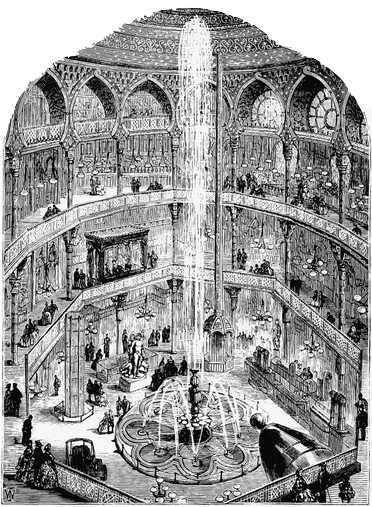
A drawing of the interior design, when The Royal Panopticon of Science and Art opened in 1854

池田光穂

語の定義と紹介

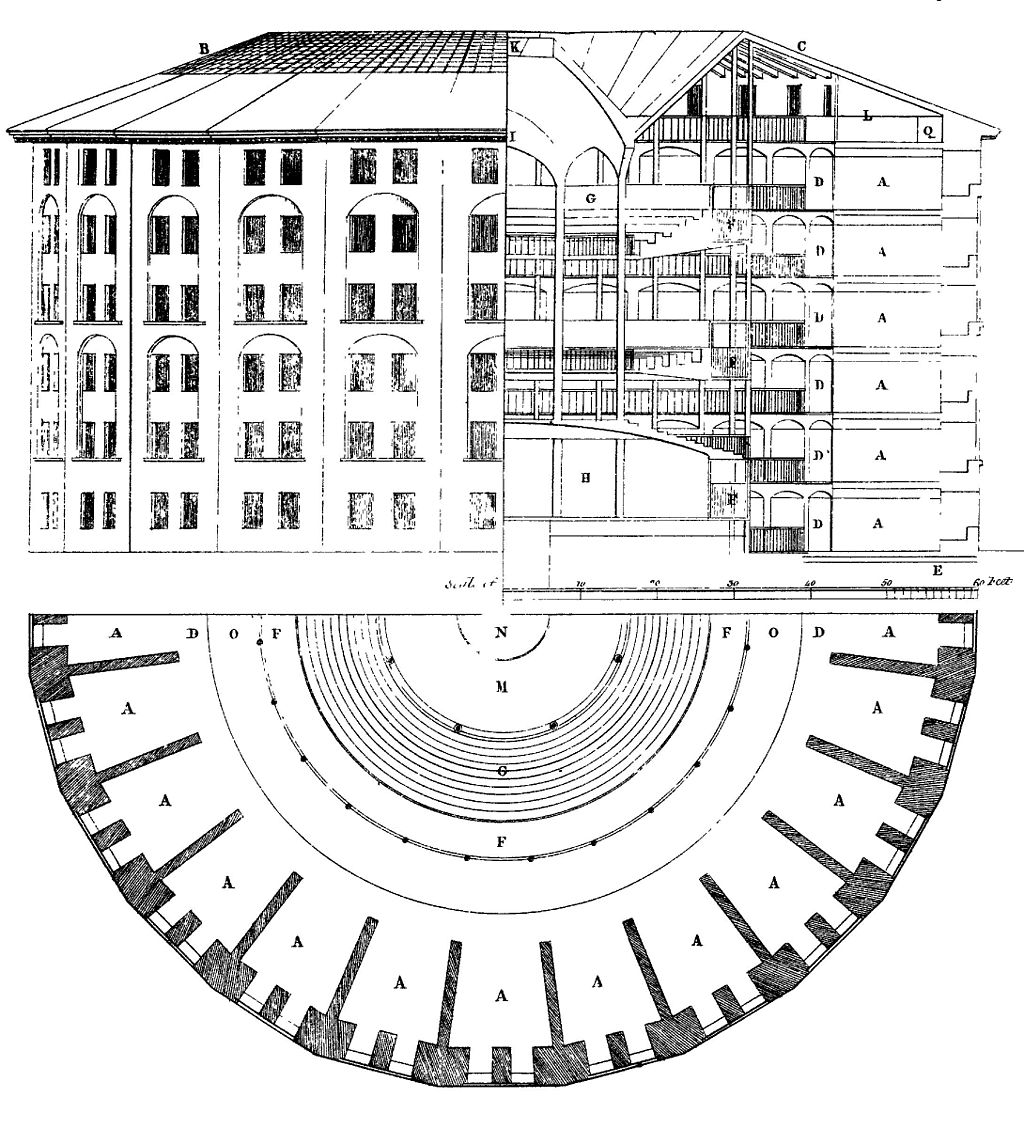
パノプティコン(panopticon)とは、ジェレ ミー・ベンサム(Jeremy Bentham, 1748-1747)が考案した、刑務所の監視システムで、展望監視装置とも呼ばれる。いわば、パノラマ](展望)と視覚=オプティ、装置=コン、というベンサムによる 造語である。ミッシェル・フーコーが自著『監視と処罰:監獄の誕生』のなか で、ベンサムを引用しながら、西欧の受刑制度が、身体刑から拘禁刑に「断絶」(=認識論的切断)的に移行し、なぜ、受刑者の身体の内面からの「改 心」が求められるようになったのか、また、それがなぜ外面の監視と観察によって「証明」されるようになったのかを、同時期の啓蒙初期の軍隊や学校制度など との考察から明らかにした時に、その契機となったものである。

"The panopticon is a type of institutional building and a system of control designed by the English philosopher and social theorist Jeremy Bentham in the 18th century. The concept of the design is to allow all prisoners of an institution to be observed by a single security guard, without the inmates being able to tell whether they are being watched. Although it is physically impossible for the single guard to observe all the inmates' cells at once, the fact that the inmates cannot know when they are being watched means that they are motivated to act as though they are being watched at all times. Thus, the inmates are effectively compelled to regulate their own behaviour. The architecture consists of a rotunda with an inspection house at its centre. From the centre, the manager or staff of the institution are able to watch the inmates. Bentham conceived the basic plan as being equally applicable to hospitals, schools, sanatoriums, and asylums, but he devoted most of his efforts to developing a design for a panopticon prison. It is his prison that is now most widely meant by the term "panopticon."-The panopticon.

  • パノプティコン(Wikipedia 英語版の翻訳解説)
  • パノプティコンスライド・ショー(以下)
600px

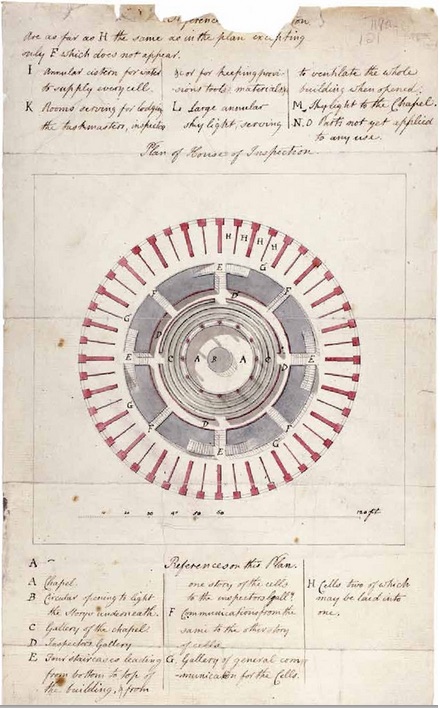
Plan of Jeremy Bentham's panopticon prison, drawn by Willey Reveley in 1791

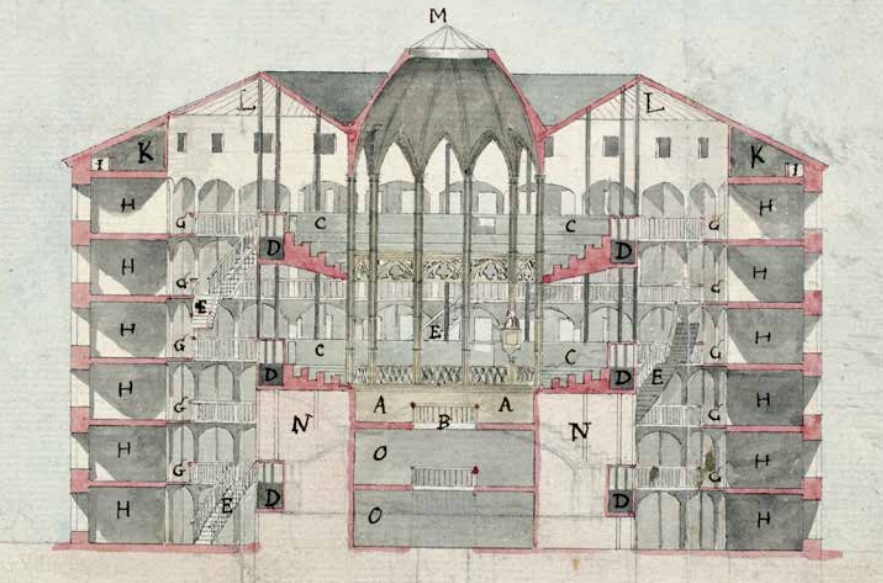
A drawing of a panopticon prison by Willey Reveley, circa 1791. The cells are marked with (H); a skylight (M) was to provide light and ventilation.[Bentham Papers 119a/119. UCL Press. p. 137.]

Elevated view of the panopticon prison, by Reveley 1791.[Bentham Papers 119a/119. UCL Press. p. 139.]

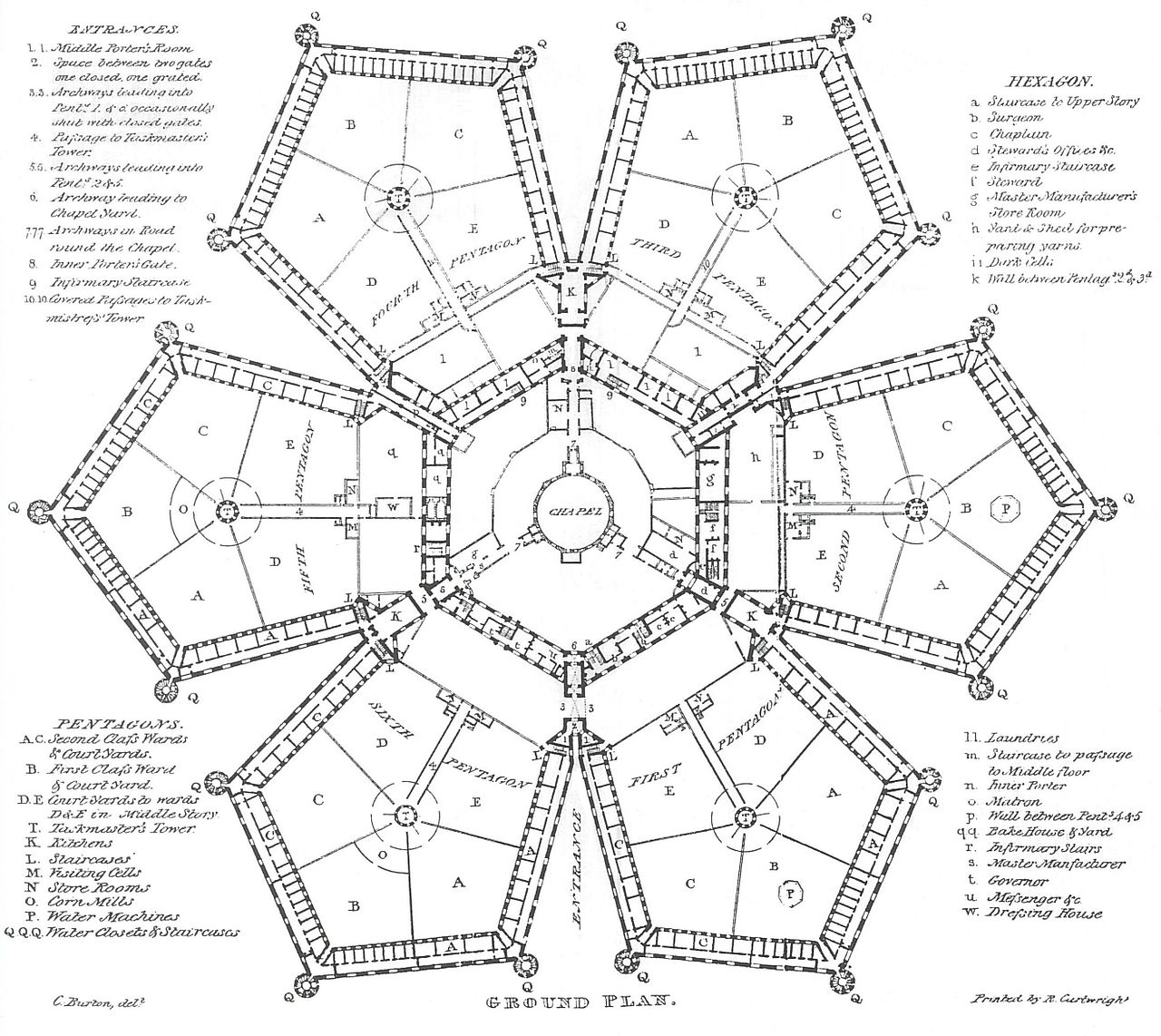
Plan of Millbank Prison: six pentagons with a tower at the centre are arranged around a chapel. - Millbank Prison was a prison in Millbank, Westminster, London, originally constructed as the National Penitentiary, and which for part of its history served as a holding facility for convicted prisoners before they were transported to Australia. It was opened in 1816 and closed in 1890.

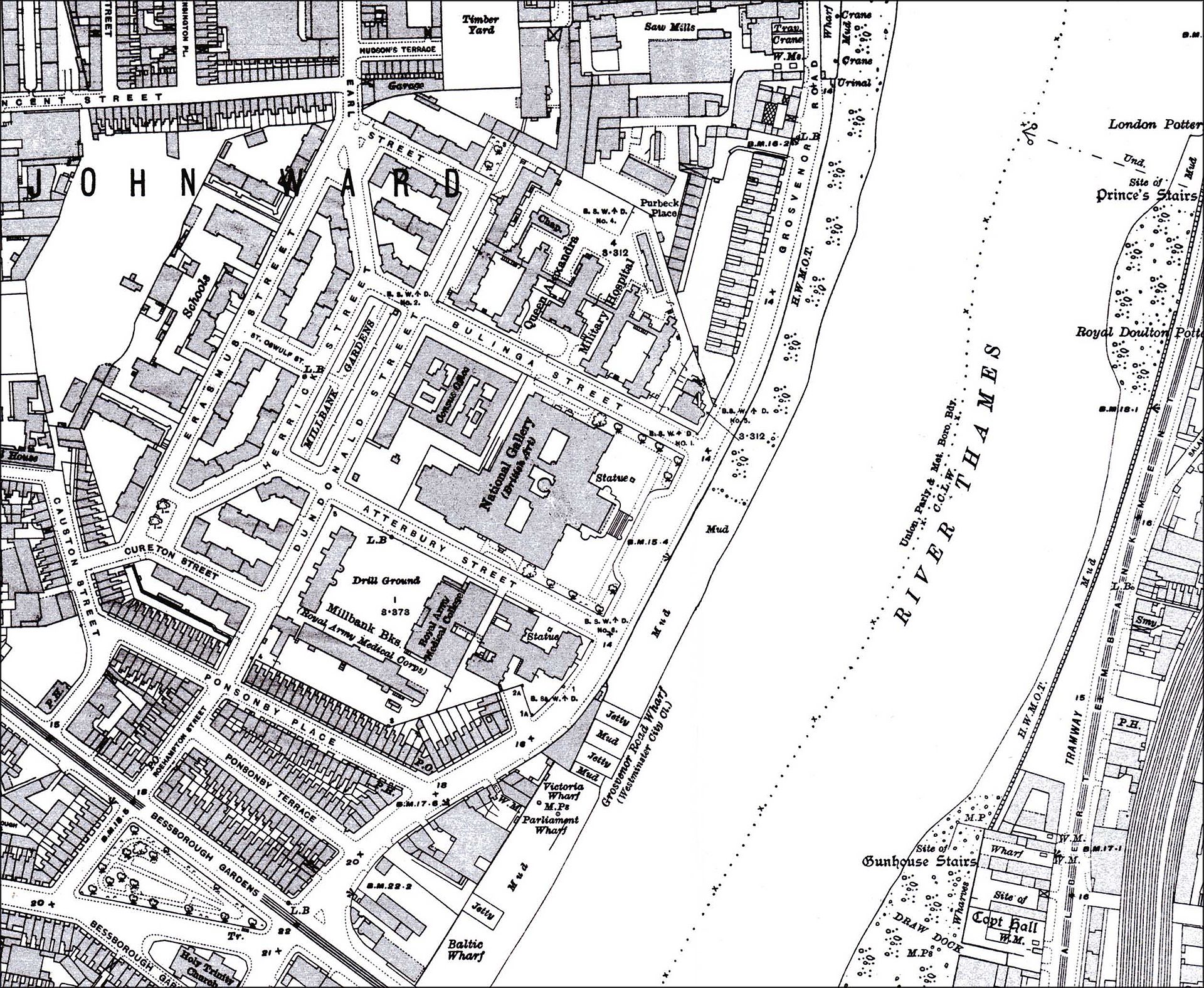
上掲の獄舎は1890年に閉鎖されて以 降、1916年の地図には、上掲のような獄舎のプランは見受けられない:The site of the prison in 1916, after redevelopment. Its outline is still visible in the pattern of streets and buildings.
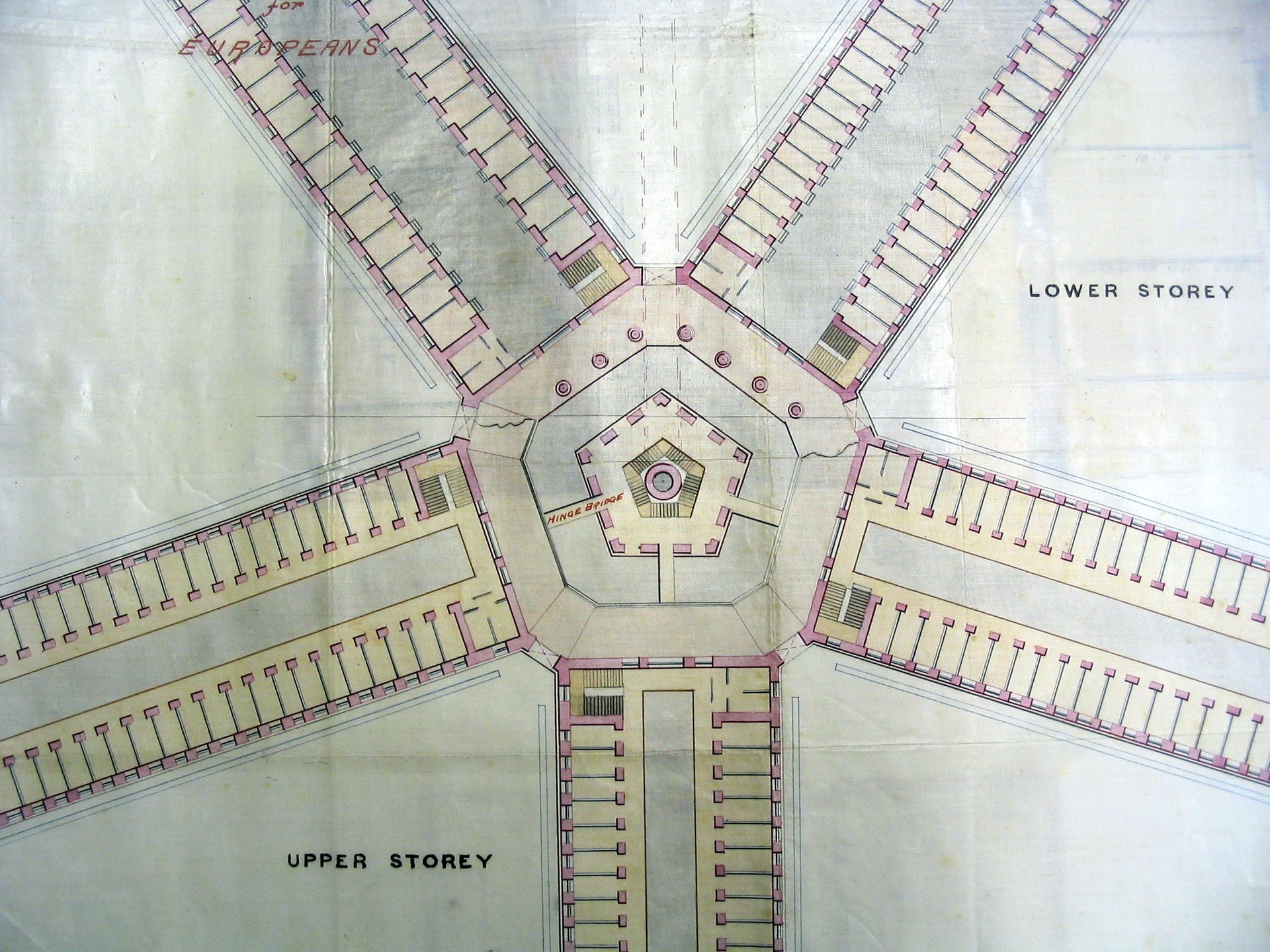
An 1880s architectural drawing by John Frederick Adolphus McNair depicting a proposed prison at Outram, Singapore that was never built.(設計図のみ)

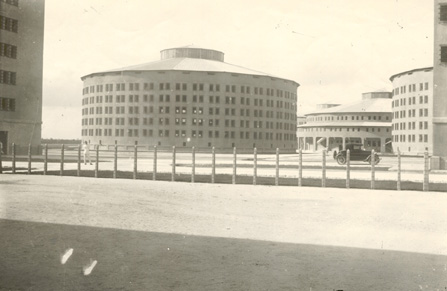
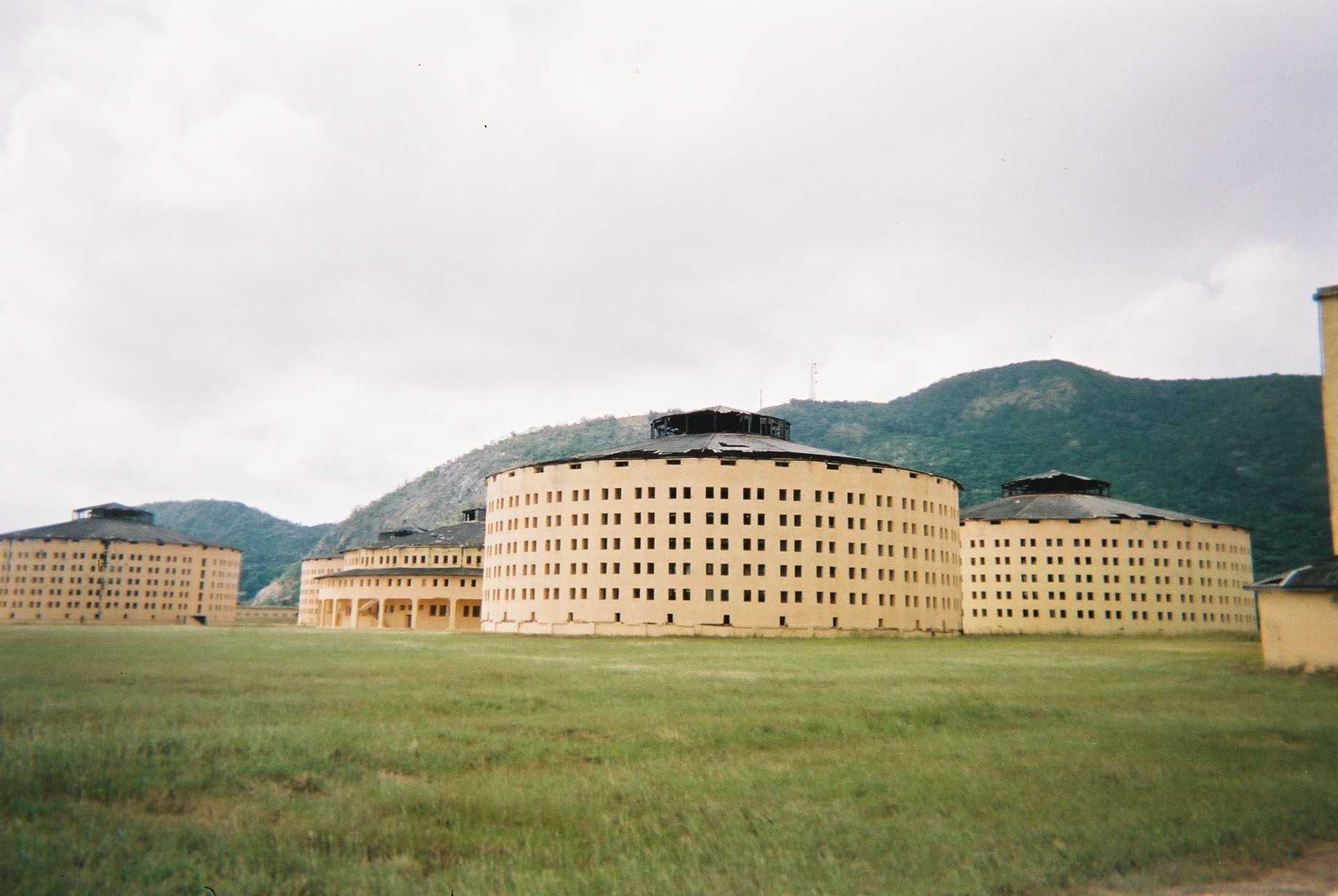
The Presidio Modelo was a "model prison" with panopticon design, built on Isla de Pinos (now the Isla de la Juventud) in Cuba. It is located in the suburban quarter of Chacón, Nueva Gerona.

The prison was built under the President-turned-dictator Gerardo Machado between 1926 and 1928.[1] The five circular blocks, with cells constructed in tiers around central observation posts, were built with the capacity to house up to 2,500 prisoners in humane conditions.
The Presidio Modelo was a "model prison" with panopticon design, built on Isla de Pinos (now the Isla de la Juventud) in Cuba. It is located in the suburban quarter of Chacón, Nueva Gerona.

フィデル・カストロや弟のラウルもモンカダ・バラック襲撃の罪で服役したが、革命後も使われ、1967年に閉鎖されたという:"After Fidel Castro's revolutionary triumph in 1959, Presidio Modelo remained in operation. By 1961, due to the overcrowded conditions (up to 4000 prisoners at one time), it was the site of various riots and hunger strikes, especially just before the Bay of Pigs invasion, when orders were given to line the tunnels underneath the entire prison with several tons of TNT.[4] Prominent Cuban political prisoners such as Armando Valladares,[5] Roberto Martín Pérez,[6] and Pedro Luis Boitel[7] were held there at one point or another during their respective incarcerations. It was permanently closed by the government in 1967.[1]"
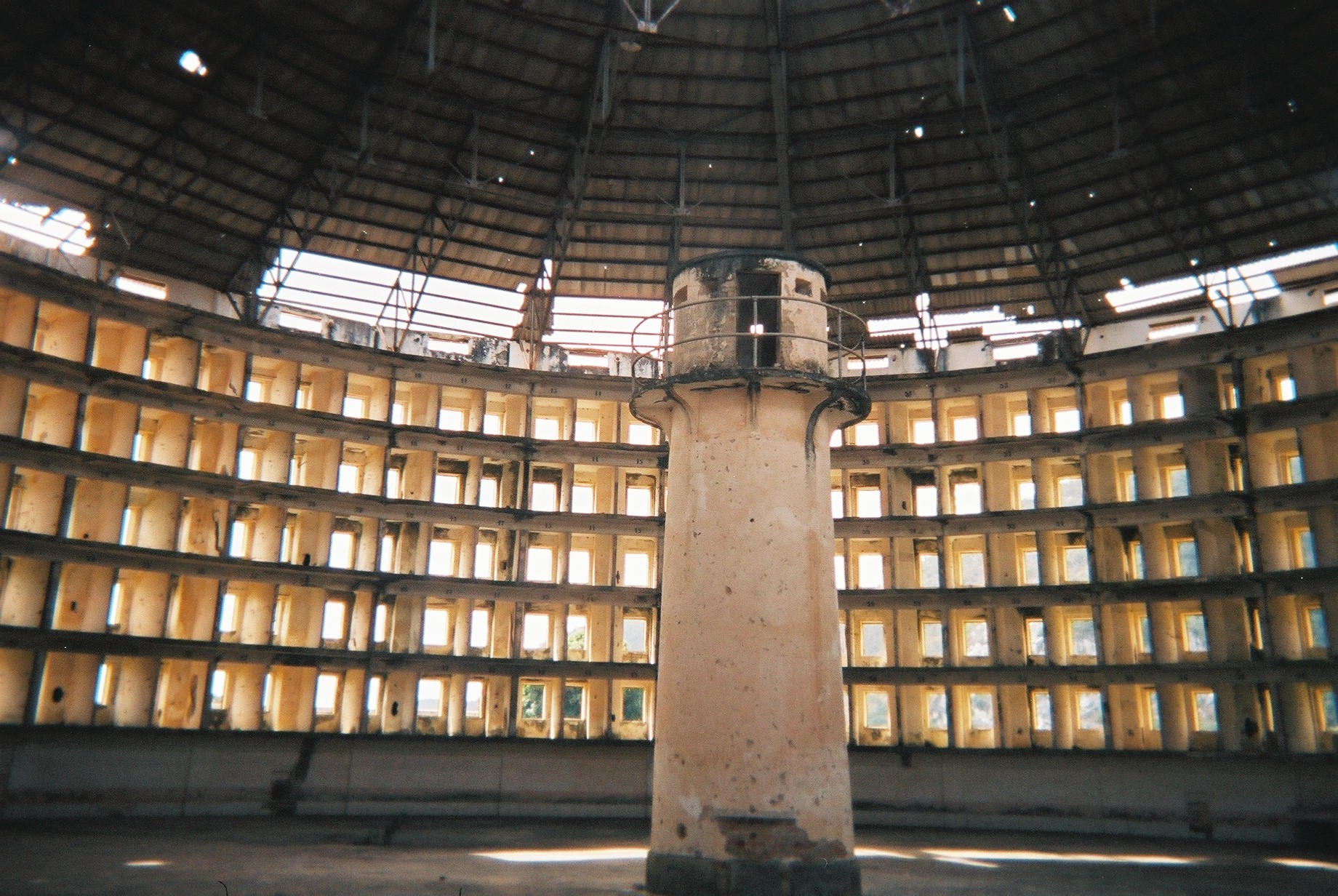
The Presidio Modeloの内景

Illinois State Penitentiary at Stateville, ner Joliet, Illinosis
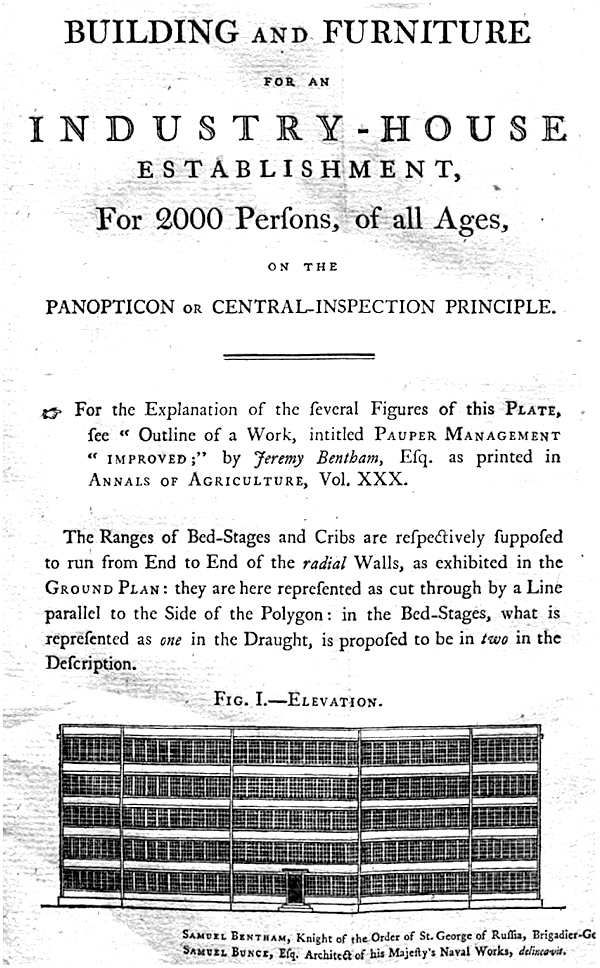
Bentham's 1812 industry-house for 2000 persons.
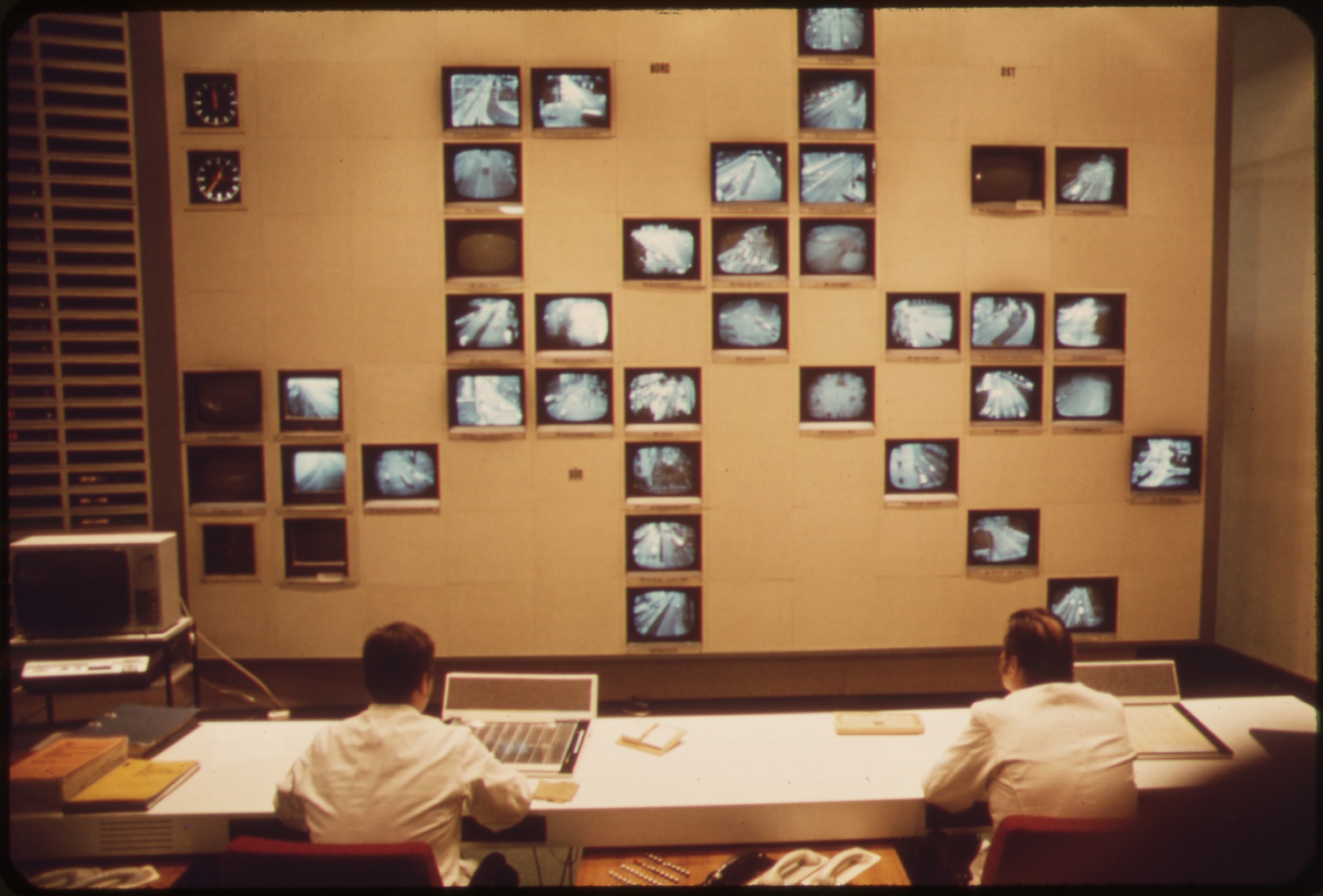
Closed circuit TV monitoring at the Central Police Control Station, Munich, 1973.

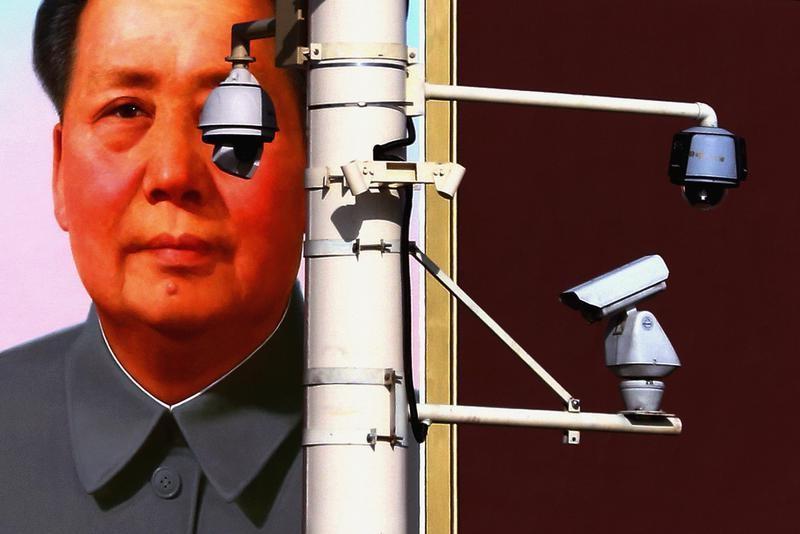
Modern scenery of a Chinese town in image(社会全体のパノプティコン化)

日本語の監視カメラの英訳は、CCTV(Closed-circuit television)あるいはビデオ監視システム(video surveillance)といわれる。
その歴史は古く、ソビエトにおけるテレビシステムの開発にまで、遡れるという。またナチスドイツのV-2ロケットの発射のモニター監視としてジーメンスも のが使われたという。米国ではベリコンというシステムが1949年から商用として発売されるようになる。

"An early mechanical CCTV system was developed in June 1927 by Russian physicist Léon Theremin[12] (cf. Television in the Soviet Union). Originally requested by the Soviet of Labor and Defense, the system consisted of a manually-operated scanning-transmitting camera and wireless shortwave transmitter and receiver, with a resolution of a hundred lines. Having been commandeered by Kliment Voroshilov, Theremin's CCTV system was demonstrated to Joseph Stalin, Semyon Budyonny, and Sergo Ordzhonikidze, and subsequently installed in the courtyard of the Moscow Kremlin to monitor approaching visitors.[12] Another early CCTV system was installed by Siemens AG at Test Stand VII in Peenemünde, Nazi Germany in 1942, for observing the launch of V-2 rockets.[13] In the U.S. the first commercial closed-circuit television system became available in 1949, called Vericon. Very little is known about Vericon except it was advertised as not requiring a government permit.[14]"

現在は、インターネットに接続するIPカメラの存在がある;"A growing branch in CCTV is internet protocol cameras (IP cameras). It is estimated that 2014 was the first year that IP cameras outsold analog cameras.[127] IP cameras use the Internet Protocol (IP) used by most Local Area Networks (LANs) to transmit video across data networks in digital form. IP can optionally be transmitted across the public internet, allowing users to view their cameras remotely on a computer or phone via an internet connection. For professional or public infrastructure security applications, IP video is restricted to within a private network or VPN.[128] IP cameras are considered part of the Internet of Things (IoT) and have many of the same benefits and security risks as other IP-enabled devices.[129]"

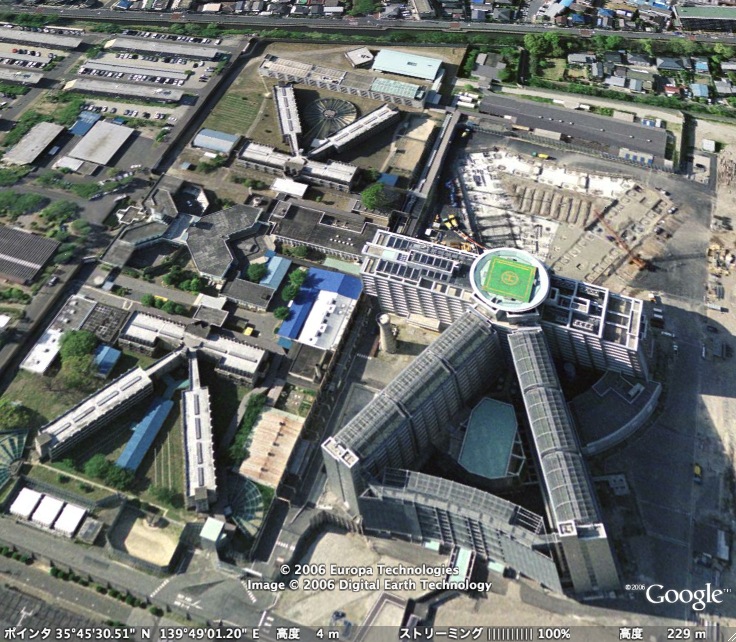
小菅にある、東京拘置所(上空から)

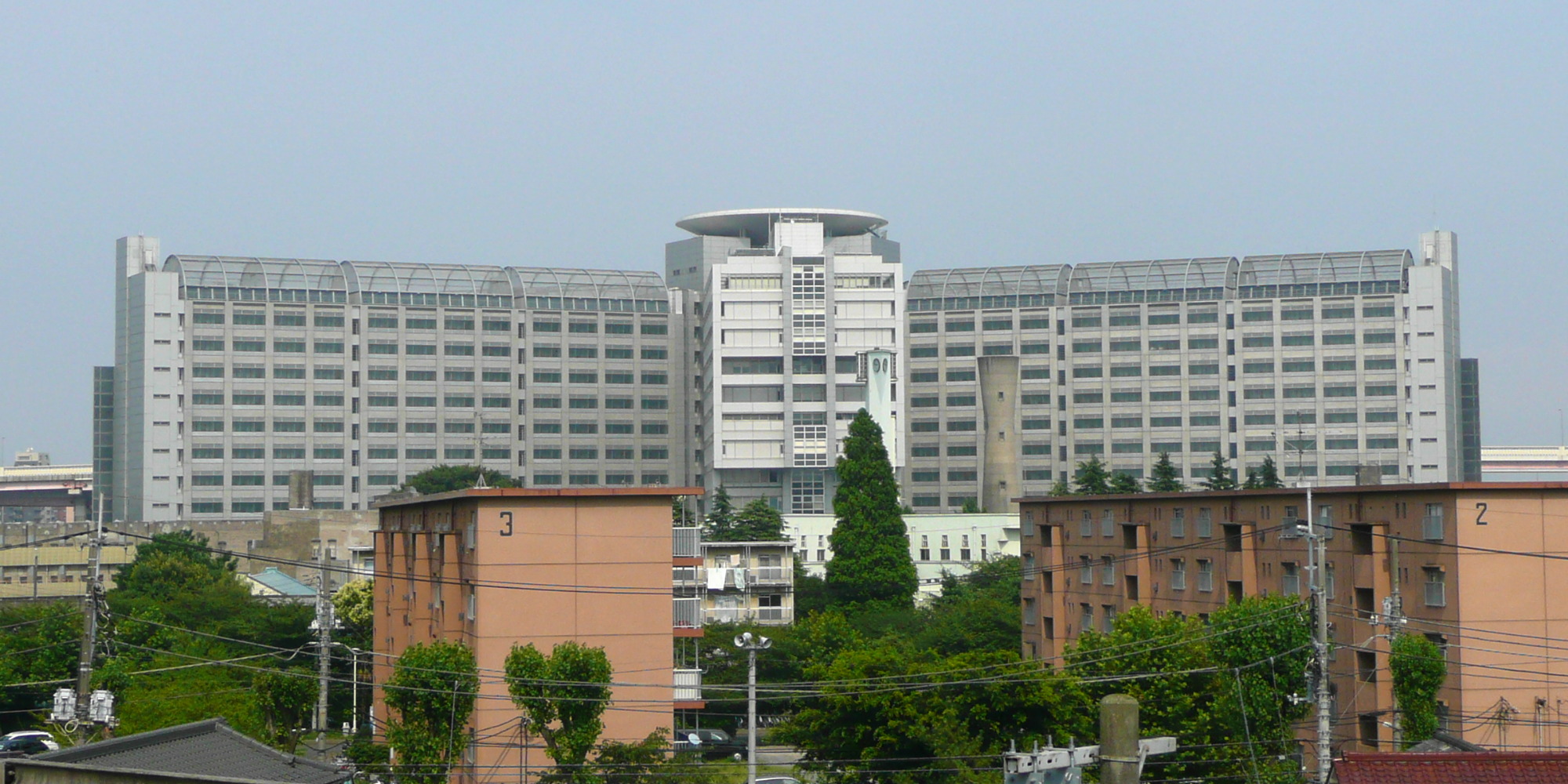
小菅にある、東京拘置所(地上から)

現代のパノプティコン、東海道山陽新幹線(N700S)——車内の監視カメラ(JRの用語では「防犯カメラ」という)- Closed-circuit television.

『修道女と修道士』 (1591)— コルネリス・ファン・ハールレム(Cornelis Corneliszoon van Haarlem, 1562-1638)——もしマニエリスムの時代に監視カメラがあるとこのような映像も手に入るかも。「16世紀のヨーロッパは、宗教や科学、政治や経済 など、社会や思想のあらゆる面から大きな動揺と不安の時代を迎え、精神的危機に直面していた。とくに前世紀以来、文芸復興の主導的役割を果たしたイタリア では、それらを典型的に美術発展に反映している。調和・均衡・安定を重んじる規範的理想美に対する反発から、自然の模倣を無視して主知的ともいえる主観主 義の傾向を強めていく。ラファエッロの晩年やミケランジェロの後期作品の影響も受けて、その様式は、洗練された技巧に加え、錯綜(さくそう)した空間構 成、ゆがんだ遠近法、強い調子の明暗法を駆使して、幻想的な寓意(ぐうい)的表現、異常なまでにゆがめられたプロポーションや激越な運動感の描出、幻惑す るような非現実的色彩法などをその特色とする」ニッポニカ)参照文献:若桑みどりマニエリスム芸術論』筑摩書房,1994年
https://en.wikipedia.org/wiki/Panopticon

The panopticon from Wikipedia.

The panopticon is a type of institutional building and a system of control designed by the English philosopher and social theorist Jeremy Bentham in the 18th century. The concept of the design is to allow all prisoners of an institution to be observed by a single security guard, without the inmates being able to tell whether they are being watched.

Although it is physically impossible for the single guard to observe all the inmates' cells at once, the fact that the inmates cannot know when they are being watched means that they are motivated to act as though they are being watched at all times. Thus, the inmates are effectively compelled to regulate their own behaviour. The architecture consists of a rotunda with an inspection house at its centre. From the centre, the manager or staff of the institution are able to watch the inmates. Bentham conceived the basic plan as being equally applicable to hospitals, schools, sanatoriums, and asylums, but he devoted most of his efforts to developing a design for a panopticon prison. It is his prison that is now most widely meant by the term "panopticon".
パノプティコンとは、18世紀にイギリスの哲学者・社会理論家ジェレ ミー・ベンサムが考案した施設建築の一種であり、管理システムのこと。設計のコンセプトは、施設のすべての囚人を一人の警備員が監視し、囚人は自分が監視 されているかどうかを知ることができないようにすることである。

一人の警備員がすべての受刑者の房を一度に観察することは物理的に不可能だが、受刑者は自分がいつ監視されているのか分からないということは、常に監視さ れているかのように行動するように動機付けられるということである。このように、受刑者は事実上、自らの行動を規制せざるを得ないのである。建築は、ロタ ンダを中心にインスペクションハウスを配置したものである。その中央から、施設の管理者や職員が受刑者を監視することができる。ベンサムは、この基本計画 を病院、学校、療養所、精神病院に等しく適用できると考えていたが、パノプティコン刑務所の設計に最も力を注いでいる。現在、「パノプティコン」という言 葉で最も広く知られているのは、このベンサムの監獄である。
The word panopticon derives from the Greek word for "all seeing" – panoptes.[3] In 1785, Jeremy Bentham, an English social reformer and founder of utilitarianism, travelled to Krichev in Mogilev Governorate of the Russian Empire (modern Belarus) to visit his brother, Samuel, who accompanied Prince Potemkin.[4]: xxxviii  Bentham arrived in Krichev in early 1786[5] and stayed for almost two years. While residing with his brother in Krichev, Bentham sketched out the concept of the panopticon in letters. Bentham applied his brother's ideas on the constant observation of workers to prisons. Back in England, Bentham, with the assistance of his brother, continued to develop his theory on the panopticon.[4]: xxxviii  Prior to fleshing out his ideas of a panopticon prison, Bentham had drafted a complete penal code and explored fundamental legal theory. While in his lifetime Bentham was a prolific letter writer, he published little and remained obscure to the public until his death.[4]: 385 

Bentham thought that the chief mechanism that would bring the manager of the panopticon prison in line with the duty to be humane would be publicity. Bentham tried to put his duty and interest junction principle into practice by encouraging a public debate on prisons. Bentham's inspection principle applied not only to the inmates of the panopticon prison, but also the manager. The unaccountable gaoler was to be observed by the general public and public officials. The apparently constant surveillance of the prison inmates by the panopticon manager and the occasional observation of the manager by the general public was to solve the age old philosophic question: "Who guards the guards?"[6]

Bentham continued to develop the panopticon concept, as industrialisation advanced in England and an increasing number of workers were required to work in ever larger factories.[7] Bentham commissioned drawings from an architect, Willey Reveley. Bentham reasoned that if the prisoners of the panopticon prison could be seen but never knew when they were watched, the prisoners would need to follow the rules. Bentham also thought that Reveley's prison design could be used for factories, asylums, hospitals, and schools.[8]

Bentham remained bitter throughout his later life about the rejection of the panopticon scheme, convinced that it had been thwarted by the king and an aristocratic elite. It was largely because of his sense of injustice and frustration that he developed his ideas of sinister interest – that is, of the vested interests of the powerful conspiring against a wider public interest – which underpinned many of his broader arguments for reform.[9]
1785年、イギリスの社会改革者であり功利主義の創始者であるジェレ ミー・ベンサムは、ポチョムキン公を伴っていた弟サミュエルを訪ねてロシア帝国モギレフ総督府(現在のベラルーシ)のクリチェフを訪れた[4]: xxxviii ベンサムは1786年の初めにクリチェフに到着し、約2年近く滞在した[5]。クリチェフに弟と滞在している間、ベンサムはパノプティコンの概念を手紙に スケッチしていた。ベンサムは、労働者の常時監視に関する兄の考えを刑務所に応用したのである。イングランドに戻ったベンサムは、弟の協力を得て、パノプ ティコンに関する理論を発展させ続けた[4]: xxxviii パノプティコン刑務所のアイデアを具体化する前に、ベンサムは完全な刑法を起草し、基本法理論を探求していたのである。生前、ベンサムは多量の書簡を書い たが、出版物はほとんどなく、死ぬまで一般には無名のままであった[4]。 385 

ベンサムは、パノプティコン刑務所の管理者を人道的であるべき義務に合致させる主なメカニズムは、公表であろうと考えた。ベンサムは、刑務所に関する公開 討論を促すことによって、その義務と利益の接合原理を実践しようとした。ベンサムの検査原則は、パノプティコン刑務所の収容者だけでなく、管理者にも適用 された。責任感のない看守は、一般市民や公職者に観察されることになった。パノプティコンの看守が刑務所の囚人を常に監視し、一般市民が時折看守を観察す ることで、古くからの哲学的な疑問が解決されることになった。"誰が看守を守るのか"[6]。

ベンサムは、イギリスで工業化が進み、ますます多くの労働者が大規模な工場で働くことを求められるようになると、パノプティコンの概念を発展させ続けた [7]。ベンサムは、建築家のウィリー・レヴェリーに図面を依頼した。ベンサムは、パノプティコン監獄の囚人たちが、見られることはあっても、いつ見られ ているのか分からないとしたら、囚人たちは規則に従わなければならないだろうと推理した。また、ベンサムは、レヴェリーの刑務所の設計は、工場、精神病 院、病院、学校にも使われるだろうと考えていた[8]。

ベンサムは、パノプティコン構想が否定されたことについて、晩年も苦言を呈し、国王と貴族のエリートによって妨害されたと確信していた。彼が不吉な利益、 つまり、より広い公共の利益に対して共謀する権力者の既得権益についての考えを発展させたのは、主に彼の不正義とフラストレーションの感覚によるものであ り、改革に対する彼の幅広い議論の多くを支えた[9]。
Prison design
The Building circular – an iron cage, glazed – a glass lantern about the size of Ranelagh – The Prisoners in their Cells, occupying the Circumference – The Officers, the Centre. By Blinds, and other contrivances, the Inspectors concealed from the observation of the Prisoners: hence the sentiment of a sort of invisible omnipresence. – The whole circuit reviewable with little, or, if necessary, without any, change of place.[10]

— Jeremy Bentham (1791). Panopticon, or The Inspection House

Bentham's proposal for a panopticon prison met with great interest among British government officials not only because it incorporated the pleasure-pain principle developed by the materialist philosopher Thomas Hobbes, but also because Bentham joined the emerging discussion on political economy. Bentham argued that the confinement of the prison, "which is his punishment, preventing [the prisoner from] carrying the work to another market."[clarification needed – missing verb] Key to Bentham's proposals and efforts to build a panopticon prison in Millbank at his own expense, was the "means of extracting labour" out of prisoners in the panopticon.[11] In his 1791 writing Panopticon, or The Inspection House, Bentham reasoned that those working fixed hours needed to be overseen.[12] Also, in 1791, Jean Philippe Garran de Coulon presented a paper on Bentham's panopticon prison concepts to the National Legislative Assembly in revolutionary France.[13]

In 1812, persistent problems with Newgate Prison and other London prisons prompted the British government to fund the construction of a prison in Millbank at the taxpayers' expense. Based on Bentham's panopticon plans, the National Penitentiary opened in 1821. Millbank Prison, as it became known, was controversial, even blamed for causing mental illness among prisoners[citation needed]. Nevertheless, the British government placed an increasing emphasis on prisoners doing meaningful work, instead of engaging in humiliating and meaningless kill-times.[11] Bentham lived to see Millbank Prison built and did not support the approach taken by the British government. His writings had virtually no immediate effect on the architecture of taxpayer-funded prisons that were to be built. Between 1818 and 1821, a small prison for women was built in Lancaster. It has been observed that the architect Joseph Gandy modelled it very closely on Bentham's panopticon prison plans. The K-wing near Lancaster Castle prison is a semi-rotunda with a central tower for the supervisor and five storeys with nine cells on each floor.[14]

It was the Pentonville prison, which was built in London after Bentham's death in 1832, that was to serve as a model for a further 54 prisons in Victorian Britain. Built between 1840 and 1842 according to the plans of Joshua Jebb, Pentonville prison had a central hall with radial prison wings.[14] It has been claimed that Bentham's panopticon influenced the radial design of 19th-century prisons built on the principles of the "separate system", including Eastern State Penitentiary in Philadelphia, which opened in 1829.[15] But the Pennsylvania–Pentonville architectural model with its radial prison wings was not designed to facilitate constant surveillance of individual prisoners. Guards had to walk from the hall along the radial corridors and could only observe prisoners in their cells by looking through the cell door's peephole.[16]

In 1925, Cuba's president Gerardo Machado set out to build a modern prison, based on Bentham's concepts and employing the latest scientific theories on rehabilitation. A Cuban envoy tasked with studying US prisons in advance of the construction of Presidio Modelo had been greatly impressed with Stateville Correctional Center in Illinois and the cells in the new circular prison were too faced inwards towards a central guard tower. Because of the shuttered guard tower, the guards could see the prisoners, but the prisoners could not see the guards. Cuban officials theorised that the prisoners would "behave" if there was a probable chance that they were under surveillance, and once prisoners behaved, they could be rehabilitated.

Between 1926 and 1931, the Cuban government built four such panopticons connected with tunnels to a massive central structure that served as a community centre. Each panopticon had five floors with 93 cells. In keeping with Bentham's ideas, none of the cells had doors. Prisoners were free to roam the prison and participate in workshops to learn a trade or become literate, with the hope being that they would become productive citizens. However, by the time Fidel Castro was imprisoned at Presidio Modelo, the four circulars were packed with 6,000 men, every floor was filled with trash, there was no running water, food rations were meagre, and the government supplied only the bare necessities of life.[17]

In the Netherlands Breda, Arnhem and Haarlem penitentiary are cited as historic panopticon prisons. However, these circular prisons with their 400 or so cells fail as panopticons because the inwards-facing cell windows were so small that guards could not see the entire cell. The lack of surveillance that was actually possible in prisons with small cells and doors discounts many circular prison designs from being a panopticon as it had been envisaged by Bentham.[18] In 2006, one of the first digital panopticon prisons opened near Amsterdam. Every prisoner in the Lelystad Prison wears an electronic tag and by design, only six guards are needed for 150 prisoners instead of the usual 15 or more.[18]
監獄の設計
円形の建物 - ガラス張りの鉄の檻 - ラネラーほどの大きさのガラスのランタン - 独房にいる囚人たち - 円周を占める - 中央の役人たち。ブラインドやその他の仕掛けによって、監察官は囚人の目から隠されている。それゆえ、ある種の目に見えない遍在という感情が生まれる。- 全周囲は、ほとんど、あるいは必要であれば全く場所を変えることなく、見直すことができる[10]。

- ジェレミー・ベンサム(1791)。パノプティコン,または検査所

ベンサムのパノプティコン監獄の提案は、唯物論哲学者トマス・ホッブズが開発した快楽と苦痛の原理を取り入れただけでなく、ベンサムが政治経済に関する新 しい議論に加わったことで、英国政府関係者の大きな関心を集めた。ベンサムは、刑務所の閉じ込めが「彼の罰であり、(囚人が)仕事を他の市場に運ぶことを 妨げる」[clarification needed - missing verb] と主張した。ベンサムの提案と自費でミルバンクにパノプティコン刑務所を建設する努力の鍵は、パノプティコンで囚人から「労働力を抽出する手段」であった [11]。 [11] 1791年に書いた『パノプティコン、あるいは検査所』の中で、ベンサムは、一定時間働く者は監視される必要があると推論していた[12] また、1791年にジャン・フィリップ・ガラン・ド・クーロンは、革命期のフランスの国民立法議会にベンサムのパノプティコン刑務所の構想に関する論文を 提出している[13]。

1812年、ニューゲート刑務所をはじめとするロンドンの刑務所に根強い問題があったため、英国政府はミルバンクに税金を投入して刑務所を建設することに なった。ベンサムのパノプティコン計画に基づき、1821年に開所したのが国立刑務所である。ミルバンク刑務所は、受刑者の精神疾患を引き起こすとまで非 難され、物議を醸した[citation needed]。それにもかかわらず、イギリス政府は、屈辱的で無意味な殺害時間に従事する代わりに、意味のある仕事をする囚人にますます重点を置くよう になった[11] ベンサムはミルバンク刑務所の建設を見るまで生きていたが、イギリス政府が取ったアプローチを支持しなかった。彼の著作は、税金で建設されることになった 刑務所の建築に即座に影響を与えることはほぼなかった。1818年から1821年にかけて、ランカスターに女性用の小さな刑務所が建設された。建築家ジョ セフ・ガンディが、ベンサムのパノプティコン監獄の計画に非常に近い形でモデル化したことが観察されています。ランカスター城刑務所の近くにあるK棟は、 監督官のための中央塔と、各階に9つの独房を持つ5階建ての半円形のロタンダである[14]。

1832年のベンサムの死後、ロンドンに建設されたペントンビル刑務所が、ヴィクトリア朝の英国でさらに54の刑務所のモデルとなることになった。 1829年に開所したフィラデルフィアのイースタン州立刑務所など、「分離システム」の原則に基づいて建てられた19世紀の刑務所の放射状のデザインに、 ベンサムのパノプティコンが影響を与えたと主張されている[15]。 しかし、放射状の囚人の翼を持つペンシルバニア・ペントンビル建築モデルは、個々の囚人を常に監視できるようには設計されていなかった。看守はホールから 放射状の廊下に沿って歩かなければならず、独房のドアの覗き穴から覗くことによってのみ、独房内の囚人を観察することができた[16]。

1925年、キューバ大統領ゲラルド・マチャドは、ベンサムの概念に基づき、最新のリハビリテーション科学理論を取り入れた近代的な刑務所の建設に着手し た。プレシディオ・モデルの建設に先立ち、アメリカの刑務所を調査したキューバの使節は、イリノイ州のステートビル矯正所に大きな感銘を受けたといい、新 しい円形の刑務所の独房は、中央の監視塔に向かって内側に向きすぎていた。シャッター付きの監視塔のため、看守は囚人を見ることができるが、囚人は看守を 見ることができない。キューバ政府は、監視されている可能性が高ければ囚人は「ふるまう」だろうし、囚人がふるえれば更生させることができる、と理論化し たのである。

1926年から1931年にかけて、キューバ政府はこのようなパノプティコンを4つ建設し、中央の巨大な建造物とトンネルでつないでコミュニティセンター として使用した。各パノプティコンは5階建てで、93の独房があった。ベンサムの思想に基づき、どの部屋にも扉はなかった。囚人たちは自由に刑務所を歩き 回り、職業訓練や識字のためのワークショップに参加し、生産的な市民となることを望んだ。しかし、フィデル・カストロがプレシディオ・モデロに収監される 頃には、4つの円形に6000人が詰め込まれ、どの階もゴミだらけ、水道はなく、食料配給はわずかで、政府は生活に必要な最低限のものだけを供給していた [17]。

オランダでは、ブレダ、アーネム、ハーレム刑務所が歴史的なパノプティコン刑務所として挙げられている。しかし、これらの円形の刑務所の400ほどの独房 は、内向きの独房の窓が小さく、看守が独房全体を見渡すことができなかったため、パノプティコンとしては失敗している。小さな独房とドアを持つ刑務所で実 際に可能だった監視の欠如は、多くの円形刑務所のデザインをベンサムが想定していたパノプティコンから割り引いた。 2006年、最初のデジタルパノプティコン刑務所のひとつがアムステルダム近郊に開設された[18]。レリスタッド刑務所の囚人は全員電子タグを身につけ ており、設計上、通常15人以上必要な看守が150人に対してわずか6人で済むようになっている[18]。


Architecture of other institutions

Bentham's 1812 industry-house for 2000 persons
Jeremy Bentham's panopticon architecture was not original, as rotundas had been used before, as for example in industrial buildings. However, Bentham turned the rotund architecture into a structure with a societal function, so that humans themselves became the object of control.[19] The idea for a panopticon had been prompted by his brother Samuel Bentham's work in Russia and had been inspired by existing architectural traditions. Samuel Bentham had studied at the Ecole Militaire in 1751, and at about 1773 the prominent French architect Claude-Nicolas Ledoux had finished his designs for the Royal Saltworks at Arc-et-Senans.[20] William Strutt in cooperation with his friend Jeremy Bentham built a round mill in Belper, so that one supervisor could oversee an entire shop floor from the centre of the round mill. The mill was built between 1803 and 1813 and was used for production until the late 19th century. It was demolished in 1959.[21] In Bentham's 1812 writing Pauper management improved: particularly by means of an application of the Panopticon principle of construction, he included a building for an "industry-house establishment" that could hold 2000 persons.[22] In 1812 Samuel Bentham, who had by then risen to brigardier-general, tried to persuade the British Admiralty to construct an arsenal panopticon in Kent. Before returning home to London he had constructed a panopticon in 1807, near St Petersburg, which served as a training centre for young men wishing to work in naval manufacturing.[23] The panopticon, Bentham writes:

will be found applicable, I think, without exception to all establishments whatsoever, in which within a space not too large to be covered or commanded by buildings, a number of persons are meant to be kept under inspections. No matter how different or even opposite the purpose.[24]

— Jeremy Bentham (1791). Panopticon, or The Inspection House

A plate by Pugin
Despite the fact that no panopticon was built during Bentham's lifetime, the principles he established on the panopticon prompted considerable discussion and debate. Shortly after Jeremy Bentham's death in 1832 his ideas were criticised by Augustus Pugin, who in 1841 published the second edition of his work Contrasts in which one plate showed a "Modern Poor House". He contrasted an English medieval gothic town in 1400 with the same town in 1840 where broken spires and factory chimneys dominate the skyline, with a panopticon in the foreground replacing the Christian hospice. Pugin, who went on to become one of the most influential 19th-century writers on architecture, was influenced by Hegel and German idealism.[25] In 1835 the first annual report of the Poor Law Commission included two designs by the commission's architect Sampson Kempthorne. His Y-shape and cross-shape designs for workhouse expressed the panopticon principle by positioning the master's room as central point. The designs provided for the segregation of occupants and maximum visibility from the centre.[26] Professor David Rothman came to the conclusion that Bentham's panopticon prison did not inform the architecture of early asylums in the United States.[27]
その他の施設の建築

ベンサムによる1812年の2000人収容の産業会館
ジェレミー・ベンサムのパノプティコン建築は、それ以前にも工業用建物などで使われていたため、独創的なものではない。しかし、ベンサムは、ロタンダ建築 を社会的機能を持つ構造に変え、人間そのものが管理の対象となった[19]。パノプティコンのアイデアは、弟のサミュエル・ベンサムのロシアでの仕事に促 されて、既存の建築の伝統に触発されたものであった。Samuel Benthamは1751年にEcole Militaireで学び、1773年頃にはフランスの著名な建築家Claude-Nicolas LedouxがArc-et-SenansのRoyal Saltworksの設計を終えていました[20] William Struttと彼の友人Jeremy Benthamはベルパーに円形の工場を建設し、1人の監督者が円形の工場の中心から工場全体を見渡すことができるようにしました。この工場は1803年 から1813年にかけて建設され、19世紀後半まで生産に使われました。ベンサムの1812年の著作では、貧困層の管理が改善され、特にパノプティコン建 築の原理を応用して、2000人を収容できる「産業施設」のための建物が含まれていた[22]。 1812年、その頃准将に昇進していたサミュエル・ベンサムは、ケントに造兵場のパノプティコン建設をイギリス提督に説得しようとした。ロンドンに帰る前 に、彼は1807年にサンクトペテルブルクの近くにパノプティコンを建設し、海軍の製造業で働くことを希望する若者のトレーニングセンターとして機能させ ていた[23]。

パノプティコンは、建物で覆われたり、指揮されたりするには大きすぎない空間の中で、多くの人が監視下に置かれることを意図している、あらゆる施設に例外なく適用されることが見つかると思う。目的がいかに異なっていても、あるいは正反対であってもだ[24]。

- ジェレミー・ベンサム(1791年)。パノプティコン、または監察所

ピュージン作のプレート
ベンサムが生きている間にパノプティコンが建設されることはなかったが、彼が確立したパノプティコンの原理は、多くの議論と討論を促した。1832年にベ ンサムが亡くなって間もなく、彼の考えを批判したのがオーガスタス・プーギンで、彼は1841年に『対比』の第2版を出版し、その中の1枚に「現代の貧し い家」が描かれている。彼は、1400年のイギリスの中世ゴシック様式の町と、1840年の同じ町を対比させ、壊れた尖塔と工場の煙突がスカイラインを支 配し、前景にはキリスト教のホスピスに代わってパノプティコンが描かれていることを指摘した。プーギンは、19世紀の最も影響力のある建築家の一人とな り、ヘーゲルとドイツ観念論の影響を受けた[25]。1835年、貧困法委員会の最初の年次報告書には、委員会の建築家サンプソン・ケンプソーンによる二 つの設計が含まれている。彼のY字型と十字型のワークハウスの設計は、主人の部屋を中心に据えることでパノプティコンの原理を表現していた。設計は、居住 者の隔離と中心からの最大限の可視性を提供した[26]。デイヴィッド・ロスマン教授は、ベンサムのパノプティコン監獄はアメリカの初期の精神病院の建築 に影響を与えていないという結論に至った[27]。
Criticism and use as metaphor
In 1965, the conservative historian Shirley Robin Letwin traced the Fabian zest for social planning to early utilitarian thinkers. She argued that Bentham's pet gadget, the panopticon prison, was a device of such monstrous efficiency that it left no room for humanity. She accused Bentham of forgetting the dangers of unrestrained power and argued that "in his ardour for reform, Bentham prepared the way for what he feared". Recent Libertarian thinkers began to regard Bentham's entire philosophy as having paved the way for totalitarian states.[28] In the late 1960s, the American historian Gertrude Himmelfarb, who had published The Haunted House of Jeremy Bentham in 1965, was at the forefront of depicting Bentham's mechanism of surveillance as a tool of oppression and social control.[29][28] David John Manning published The Mind of Jeremy Bentham in 1986, in which he reasoned that Bentham's fear of instability caused him to advocate ruthless social engineering and a society in which there could be no privacy or tolerance for the deviant.[28]

In the mid-1970s, the panopticon was brought to the wider attention by the French psychoanalyst Jacques-Alain Miller and the French philosopher Michel Foucault.[30] In 1975, Foucault used the panopticon as metaphor for the modern disciplinary society in Discipline and Punish. He argued that the disciplinary society had emerged in the 18th century and that discipline are techniques for assuring the ordering of human complexities, with the ultimate aim of docility and utility in the system.[31] Foucault first came across the panopticon architecture when he studied the origins of clinical medicine and hospital architecture in the second half of the 18th century. He argued that discipline had replaced the pre-modern society of kings, and that the panopticon should not be understood as a building, but as a mechanism of power and a diagram of political technology.[31]

Foucault argued that discipline had already crossed the technological threshold in the late 18th century, when the right to observe and accumulate knowledge had been extended from the prison to hospitals, schools, and later factories.[31] In his historic analysis, Foucault reasoned that with the disappearance of public executions pain had been gradually eliminated as punishment in a society ruled by reason.[31] The modern prison in the 1970s, with its corrective technology, was rooted in the changing legal powers of the state. While acceptance for corporal punishment diminished, the state gained the right to administer more subtle methods of punishment, such as to observe.[31] The French sociologist Henri Lefebvre studied urban space and Foucault's interpretation of the panopticon prison, arriving at the conclusion that spatiality is a social phenomenon. Lefebvre contended that architecture is no more than the relationship between the panopticon, people, and objects. In urban studies, academics such as Marc Schuilenburg now argue that a different self-consciousness arises among humans who live in an urban area.[32]


Wall of an industrial building in Donetsk, Ukraine
In 1984, Michael Radford gained international attention for the cinematographic panopticon he had staged in the film Nineteen Eighty-Four. Of the telescreens in the landmark surveillance narrative Nineteen Eighty-Four (1949), George Orwell said: "there was of course no way of knowing whether you were being watched at any given moment ... you had to live ... in the assumption that every sound you made was overheard, and, except in darkness, every movement scrutinised".[33] In Radford's film the telescreens were bidirectional and in a world with an ever increasing number of telescreen devices the citizens of Oceania were spied on more than they thought possible.[34] In The Electronic Eye: The Rise of Surveillance Society (1994) the sociologist David Lyon concluded that "no single metaphor or model is adequate to the task of summing up what is central to contemporary surveillance, but important clues are available in Nineteen Eighty-Four and in Bentham's panopticon".[35]

The French philosopher Gilles Deleuze shaped the emerging field of surveillance studies with the 1990 essay Postscript on the Societies of Control.[36]: 21  Deleuze argued that the society of control is replacing the discipline society. With regards to the panopticon, Deleuze argued that "enclosures are moulds ... but controls are a modulation". Deleuze observed that technology had allowed physical enclosures, such as schools, factories, prisons and office buildings, to be replaced by a self-governing machine, which extends surveillance in a quest to manage production and consumption. Information circulates in the control society, just like products in the modern economy, and meaningful objects of surveillance are sought out as forward-looking profiles and simulated pictures of future demands, needs and risks are drawn up.[36]: 27 

In 1997, Thomas Mathiesen in turn expanded on Foucault's use of the panopticon metaphor when analysing the effects of mass media on society. He argued that mass media such as broadcast television gave many people the ability to view the few from their own homes and gaze upon the lives of reporters and celebrities. Mass media has thus turned the discipline society into a viewer society.[37] In the 1998 satirical science fiction film The Truman Show, the protagonist eventually escapes the OmniCam Ecosphere, the reality television show that, unknown to him, broadcasts his life around the clock and across the globe. But in 2002, Peter Weibel noted that the entertainment industry does not consider the panopticon as a threat or punishment, but as "amusement, liberation and pleasure". With reference to the Big Brother television shows of Endemol Entertainment, in which a group of people live in a container studio apartment and allow themselves to be recorded constantly, Weibel argued that the panopticon provides the masses with "the pleasure of power, the pleasure of sadism, voyeurism, exhibitionism, scopophilia, and narcissism". In 2006, Shoreditch TV became available to residents of the Shoreditch in London, so that they could tune in to watch CCTV footage live. The service allowed residents "to see what's happening, check out the traffic and keep an eye out for crime".[38]

In their 2004 book Welcome to the Machine: Science, Surveillance, and the Culture of Control, Derrick Jensen and George Draffan called Bentham "one of the pioneers of modern surveillance" and argued that his panopticon prison design serves as the model for modern supermaximum security prisons, such as Pelican Bay State Prison in California.[39] In the 2015 book Dark Matters: On the Surveillance of Blackness, Simone Browne noted that Bentham travelled on a ship carrying slaves as cargo while drafting his panopticon proposal. She argues that the structure of chattel slavery haunts the theory of the panopticon. She proposes that the 1789 plan of the slave ship Brookes should be regarded as the paradigmatic blueprint.[40] Drawing on Didier Bigo's Banopticon, Brown argues that society is ruled by exceptionalism of power, where the state of emergency becomes permanent and certain groups are excluded on the basis of their future potential behaviour as determined through profiling.[41]
批判と比喩としての使われ方
1965年、保守派の歴史家シャーリー・ロビン・レットウィンは、フェビアンによる社会計画への熱意を初期の功利主義思想家まで遡及させた。彼女は、ベン サムの愛用したパノプティコン監獄は、人間性の入り込む余地がないほど巨大な効率を持つ装置であると主張した。彼女は、ベンサムが無制限の権力の危険性を 忘れていると非難し、「改革への熱意が、ベンサムが恐れていたものへの道を用意した」と論じた。最近のリバタリアン思想家たちは、ベンサムの哲学全体が全 体主義国家への道を開いたとみなすようになった[28]。 1960年代後半、1965年に『ジェレミー・ベンサムの幽霊屋敷』を出版したアメリカの歴史家ガートルード・ヒメルファーブは、ベンサムの監視機構を抑 圧と社会統制の道具として描写する最前線に立っていた[29]。 [29][28] デイヴィッド・ジョン・マニングは1986年に『ジェレミー・ベンサムの心』を出版し、ベンサムの不安定さに対する恐怖が冷酷な社会工学とプライバシーや 逸脱者に対する寛容さが存在し得ない社会を提唱させたと推論している[28]。

1970年代半ばに、パノプティコンはフランスの精神分析家ジャック=アラン・ミラーとフランスの哲学者ミシェル・フーコーによって広く注目されるように なった[30]。 1975年にフーコーは『規律と罰』で現代の規律社会の隠喩としてパノプティコンを使っていた。彼は規律社会が18世紀に出現し、規律は人間の複雑な秩序 を保証するための技術であり、最終的な目的はシステムにおける従順さと有用性であると主張した[31] フーコーは18世紀後半に臨床医学と病院建築の起源を研究する際にパノプティコン建築に初めて遭遇している。彼は規律が前近代の王様の社会に取って代わっ たと主張し、パノプティコンは建築物としてではなく、権力のメカニズムや政治技術の図式として理解されるべきであるとした[31]。

フーコーは、観察し知識を蓄積する権利が刑務所から病院、学校、そして後に工場へと拡張された18世紀後半に、規律はすでに技術的な閾値を越えていたと主 張していた[31]。彼の歴史分析において、フーコーは公開処刑の消滅とともに痛みが理性によって支配された社会における罰として徐々に排除されたと推論 した。 1970年代の修正技術を備えた近代刑務所は国家の法的権限の変化に根差していたのだった[31]。体罰に対する容認が減少する一方で、国家は観察などの より巧妙な処罰方法を施す権利を獲得した[31]。 フランスの社会学者アンリ・ルフェーヴルは都市空間とフーコーのパノプティコン刑務所に対する解釈を研究し、空間性が社会現象であるという結論に到達して いる。ルフェーヴルは、建築とはパノプティコンと人、モノとの関係にほかならないと主張した。都市研究においては、現在、マルク・シューレンブルクのよう な学者が、都市部に住む人間の間に異なる自己意識が生じると主張している[32]。


ウクライナ、ドネツクの工業用建物の壁面
1984年、マイケル・ラドフォードは映画『Nineteen Eighty-Four』で演出した映画的パノプティコンで国際的に注目されるようになった。画期的な監視小説『Nineteen Eighty-Four』(1949年)に登場するテレスクリーンについて、ジョージ・オーウェルはこう語っている。「ラドフォードの映画ではテレスク リーンは双方向であり、テレスクリーン装置が増え続ける世界においてオセアニアの市民は想像以上に監視されていた[34]。社会学者のデヴィッド・ライオ ンは『The Rise of Surveillance Society』(1994年)で、「現代の監視の中心となるものを要約する作業に適した単一のメタファーやモデルはないが、重要な手がかりは 『Nineteen Eighty Four』やベンサムのパノプティコンにある」と結論付けている[35]。

フランスの哲学者ジル・ドゥルーズは1990年のエッセイ『管理社会についてのあとがき』[36]で監視学という新たな分野を形成していた: 21 ドゥルーズは、管理社会が規律社会に取って代わろうとしていると論じていた。パノプティコンに関して、ドゥルーズは「囲いは型であるが......統制は 変調である」と論じた。ドゥルーズは、技術によって、学校、工場、刑務所、オフィスビルなどの物理的な囲いが、生産と消費を管理するために監視を拡張する 自己管理機械に取って代わられたと観察している。情報は現代経済における製品のように管理社会で循環し、将来の需要、ニーズ、リスクに関する未来志向のプ ロファイルやシミュレーションの絵が描かれることで意味のある監視の対象が探し出される[36]: 27。 

1997年、トーマス・マティーセンは、マスメディアが社会に及ぼす影響を分析する際に、フーコーがパノプティコンのメタファーを使ったことを発展させて いる。彼は、放送テレビのようなマスメディアは、多くの人々に、自分の家から少数の人々を眺め、レポーターや有名人の生活を見つめる能力を与えたと主張し た。マスメディアはこうして規律社会を視聴者社会に変えた[37]。 1998年の風刺SF映画『トゥルーマンショー』では、主人公はやがて、自分でも知らないうちに自分の生活を24時間、世界中に放送しているリアリティテ レビ番組、オムニカム・エコスフィアから逃れられるようになる。しかし、2002年、ピーター・ウェイベルは、エンターテインメント産業はパノプティコン を脅威や罰としてではなく、「娯楽、解放、快楽」として捉えていると指摘する。コンテナのワンルームマンションに集団で住み、常に録画されることを許すエ ンデモル・エンタテインメントのテレビ番組「ビッグブラザー」を引き合いに、ワイベルはパノプティコンが大衆に「権力の快楽、サディズム、覗き見、展示、 スコポフィリア、ナルシズムの快楽」を提供すると主張している。2006年、ロンドンのショーディッチの住民は、CCTVの映像を生中継で見られるよう に、ショーディッチTVを利用できるようになった。このサービスによって住民は「何が起きているかを見たり、交通状況をチェックしたり、犯罪に目を光らせ たりすることができた」[38]。

2004年に出版された「Welcome to the Machine: Science, Surveillance, and the Culture of Control, Derrick Jensen and George Draffanはベンサムを「現代の監視の先駆者の一人」と呼び、彼のパノプティコン刑務所の設計がカリフォルニアのペリカンベイ州立刑務所など、現代の 超最大セキュリティ刑務所のモデルとして機能していると主張している[39]。 2015年の著書Dark Mattersにおいて、シモーヌ・ブラウンはベンサムがパノプティコン案を起草している間、貨物として奴隷を乗せた船で旅をしたことを指摘している。 On the Surveillance of Blacknessで、シモーヌ・ブラウンはベンサムがパノプティコン案を起草している間、貨物として奴隷を運ぶ船で旅をしたことに言及している。彼女 は、動産奴隷制の構造がパノプティコンの理論につきまとう、と主張する。ディディエ・ビゴの『バノプティコン』を引きながら、ブラウンは社会が権力の例外 主義によって支配されていると主張し、そこでは非常事態が永続的になり、ある集団がプロファイリングを通して決定された将来の潜在的な行動に基づいて排除 される[41]。
Surveillance technology

The metaphor of the panopticon prison has been employed to analyse the social significance of surveillance by closed-circuit television (CCTV) cameras in public spaces. In 1990, Mike Davis reviewed the design and operation of a shopping mall, with its centralised control room, CCTV cameras and security guards, and came to the conclusion that it "plagiarizes brazenly from Jeremy Bentham's renowned nineteenth-century design". In their 1996 study of CCTV camera installations in British cities, Nicholas Fyfe and Jon Bannister called central and local government policies that facilitated the rapid spread of CCTV surveillance a dispersal of an "electronic panopticon". Particular attention has been drawn to the similarities of CCTV with Bentham's prison design because CCTV technology enabled, in effect, a central observation tower, staffed by an unseen observer.[42]: 249 
監視技術

パノプティコン監獄のメタファーは、公共空間におけるCCTVカメラによる監視の社会的意義を分析するために用いられてきた。1990年、マイク・デイビ スは、集中管理室、CCTVカメラ、警備員を備えたショッピングモールの設計と運営を検討し、「ジェレミー・ベンサムの有名な19世紀の設計を堂々と盗用 している」という結論に至った。ニコラス・ファイフとジョン・バニスターは、1996年にイギリスの都市に設置されたCCTVカメラに関する研究で、 CCTV監視の急速な普及を促進した中央・地方政府の政策を「電子パノプティコン」のばらまきと呼んだ。特に,CCTVの技術が,事実上,見えない監視者 が配置された中央監視塔を可能にしたことから,ベンサムの監獄設計との類似性に注目が集まっている[42]: 249. 
Employment and management
Shoshana Zuboff used the metaphor of the panopticon in her 1988 book In the Age of the Smart Machine: The Future of Work and Power to describe how computer technology makes work more visible. Zuboff examined how computer systems were used for employee monitoring to track the behavior and output of workers. She used the term 'panopticon' because the workers could not tell that they were being spied on, while the manager was able to check their work continuously. Zuboff argued that there is a collective responsibility formed by the hierarchy in the information panopticon that eliminates subjective opinions and judgements of managers on their employees. Because each employee's contribution to the production process is translated into objective data, it becomes more important for managers to be able to analyze the work rather than analyze the people.[43]

Foucault's use of the panopticon metaphor shaped the debate on workplace surveillance in the 1970s. In 1981 the sociologist Anthony Giddens expressed scepticism about the ongoing surveillance debate, criticising that "Foucault's 'archaeology', in which human beings do not make their own history but are swept along by it, does not adequately acknowledge that those subject to the power ... are knowledgeable agents, who resist, blunt or actively alter the conditions of life."[42]: 39  The social alienation of workers and management in the industrialised production process had long been studied and theorised. In the 1950s and 1960s, the emerging behavioural science approach led to skills testing and recruitment processes that sought out employees that would be organisationally committed. Fordism, Taylorism and bureaucratic management of factories was still assumed to reflect a mature industrial society. The Hawthorne Plant experiments (1924–1933) and a significant number of subsequent empirical studies led to the reinterpretation of alienation: instead of being a given power relationship between the worker and management, it came to be seen as hindering progress and modernity.[44] The increasing employment in the service industries has also been re-evaluated. In Entrapped by the electronic panopticon? Worker resistance in the call centre (2000), Phil Taylor and Peter Bain argue that the large number of people employed in call centres undertake predictable and monotonous work that is badly paid and offers few prospects. As such, they argue, it is comparable to factory work.[45]: 15 

The panopticon has become a symbol of the extreme measures that some companies take in the name of efficiency as well as to guard against employee theft. Time-theft by workers has become accepted as an output restriction and theft has been associated by management with all behaviour that include avoidance of work. In the past decades "unproductive behaviour" has been cited as rationale for introducing a range of surveillance techniques and the vilification of employees who resist them.[45]: x  In a 2009 paper by Max Haiven and Scott Stoneman entitled Wal-Mart: The Panopticon of Time[46] and the 2014 book by Simon Head Mindless: Why Smarter Machines Are Making Dumber Humans, which describes conditions at an Amazon depot in Augsburg, it is argued that catering at all times to the desires of the customer can lead to increasingly oppressive corporate environments and quotas in which many warehouse workers can no longer keep up with demands of management.[47]
雇用と管理
ショシャナ・ズボフは1988年の著書『スマート・マシンの時代に』でパノプティコンという比喩を使っている。コンピュータ技術がいかに仕事を可視化する かを説明するために、1988年の著書『In the Age of Smart Machine: The Future of Work and Power』において、パノプティコンという比喩を使っている。ズボフは、コンピュータ・システムがどのように従業員監視に使われ、労働者の行動や生産高 を追跡しているかを調べた。彼女は「パノプティコン」という言葉を使った。労働者は自分が監視されていることを知ることができないが、管理者は彼らの仕事 を継続的にチェックすることができるからである。ズボフは、情報パノプティコンには階層によって形成される集団責任があり、管理者の従業員に対する主観的 な意見や判断を排除することができると主張した。生産プロセスに対する各従業員の貢献は客観的なデータに変換されるため、管理者は人を分析するよりも仕事 を分析できることが重要になるのである[43]。

フーコーがパノプティコンという比喩を使ったことで、1970年代の職場監視に関する議論が形成された。1981年に社会学者のアンソニー・ギデンズは現 在進行中の監視の議論について懐疑的な見方を示し、「人間が自分自身の歴史を作るのではなく、それに流されるというフーコーの『考古学』は、権力の対象と なる人々が...生活の条件に抵抗したり鈍ったり活発に変えたりする知識ある主体であることを適切に認めていない」と批判している[42]。 39 工業化された生産過程における労働者と経営者の社会的疎外は、長い間研究され理論化されてきた。1950年代と1960年代には、新興の行動科学的アプ ローチが、組織的にコミットする従業員を探し出す技能テストと採用プロセスにつながった。フォーディズム、テイラー主義、官僚主義的な工場経営は、まだ成 熟した産業社会を反映していると思われていました。ホーソン工場実験(1924-1933)とその後の相当数の実証的研究は疎外感の再解釈につながった。 労働者と経営者の間の与えられた力関係である代わりに、それは進歩と近代化を妨げるとみなされるようになった[44]。サービス産業における雇用の増加も 再評価された。電子パノプティコンに捕らわれた?Entrapped by the electronic panopticon? The Worker resistance in the call centre, 2000)において、フィル・テイラーとピーター・ベインは、コールセンターで雇用される多くの人々は、予測可能で単調な仕事を行い、賃金も低く、ほとん ど展望を提供しないと論じている。そのため、彼らは工場労働に匹敵すると主張している[45]。 15 

パノプティコンは、効率性の名の下に、従業員の盗難を防ぐために一部の企業がとっている極端な措置の象徴となっています。労働者による時間泥棒は生産性の 制限として受け入れられ、盗難は経営陣によって仕事の回避を含むすべての行動と結びつけられてきた。過去数十年の間、「非生産的な行動」は様々な監視技術 を導入し、それに抵抗する従業員を中傷する根拠として引用されてきた[45]:x マックス・ハイヴンとスコット・ストーンマンによる2009年の論文では、ウォルマートと題されている。時のパノプティコン[46]とサイモン・ヘッドに よる2014年の著書「Mindless: アウグスブルクのアマゾンの倉庫での状況を描いたサイモン・ヘッドによる「Why Smarter Machines Are Making Dumber Humans」では、顧客の欲望に常に応えることは、多くの倉庫労働者がもはや経営者の要求についていくことができない、ますます抑圧的な企業環境とノル マにつながりかねないと主張されている[47]。


Social media
The concept of panopticon has been referenced in early discussions about the impact of social media. The notion of dataveillance was coined by Roger Clarke in 1987, since then academic researchers have used expressions such as superpanopticon (Mark Poster 1990), panoptic sort (Oscar H. Gandy Jr. 1993) and electronic panopticon (David Lyon 1994) to describe social media. Because the controlled is at the center and surrounded by those who watch, early surveillance studies treat social media as a reverse panopticon.[48]

In modern academic literature on social media, terms like lateral surveillance, social searching, and social surveillance are employed to critically evaluate the effects of social media. However, the sociologist Christian Fuchs treats social media like a classical panopticon. He argues that the focus should not be on the relationship between the users of a medium, but the relationship between the users and the medium. Therefore, he argues that the relationship between the large number of users and the sociotechnical Web 2.0 platform, like Facebook, amounts to a panopticon. Fuchs draws attention to the fact that use of such platforms requires identification, classification and assessment of users by the platforms and therefore, he argues, the definition of privacy must be reassessed to incorporate stronger consumer protection and protection of citizens from corporate surveillance.[48]
ソーシャルメディア
ソーシャルメディアの影響に関する初期の議論では、パノプティコンの概念が参照されてきた。データ監視の概念は1987年にRoger Clarkeによって作られ、それ以来、学術研究者はスーパーパノプティコン(Mark Poster 1990)、パノプティックソート(Oscar H. Gandy Jr. 1993)、電子パノプティコン(David Lyon 1994)などの表現を使って、ソーシャルメディアを表現している。管理された者が中心にいて、見る者に囲まれているので、初期の監視研究はソーシャル・ メディアを逆パノプティコンとして扱っている[48]。

ソーシャルメディアに関する現代の学術文献では、横方向の監視、社会的探索、社会的監視といった用語が、ソーシャルメディアの効果を批判的に評価するため に採用されています。しかし、社会学者であるクリスチャン・フックスは、ソーシャルメディアを古典的なパノプティコンのように扱っている。彼は、メディア の利用者間の関係ではなく、利用者とメディアの関係に焦点を当てるべきだと主張しています。したがって、多数のユーザーとFacebookのような社会技 術的なWeb 2.0プラットフォームとの関係は、パノプティコンに等しいと主張するのである。フックスはこのようなプラットフォームの利用にはプラットフォームによる ユーザーの識別、分類、評価が必要であることに注目し、それゆえプライバシーの定義をより強力な消費者保護と企業の監視からの市民の保護を組み込むために 見直す必要があると主張している[48]。
The arts and literature

According to professor Donald Preziosi, the panopticon prison of Bentham resonates with the memory theatre of Giulio Camillo, where the sitting observer is at the centre and the phenomena are categorised in an array, which makes comparison, distinction, contrast and variation legible.[49] Among the architectural references Bentham quoted for his panopticon prison was Ranelagh Gardens, a London pleasure garden with a dome built around 1742. At the center of the rotunda beneath the dome was an elevated platform from which a 360 degrees panorama could be viewed, illuminated through skylights.[50] Professor Nicholas Mirzoeff compares the panopticon with the 19th-century diorama, because the architecture is arranged so that the seer views cells or galleries.[51]

In 1854 the work on the building that was to house the Royal Panopticon of Science and Art in London was completed. The rotunda at the centre of the building was encircled with a 91 meter procession. The interior reflected the taste for religiously meaningless ornament and emerged out of the contemporary taste for recreational learning. Visitors of the Royal Panopticon of Science and Art could view changing exhibits, including vacuum flasks, a pin making machine, and a cook stove. However, a competitive entertainment industry emerged in London[52] and despite the varying music, the large fountains, interesting experiments, and opportunities for shopping,[53] two years after opening the amateur science panopticon project closed.[54]

Panopticon principle lies as the central idea in the plot of We (Russian: Мы, romanized: My), a dystopian novel by Russian writer Yevgeny Zamyatin, written 1920–1921. Zamyatin goes beyond a concept of a single prison and projects panopticon principles to the whole society where people live in buildings with fully transparent walls.

Foucault's theories positioned Bentham's panopticon prison in the social structures of 1970s Europe. This led to the widespread use of the panopticon in literature, comic books, computer games, and TV series.[55] In Doctor Who, an abandoned panopticon was featured.[56] In the 1981 the novella Chronicle of a Death Foretold by Gabriel García Márquez on the murder of Santiago Nasar, chapter four is written with a view on the characters through the panopticon of Riohacha.[57] Angela Carter, in her 1984 novel Nights at the Circus, linked the panopticon of Countes P to a "perverse honeycomb" and made the character the matriarchal queen bee.[58] In the 2011 TV series, Person of Interest, Foucault's panopticon is used to grasp the pressure under which the character Harold Finch suffers in the post-9/11 United States of America.[59] In the manga series Usogui by author Sako Toshio, an abandoned panopticon is the main setting of the Air Poker arc.
芸術と文学

ドナルド・プレツィオージ教授によれば、ベンサムのパノプティコン監獄はジュリオ・カミッロの記憶劇場と共鳴しており、そこでは座っている観察者が中心に いて現象が配列に分類され、比較、区別、コントラスト、変化が読みやすくなる[49] ベンサムがパノプティコン監獄として引用した建築物の中には、1742年に建てられたロンドンのドーム付き遊園地のラネラージ・ガーデンというものもあっ た[50]。ドームの下のロタンダの中央には、天窓を通して照らされた360度のパノラマを見ることができる高架があった[50]。ニコラス・ミルゾエフ 教授は、パノプティコンを19世紀のジオラマと比較しているが、それは建築が監視者が細胞やギャラリーを見るように配置されているためである[51]。

1854年、ロンドンにある王立科学芸術パノプティコンが入る建物の工事が完了した。建物の中央のロタンダは91メートルの行列で囲まれていた。内装は、 宗教的に意味のない装飾を好み、娯楽的な学問を好む現代の風潮を反映して出現した。科学と芸術の王立パノプティコンでは、魔法瓶、ピンを作る機械、調理用 コンロなど、展示物の入れ替わりを見ることができた。しかし、ロンドンでは競争の激しい娯楽産業が出現し[52]、変化する音楽、大きな噴水、興味深い実 験、買い物の機会にもかかわらず、開館から2年後にアマチュア科学のパノプティコン計画は閉鎖された[53]。

パノプティコン原理は、ロシアの作家エフゲニー・ザミャーチンが1920年から1921年にかけて書いたディストピア小説『われら』(ロシア語:Мы、 ローマ字:My)の筋の中心思想として存在する。ザミャーチンは、一つの監獄という概念を超えて、壁が完全に透明な建物に人々が住むというパノプティコン の原理を社会全体に投影している。

フーコーの理論は、ベンサムのパノプティコン監獄を1970年代のヨーロッパの社会構造の中に位置づけた。ドクター・フー』では廃墟となったパノプティコ ンが登場する[56]。 1981年にガブリエル・ガルシア・マルケスがサンティアゴ・ナサールの殺害を描いた小説『Chronicle of a Death Foretold』の第4章はリオハッチャのパノプティコンを通して登場人物を見るように書かれる[57]。 アンジェラ・カーターは1984年の小説『サーカスの夜』の中で、カウンテス・Pのパノプティコンを「倒錯したハニカム」に結びつけ、そのキャラクターを 母系制の女王蜂としている[57]。 [58] 2011年のテレビシリーズ『パーソン・オブ・インタレスト』では、フーコーのパノプティコンが、登場人物のハロルド・フィンチが9/11後のアメリカ合 衆国で苦しんでいる圧力を把握するために使われている。 59] 作者の佐孝敏夫による漫画シリーズ『うそつき』では、廃墟のパノプティコンがエアポーカー編の主要舞台となる。
Atrium (architecture)
Architecture
Consumerism
Landscapes of power
Mass surveillance
PRISM (surveillance program)
Right to privacy
Social facilitation
Sousveillance
Urban planning
Total institution
Torture

https://en.wikipedia.org/wiki/Panopticon
https://www.deepl.com/ja/translator

リンク

文献

  • アンジェラ・デイヴィス『監獄ビジネス:グローバリズムと産獄複合体』上杉忍訳、岩波書店、2008年/Are prisons obsolete?  / Angela Y. Davis, Seven Stories Press , 2003
  • ミッシェル・フーコー『監視と処罰:監獄の誕生』(邦訳名『監獄の誕生』)Surveiller et punir, naissance de la prison (Paris: Gallimard, February 1975).
  • Samuel Bentham's Panopticon, by PHILIP STEADMAN.

その他の情報

Copyleft, CC, Mitzub'ixi Quq Chi'j, 1996-2099

カメレオン

池田蛙  授業蛙  電脳蛙  医人蛙  子供蛙