| ||||||||||||||||||||||||





日本の新型コロナウイルス対策は、諸外国より非科学的だとされる。なぜ安倍・菅両政権下で医療政策の迷走が続いたのか。その背景について、上昌広・医療ガバナンス研究所理事長が語る。AERA 2021年10月4日号から。
* * *
新型コロナウイルスについては世界中が試行錯誤し、ネイチャーやサイエンスなどの科学誌に論文を発表しています。ワクチンにしても、中国の研究者が発表した遺伝子配列をもとにドイツのベンチャー企業がワクチン候補を選定、ファイザー社が治験に入りました。つまり、科学的にグローバルコンセンサスをとれるという意味で、理想的な時代になった。そこに独自解はありません。
ところが、日本はグローバルコンセンサスから外れ、非科学的な医療政策を続けています。偽陽性を引き合いに出してPCR検査を拡充しなかったことも、クラスター対策や濃厚接触者探しも、空気感染が主流とわかったいま、すべて失敗だったといっていい。そもそも、空気感染が主流であることは遅くとも今春には医学界のコンセンサスになっています。現在、世界は冬に向けて備えているのに、日本では季節性の問題を議論せず、人流抑制を続けています。
なぜこんな事態になっているのか。私は、日本の専門家たちは暴走していると考えています。医療は高度に専門的なので、メディアや行政や世論もチェックしづらい面があります。
たとえば、昨年夏、エッセンシャルワーカーに定期的なPCR検査を行う議論があり、自民党の行革本部もその方向で提言しましたが、7月16日、コロナ分科会後に尾身茂会長が記者会見で「(感染リスクの低い無症状者には)行政検査を実施しない」と言ったのです。結果、今年の感染症法改正には具体的に盛り込まれませんでした。PCR検査を事実上独占する保健所や感染研の利権を優先したためではないかと私は考えています。
尾身氏が理事長を務める地域医療機能推進機構(JCHO)では、補助金を受けながら、コロナ患者を十分に受け入れていなかったことが報じられています。コロナ名目の補助金235億円のうち、40億円しか使っていなかったことも判明しました。けれども、大きな批判は起こっていない。
この惨状こそ、安倍・菅の政権1強の9年間で民主主義が劣化したことの表れでしょう。
現在、緊急事態宣言を発令しているのはG7で日本だけです。
感染者も死者も少ない日本で、なぜ緊急事態宣言を続けなければならないのか。政府は病床逼迫が理由としていますが、世界で病床数が最も多いにもかかわらず医療が逼迫するのは、やり方が悪いからです。新型コロナ医療の基本を規定しているのは、感染症法です。感染症法の主体は国民ではなく国家であり、この法を変えないと状況は変わらないでしょう。そして、それを変えるのが政治の仕事です。
菅義偉氏の退陣は、周囲の技術官僚をコントロールできなくなった結果と見ています。9月に発令された厚生労働省の人事では、医系技官のトップの医務技監は留任しました。つまり、厚労省は方向転換しないということ。
次の政権でも、医療政策は迷走が続くと思います。
ただし、専門家の間違いを指摘し、患者中心の治療をすべきであると、アカデミズムとメディアが訴え、世論が支持するのであれば、変わると思います。
(構成/編集部・井上有紀子)
※AERA 2021年10月4日号
| ||||||||||||||||||||||||

Flagging Down the Double E's is an email newsletter exploring Bob Dylan shows of yesteryear. Free subscribers get one or two posts a month, paid subscribers get several times that (and can even assign me a show to tackle). If you found this article online or someone forwarded you the email, subscribe here:

Earlier this week, I published a lengthy conversation with the great guitarist-and-more Larry Campbell about the eight years he spent in Bob Dylan's band. We spoke about the highs and lows of his time with Dylan, why he joined the band and why he left. If you missed it, catch up here.
As a fun little postscript, at the end of our conversation I ran Larry through some performances I thought he might particularly remember. These aren't normal concerts for the most part. They're awards shows, movie tapings, all-star tours, and assorted one-offs. Sure enough, he remembered them all, and had some great behind-the-scenes anecdotes to share.
So, going chronologically from Larry's early days with Dylan in 1997 up through his final show in 2004, here's Larry on eleven of the most strange or unusual performances he gave with Dylan.
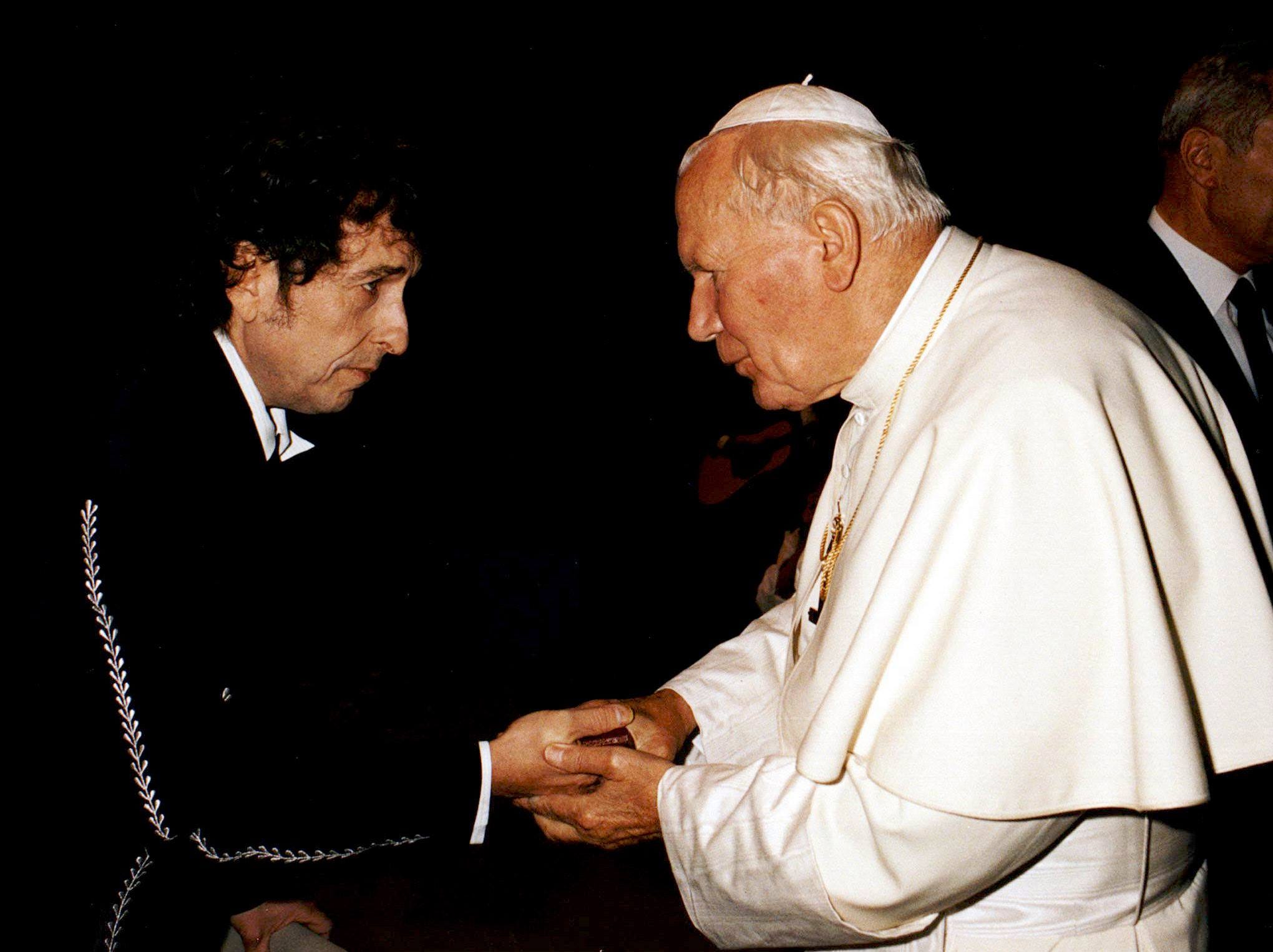
That I remember really well. There's 400,000 people out there. The Pope's been up there all day long with all these international acts performing, acrobats and magicians. Then we get up to play a few songs. We're facing the audience and off on stage left is the Pope's throne. He's sitting there, and he's got his chin in his hand. He must have been exhausted.
We play a couple of tunes. I'm at stage right and Bob is doing-- I forgot what song, maybe it was "Knockin' on Heaven's Door" or something like that. The TV director with his headphones on comes walking up to me [as I'm playing]. He says, "He's got-a go meet-a the Pope! He's got-a go meet-a the Pope!" He's looking at me like I'm supposed to do something about this. Typical Italian fashion, man. He's shaking his head, he's looking at his watch. "He's got-a go meet-a the Pope!" And I'm trying to play this song.
The song ends, and I walk over to Bob and I go, "Hey, Bob, this guy is telling me you got to go and meet the Pope." Bob looks around like, "What?" Then the TV director looks at him with hand signal and he points to the Pope. So Bob hands his guitar to somebody and goes over and shakes the Pope's hand. The Pope gives him a rosary or something. He comes back, and we play one more tune, and then that's over. That was an experience I never expected to have. It was just surreal.
Bob had this really cool idea that he wanted this segment of us performing to be like an old Shindig performance, where you just had a bunch of kids hanging out behind the band, moving and grooving. They hired all these extras from central casting or whatever. They were just behind us in a circle.
We did the soundcheck, and it went great. Then it comes to the performance. We start the tune and, before I knew it, one of these extras comes running up, starts dancing, pulls off his shirt. On his chest is written "Soy Bomb" and he's standing next to Bob dancing. Bob turns to me and says, "Who the hell is this guy?"
I said, "I don't know, man. I don't know." But before he gets those words out of his mouth, two stage guys came running out and grabbed the guy and pulled him off. That was his 60 seconds or whatever it was of fame right there. Bob just kept his cool and continued. He wasn't too rattled by it, I don't think. For a second, I thought this was planned or something, but when he turned to me and asked, "Who the hell is this guy?" I realized, no, it's not. Bob was laughing about it afterwards.
Hanging with them was great. We'd be in the hotel lounge after a show and talking about music and stuff. Van talked about his road experience and things. Listening to Joni every night, good god, man. Wow.
That was a great tour. It was really great. I felt like the competitive thing was sort of there, but in a good way. Bob wanted to up the show every night, and it wasn't coming from a place of frustration, which could happen with Bob. It was coming more from a place of, "We're all in this together. Let's get out there and do something cool." And we did. The gravity of the artistry of these three people was a good launching pad for us to get out there and do the best we could every night.
What did you mean when you said the competitiveness sometimes came from a place of frustration? Was that something that was happening elsewhere?
Yes. Sometimes you'd get this feeling if there was a particularly good show from an opening act that Bob would get competitive and seemingly insecure. Seemingly. I don't know that for sure, but that's my amateur psychiatry analyzation of it. We're all insecure, and this would seem to come out in him sometimes.
How would that affect you and the band? Something you noticed on stage or you're getting really drilled during soundcheck the next day?
Both. You see him uncomfortable on stage and there's nothing you can do about it. Just play the best you can play and move on. But I don't want to seem like Bob is the only cat that does that, because everybody does that. That's a normal thing when you're trying to be the best artist you can be. That kind of insecurity and frustration and not feeling like you're delivering what you want to deliver for whatever reason.
We ran through the tune a whole bunch of different ways. It was at the rehearsal studio in New York. We tried it a bunch of different ways. The Johnny Cash way, a dirtier blues way, a more uptempo way, and just nothing was hitting.
Then what happened was we were on a break and David [Kemper, drums], Tony [Garnier, bass], and I started getting into this sort of jamming flow, a bluesy kind of thing. It had nothing to do with the song. We were just jamming on a chord progression or something. Then Bob picked up his guitar and said, "Let's try something that feels like that." That's where we ended up with that version of it. I love that version of it. In fact, I'm trying to get Teresa and I to do that song that way. I think she would sing the hell out of it.
They'd alternate each night who would go on first. Every night if we opened the show, Paul would come out and do a tune with us at the end, then he and his band would come on. Then when Paul opened the show, Bob would go out and sing a song with him and his band before we went on. That was cool. That was really cool.
I got to know Paul pretty well on that tour and ended up working on his record [You're the One] with him and a couple other things. I think him and McCartney are the two greatest melody guys of the 20th century
Plus Paul had a great arm. One of my favorite things to do on these summer tours would be before or after soundcheck get out in the field and throw the ball around. That was cool.
Now you've got me retroactively nervous about you and Paul Simon throwing the baseball around. You both do all this complicated finger picking. I'm glad no one wrenched their pinky or something.
Yes. Good point. [laughs]
Paul made an observation early on in the tour where he said, "Bob and I, we're coming from the same place, but at different ends of the spectrum." He said, "Bob's thing has always been a lot closer to musical anarchy. My thing has always been, I've tried to get it as refined and controlled as possible." That was a really interesting observation. They're drinking water from the same well, basically, and just presenting it in two different ways.
We were in Australia and we had to go to a studio there. The TV director had this whole thing planned out. Bob didn't like it. The lighting and the panning and all the stuff. He said, "Man, no, no, no. Get rid of those lights, get rid of those lights, get rid of those lights!" We ended up with just the room lights on, which gave a dark feel to him and the band on stage. You got the feeling that he was messing with the director, but it worked out great.
A few months ago I saw this thing on YouTube. The lighting just seemed a little bit more organic than what the director was trying to get to. The director was looking for a little more splash and razzle-dazzle or something and Bob just wanted this plain lighting. We played the song, it was done and that was the end of it.
Bob's thing with these kind of performances for award shows and ceremonies and things, he was always trying to just forget about the show bit of it. Just play the song. Rather than all the smoke and lights and all the glitter - forget about all that stuff. Just shoot the band, shoot him, and play the song, so that nothing distracts from the song.
Same thing. They had this whole big stage show they were trying to sell Bob on. He said, "No, man." He had them construct this tent over on the side of the stage. He said, "Let's just narrow down the environment. Put us in this little box and let the band play and be the band. Forget about all this." Again, it was about the lighting. He just didn't want a light show going on. He just wanted one light or one mood of lighting. Let it look like we're in a club somewhere playing this song.
Even with the Soy Bomb thing, having those extras around us - let everybody else do the big show with the dancers and the smoke bombs and all that stuff. He just wanted to play the song.
What you're seeing is what we're playing. They put lavalier mics on all of us, mic'd the instruments. The performance you're seeing is unadulterated, nothing punched in, nothing manipulated. They did that right. That was important to me. You see these movies, and what the band is playing is not what you're seeing. Larry Charles, the director of that thing, was really cool about making this happen, about using the performance that you're seeing. I think that part came out great.
Was that something where there were separate rehearsals? Because a lot of the songs you did were not just songs from your stage show. They were different songs, different arrangements.
Yes, we did. I remember we spent a lot of time rearranging certain songs. Like "Cold Irons Bound", that's its own arrangement for that movie. Or "Diamond Joe," that was just specifically for the movie. The other stuff I can't really remember now, but the songs we played in that movie, we rearranged specifically for the movie.

The most notable thing to me was, we get on stage and here comes Bob with a wig and a fake beard and mustache on and a hat. He hadn't said anything to anybody about this. There was no warning. We're absorbing that on stage at the same time as everybody in the audience is absorbing that. I was amused by it. What the purpose of that was, I didn't know at the time and I still don't know, but okay. I'm not going to try and analyze that.
I remember it being a cool performance. I also remember realizing the importance of this, the monumental significance of this. Bob Dylan, whose [1965] performance at Newport was an iconic moment - now I'm able to participate in this thing with him for the next and possibly only other time he's ever going to do it. That was cool.
A while ago, I tried to find every time Bob has sung Happy Birthday on stage to someone and there were not many. There were only five or six, and one of them is for you. Do you remember that?
Yeah, how about that? I do! Yes, I do. I was very moved and touched by that. [laughs]
Did you thank him after or did you just move on to the next gig and keep a low profile?
We just move on. You just take that in stride. I didn't think that was a candidate for making a big deal over.
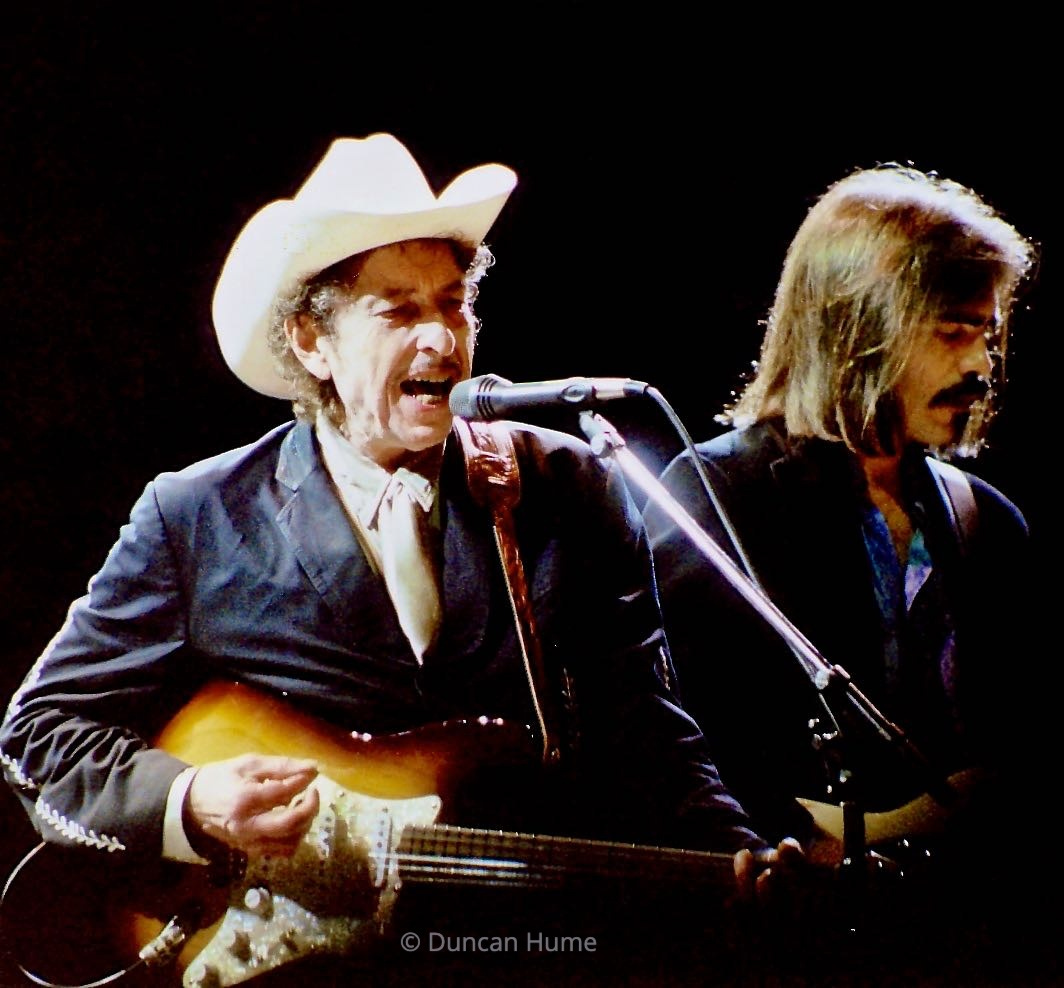
I guess I should ask first, did you know this was your final show? Had you already given notice or did you make the decision subsequently?
No, I didn't. That tour was when I started mulling it over. That last tour, I forget what it was, but there were these projects that I wanted to do and I wasn't able to do them. I think one of these things was playing on a recording with McCartney, and I just couldn't do it. That in itself wouldn't have been the catalyst, but these things were adding up.
That's a tough one though. One of your heroes.
Yes, exactly. Exactly. [Also,] I wanted to be with Teresa. When I got off that last tour with Bob, Teresa was in the middle of this run of a play about the Carter family. We got together around Christmas, and then she was going back out on this Carter family thing. I came back home and I was looking at the potential tour schedule for the next year with Bob and things just started adding up.
It was in that time off that I decided I got to do something. I called [Dylan's manager Jeff] Kramer. The next tour was going to be with Merle Haggard. I wanted to do that, but I just told him, "I can't do this anymore. I'll give you as much notice as you need." I explained the whole thing and he got it. He thought maybe I should come out and do the Merle Haggard tour, but after he discussed it with Bob they just said, "Okay, go ahead and we'll get somebody else for this next run."
It was scary. That's a big ship to jump off of. I just knew I had to do it and something cool would happen. Then, two weeks later I get a call from Levon [Helm], he said, "Hey, I heard you left Bob, come on up here and let's start making some music."
That was the beginning of the greatest chapter of music-making in my life. Not that Bob wasn't, it was just that with Levon, that 10 years or close to it, everything that I needed as an artist and as a human being was in place. He quickly wanted Teresa to join us. We are doing this music with this guy where we have complete freedom to do it the way we want to. I become his producer; I'm fulfilling that need. He encouraged everyone in the band to step up and do their own thing within this really comfortable environment.
Plus, we get to play all these great tunes with this cat who, as I said before, has complete authority in any genre that you can call American roots music. It was heaven. Teresa says it was music made of honor and that's exactly what it was. It's from there that her and I were able to develop the thing that we do now. Being able to play music that you love to play with the person that you want to be with, I mean, what else can you ask for? It was the perfect situation. Also, within that, having the freedom to work with other people too. It just fulfilled everything that to me was missing in those years with Bob.
Thanks to Larry for taking the time to run through these! Again, if you haven't read Part 1 of our interview, it's here, and the new documentary series on his life and career with Teresa Williams, 'It Was the Music,' is available here.
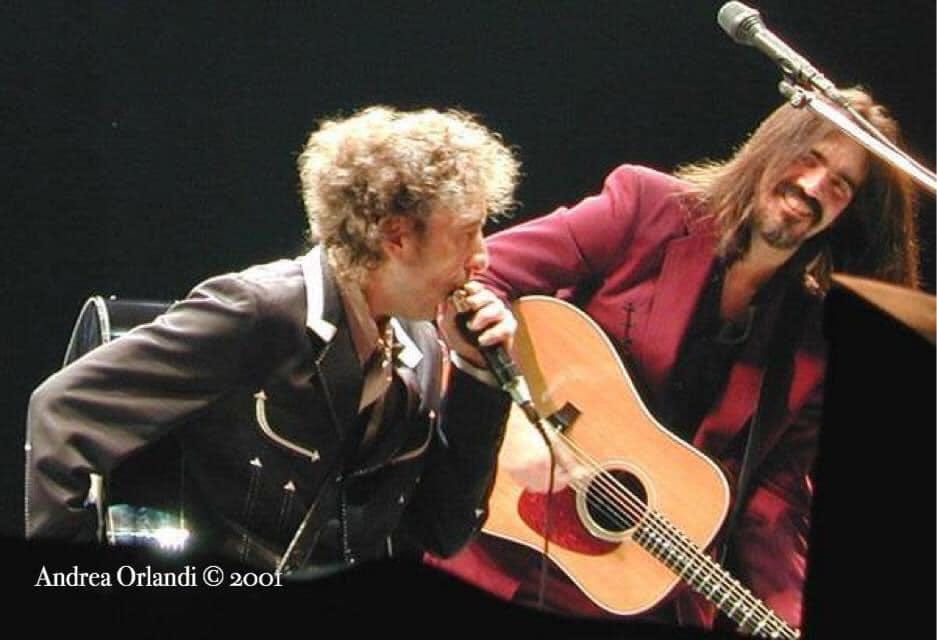
I shared a recording of Larry's first show in Part 1, so, to close us out, here's a recording of his final show:
2004-11-21, Harvard University, Allston, MA
That's it for my conversation with Larry Campbell, but I've got a bunch more coming up - including more interviews with former Dylan band members. See below for a sample of what's run recently, and subscribe here to get the newsletter sent straight to your inbox:
Two 1997 Dylan soundchecks [subscribers only]
1997-12-01&02, Roxy, Atlanta, GA - Soundchecks
Melancholy Moods [subscribers only]
2016-04-04, Bunkamura Orchard Hall, Tokyo, Japan
This Date in Dylan: April 6 [subscribers only]
A whole lotta Never Ending Tour
Turning Back the Clock [subscribers only]
1992-03-28, Entertainment Centre, Brisbane, Queensland, Australia
Pianist Alan Pasqua Talks "Murder Most Foul," Dylan's Nobel Lecture, and the 1978 Tour [free]
1978-03-27, Entertainment Center, Perth, Australia
Freddy or Not [subscribers only]
2004-03-21, Kool Haus, Toronto, ON
After Prague [subscribers only]
1995-03-14, Stadthalle, Furth, Germany
Playing the Electric Violin [free]
2005-03-07, Paramount Theatre, Seattle, WA

